Albert Maori Kiki: Author
p. 70 · Read in the full issue
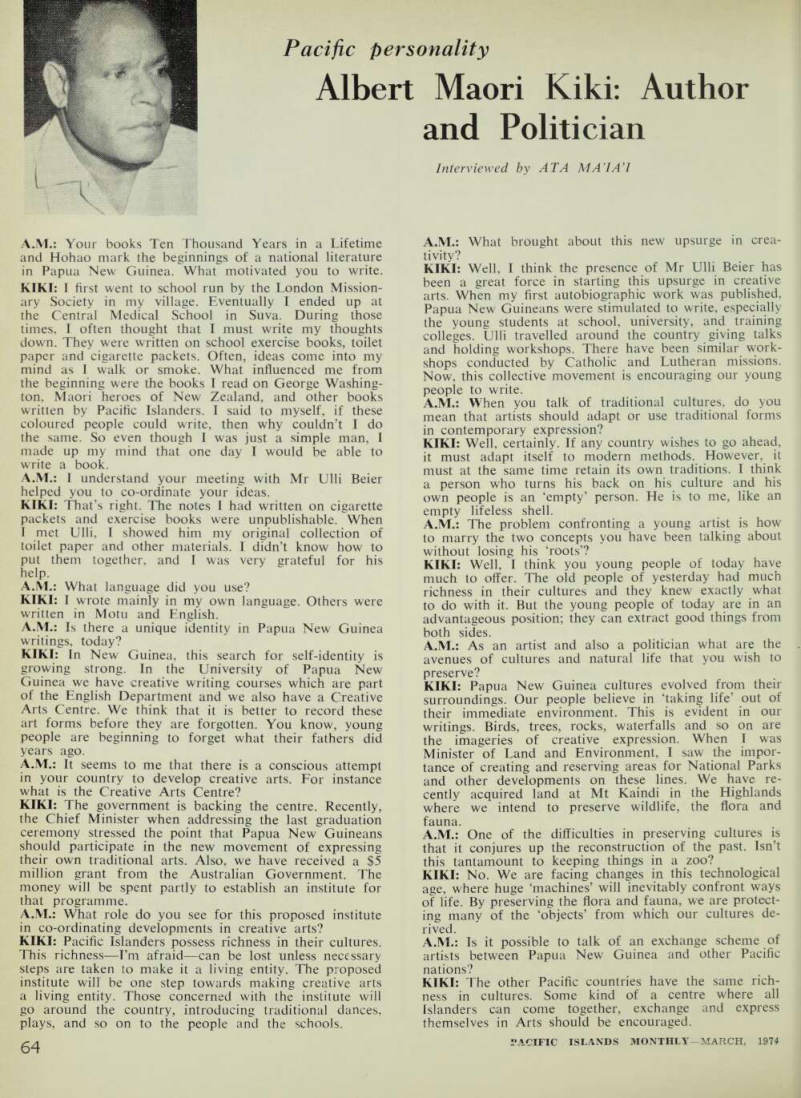
Pacific personality Albert Maori Kiki: Author and Politician
Interviewed by AT A MAT AT
A.M.: Your books Ten Thousand Years in a Lifetime and Hohao mark the beginnings of a national literature in Papua New Guinea. What motivated you to write.
KIKI: I first went to school run by the London Mission ary Society in my village. Eventually I ended up at the Central Medical School in Suva. During those times, I often thought that I must write my thoughts down. They were written on school exercise books, toilet paper and cigarette packets. Often, ideas come into my mind as I walk or smoke. What influenced me from the beginning were the books I read on George Washing ton, Maori heroes of New Zealand, and other books written by Pacific Islanders. I said to myself, if these coloured people could write, then why couldn’t I do the same. So even though I was just a simple man, 1 made up my mind that one day I would be able to write a book.
A.M.: I understand your meeting with Mr Ulli Beier helped you to co-ordinate your ideas.
KIKI: That’s right. The notes I had written on cigarette packets and exercise books were unpublishable. When I met Ulli, I showed him my original collection of toilet paper and other materials. I didn’t know how to put them together, and I was very grateful for his help.
A.M.: What language did you use?
KIKI: I wrote mainly in my own language. Others were written in Motu and English.
A.M.: Is there a unique identity in Papua New Guinea writings, today?
KIKI: In New Guinea, this search for self-identity is growing strong. In the University of Papua New Guinea we have creative writing courses which are part of the English Department and we also have a Creative Arts Centre. We think that it is better to record these art forms before they are forgotten. You know, young people are beginning to forget what their fathers did years ago.
A.M.: It seems to me that there is a conscious attempt in your country to develop creative arts. For instance what is the Creative Arts Centre?
KIKI: The government is backing the centre. Recently, the Chief Minister when addressing the last graduation ceremony stressed the point that Papua New Guineans should participate in the new movement of expressing their own traditional arts. Also, we have received a $5 million grant from the Australian Government. The money will be spent partly to establish an institute for that programme.
A.M.: What role do you see for this proposed institute in co-ordinating developments in creative arts?
KIKI: Pacific Islanders possess richness in their cultures.
This richness—l’m afraid—can be lost unless necessary steps are taken to make it a living entity. The proposed institute will be one step towards making creative arts a living entity. Those concerned with the institute will go around the country, introducing traditional dances, plays, and so on to the people and the schools.
A.M.: What brought about this new upsurge in crea tivity?
KIKI: Well, I think the presence of Mr Ulli Beier has been a great force in starting this upsurge in creative arts. When my first autobiographic work was published, Papua New Guineans were stimulated to write, especially the young students at school, university, and training colleges. Ulli travelled around the country giving talks and holding workshops. There have been similar work shops conducted by Catholic and Lutheran missions.
Now, this collective movement is encouraging our young people to write.
A.M.: When you talk of traditional cultures, do you mean that artists should adapt or use traditional forms in contemporary expression?
KIKI: Well, certainly. If any country wishes to go ahead, it must adapt itself to modern methods. However, it must at the same time retain its own traditions. I think a person who turns his back on his culture and his own people is an ‘empty’ person. He is to me, like an empty lifeless shell.
A.M.: The problem confronting a young artist is how to marry the two concepts you have been talking about without losing his ‘roots’?
KIKI: Well, I think you young people of today have much to offer. The old people of yesterday had much richness in their cultures and they knew exactly what to do with it. But the young people of today are in an advantageous position; they can extract good things from both sides.
A.M.: As an artist and also a politician what are the avenues of cultures and natural life that you wish to preserve?
KIKI: Papua New Guinea cultures evolved from their surroundings. Our people believe in ‘taking life’ out of their immediate environment. This is evident in our writings. Birds, trees, rocks, waterfalls and so on are the imageries of creative expression. When I was Minister of Land and Environment, I saw the impor tance of creating and reserving areas for National Parks and other developments on these lines. We have re cently acquired land at Mt Kaindi in the Highlands where we intend to preserve wildlife, the flora and fauna.
A.M.: One of the difficulties in preserving cultures is that it conjures up the reconstruction of the past. Isn’t this tantamount to keeping things in a zoo?
KIKI: No. We are facing changes in this technological age, where huge ‘machines’ will inevitably confront ways of life. By preserving the flora and fauna, we are protect ing many of the ‘objects’ from which our cultures de rived.
A.M.: Is it possible to talk of an exchange scheme of artists between Papua New Guinea and other Pacific nations?
KIKI: The other Pacific countries have the same rich ness in cultures. Some kind of a centre where all Islanders can come together, exchange and express themselves in Arts should be encouraged.