Migrant Workers
pp. 68-69 · Read in the full issue
Songs Of The Troubles Of
PACIFIC ISLANDERS have been taking jobs as migrant workers on plantations, ships, mines and in other industries for nearly 150 years. Their im pressions of these experiences have been expressed not only in stories, but in thousands of songs. Many are long since forgotten, but some old historic ones are still heard today. Unless we know the language and history of the people concerned we are often not aware of their significance. New songs are being written by workers travelling the Pacific today. I hope interested people in all islands will try and collect and record the words and music and history of as many of their songs as possible.
We present here a small selection of popular songs by Polynesian labourers recruited to dig phosphate. The first was sent and translated by Tahafa Pope Talangi, leader of the Niue Islands dancing team which per formed at the South Pacific Arts Festival. Niuean men used to be recruited to dig phosphate on uninhabited Malden Island. It was thankless, lonely work. The women had to be left at home while the menfolk were away for one or two years at a time. These songs tell of both the longing for their womenfolk and the harsh supervision of the workers.
KO E LOLOGO HA E HE FIFINE KE
He Taane Haana
Ka hake a koe ki Pakula Si uku mai taha sevae kula mo totongi E ami elo ne pi ka e pi E koe to hake a koe ki Pakula.
Translation If you go to Malden, Bring me a red pair of shoes To pay for the vagina, That you dug before you Left for Malden.
KO E LOLOGO HA E HE FIFINE KE
Leoleo Gahua I Pakula
Kata si tamai ke he tua Kae toka haku Patu kaupu Neke felaia e Fale malie Ke ai fai fale malie Ka hake an ki Niue Tamai ke he tuaa Tamai ke he tuaa.
A worker’s song to the foreman If you hit me, Do it on my back Leave my back side Otherwise my genitals Will be destroyed When I go back to Niue Hit me on the back Hit me on the back.
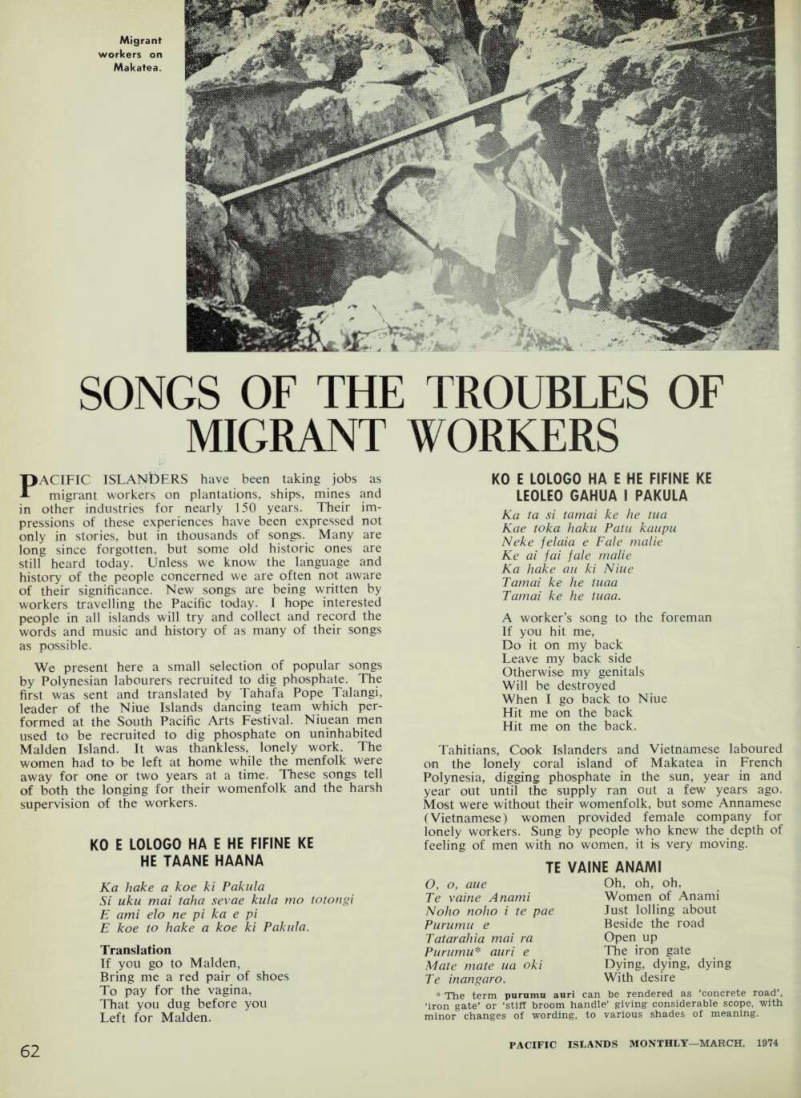
Tahitians, Cook Islanders and Vietnamese laboured on the lonely coral island of Makatea in French Polynesia, digging phosphate in the sun, year in and year out until the supply ran out a few years ago.
Most were without their womenfolk, but some Annamese (Vietnamese) women provided female company for lonely workers. Sung by people who knew the depth of feeling of men with no women, it is very moving.
Te Vaine Anami
O, o, aue Oh, oh, oh, Te vaine Anami Women of Anami Noho noho i te pae Just lolling about Purumu e Beside the road Tatarahia mai ra Open up Purumu* auri e The iron gate Mate mate ua oki Dying, dying, dying Te inangaro. With desire * The term purumu auri can be rendered as ‘concrete road’, ‘iron gate’ or ‘stiff broom handle’ giving considerable scope, with minor changes of wording, to various shades of meaning.
Migrant workers on Makatea.
Tahiti Nui is perhaps the best-known song in the Pacific Islands. You hear it over the radio everywhere from Port Moresby and Guam to Rarotonga and Hono lulu, and it seems to be played at every party where Islanders gather. Probably not one in 100 of the people who sing it know that it tells the story of a young lad recruited in the Cook Islands to dig phosphate at Makatea. The recruiting ship had to stop for a day at Papeete to clear customs and immigration, before going on to Makatea. This lad met a girl in a bar in Papeete and went home with her, and missed the ship when it sailed for Makatea. The song tells his story:
Tahiti Nui
Tahiti Nui 1 te fare auri Taua here ai.
Ananahi a feruri au e Eaha te huru Aue, aue aue hoi e.
Te rev a nei au Na te moana No to’oe ino ino ia’u 0 tau ia e pea pea nei Aue ra ho’i au e mama e.
In great Tahiti In the gaol There (in Tahiti) we met. 1 began to wonder What tomorrow would bring Oh, woe is me.
I am sailing Over the ocean Because you rejected me That is what’s troubling me Oh! I’ll have to return to Mother!
In another issue of MANA we will look at some of the current political songs that every election generates, from various parts of the Pacific, and then at some historical songs, and some songs about current events.
If you have a favourite song of your island send it in, in the original, a translation in English and a full explanation of what it is about. The translation is the hardest part, because the most meaningful words in many Islands songs have no equivalent in English, and it would take pages to describe the meaning they convey. But we can only try. We can’t learn all each other’s languages.