Cloak And Dagger On Christmas
pp. 63-112 · Read in the full issue
When, as a radio operator, I went to Suva in the 1930 s to join Station VJO, which was operated by my em ployers AWA, I little dreamt that 18 months later I would land from a British cruiser, HMS Achilles, later to win fame in the Battle of the River Plate, on Christmas Island in a real cloak and dagger operation.
Everything was hush-hush when, in June 1937, I was interviewed by the Government Secretary in Suva, and appointed acting Deputy Commis sioner of Christmas Island in the Gilbert and Ellice Colony. During preparations prior to my departure from Suva, I was not allowed to dis close my appointment, or my pending departure—a fact which made the preparation of a stores list quite a formidable task.
My appointment was for 12 months, and during the negotiations, it was indicated that I had to be pre pared to rough it as regards ameni ties. During my medical examination, the doctor declared me medically fit but facetiously suggested that I should see a specialist to have my head examined!
However, I was allowed to take my bull terrier pup with me, quite a concession, because in those days regulations covering dogs leaving and entering the colony were rigid, and my fourfooted companion was the nrst dog to be given such a full clearance.
About two months earlier, the estem Pacific High Commission sent the late Oscar Barrack, along P r or ! able ra dio equipment, per Lii S u Le i th to Christmas Island to noid the fort until arrangements could
be made to have a permanent British Representative. As with my appoint ment, this project was also classified as secret.
Behind the cloak of secrecy was the fact that such islands and atolls had acquired considerable significance because of the then-incubating Trans- Pacific air service. Although Britain claimed Christmas Island as a British
possession, this had never been offici ally recognised by America.
Pan American Airways with their clipper service from the west coast of America to Auckland via Hawaii and Samoa, were the pioneers, and their service emphasised the potential of such mid-Pacific islands. Under the circumstances, it was considered incumbent on Britain to assert its ownership of the 222 sq mile island, reputed to be the largest coral atoll in the world.
Towards the end of July, 1937, I left Suva on RMS Niagara for Honolulu where HMS Achilles was waiting to take me to my new island abode. At Honolulu, my dog was transported by car from one ship to the other, leaving me free to attend to my somewhat bulky pile of “luggage”. Being a passenger and a member of the wardroom of such a shin as the Achilles was an experience in itself. She carried the flag of Rear- Admiral Drummond, and my welfare —landing arrangements, etc—were in the hands of Lieutenant Commander P. Dawnay, who was married to the Duchess of Gloucester’s sister, and who, about 18 months ago, retired from the Navy as Vice-Admiral in charge of the Royal Yacht.
After our departure from Honolulu and a short passage along the coast, there was a brief stop for a landing party to tend the grave of Captain Cook. Next, there was a call at Fanning Island, which, as well as being “next door neighbour” to Christmas Island, was an important link on the Pacific cable service. Our departure from Fanning Island was so timed that we made landfall at
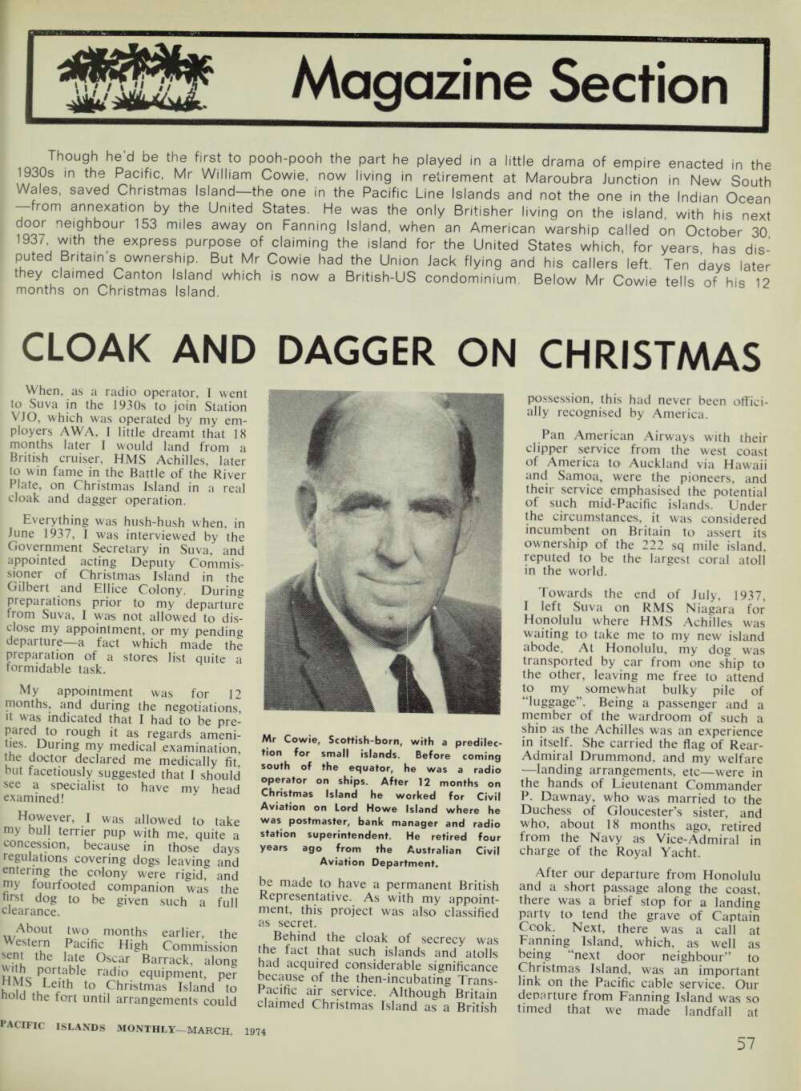
Mr Cowi e, Scottish-born, with a predilec tion for small islands. Before coming south of the equator, he was a radio operator on ships. After 12 months on Christmas Island he worked for Civil Aviation on Lord Howe Island where he was postmaster, bank manager and radio station superintendent. He retired four years ago from the Australian Civil Aviation Department.
Christmas Island first light the next morning—July 31, 1937.
Being low lying, it was not very impressive—even from our anchorage.
The first person on board to greet me was Mr Jerabek, the Czechoslovakian plantation manager. I was having an early breakfast when he was ushered into the wardroom. The initial meet ing could only be described as chaotic. The greeting was in French, and, as my knowledge of the lan guage was rusty schoolboy standard, 1 understood little or nothing of it.
I was landed with 97 cases of stores and radio equipment—plus one copy of the Commonsense Cookery Book! The latter item was almost top priority because like most young bachelors, my cooking abilities were sadly lacking. Necessity is the mother of invention, and suffice it, I learned quickly.
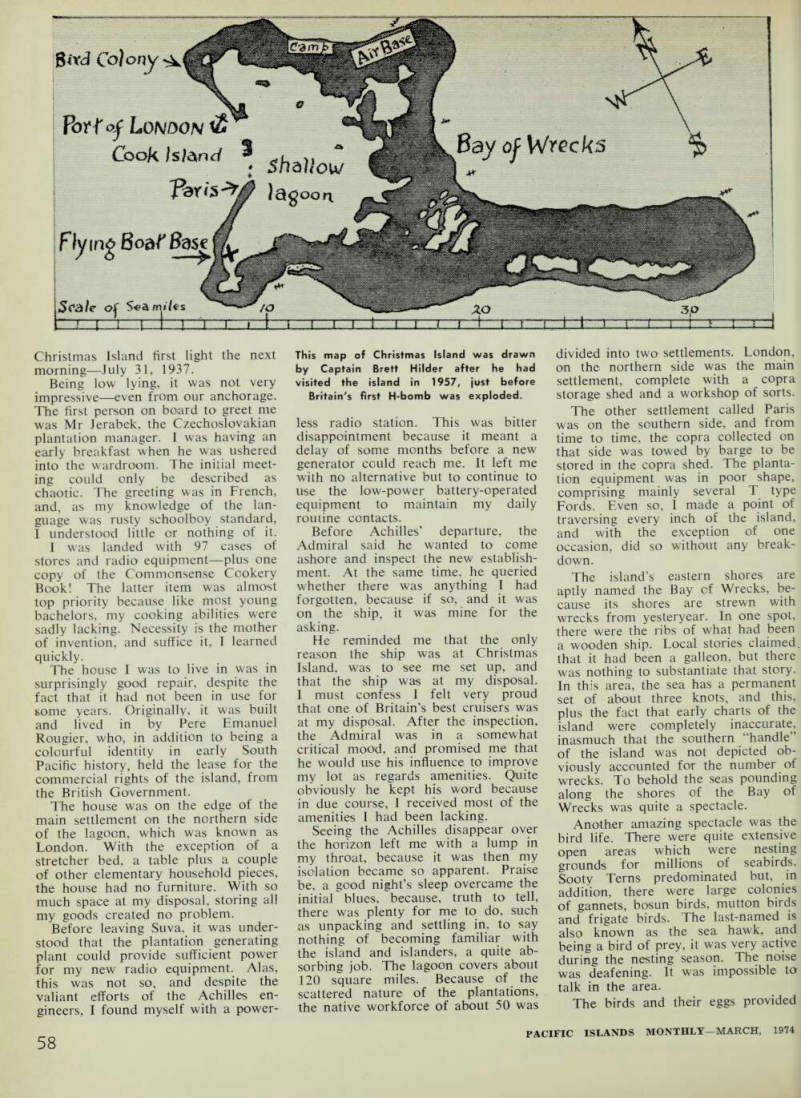
The house I was to live in was in surprisingly good repair, despite the fact that it had not been in use for gome years. Originally, it was built and lived in by Pere Emanuel Rougier, who, in addition to being a colourful identity in early South Pacific history, held the lease for the commercial rights of the island, from the British Government.
The house was on the edge of the main settlement on the northern side of the lagoon, which was known as London. With the exception of a stretcher bed, a table plus a couple of other elementary household pieces, the house had no furniture. With so much space at my disposal, storing all my goods created no problem.
Before leaving Suva, it was under stood that the plantation generating plant could provide sufficient power for my new radio equipment. Alas, this was not so, and despite the valiant efforts of the Achilles en gineers, I found myself with a power
less radio station. This was bitter disappointment because it meant a delay of some months before a new generator could reach me. It left me with no alternative but to continue to use the low-power battery-operated equipment to maintain my daily routine contacts.
Before Achilles’ departure, the Admiral said he wanted to come ashore and inspect the new establish ment. At the same time, he queried whether there was anything I had forgotten, because if so, and it was on the ship, it was mine for the asking.
He reminded me that the only reason the ship was at Christmas Island, was to see me set up, and that the ship was at my disposal.
I must confess I felt very proud that one of Britain’s best cruisers was at my disposal. After the inspection, the Admiral was in a somewhat critical mood, and promised me that he would use his influence to improve my lot as regards amenities. Quite obviously he kept his word because in due course, I received most of the amenities I had been lacking.
Seeing the Achilles disappear over the horizon left me with a lump in my throat, because it was then my isolation became so apparent. Praise be, a good night’s sleep overcame the initial blues, because, truth to tell, there was plenty for me to do, such as unpacking and settling in, to say nothing of becoming familiar with the island and islanders, a quite ab sorbing job. The lagoon covers about 120 square miles. Because of the scattered nature of the plantations, the native workforce of about 50 was
divided into two settlements. London, on the northern side was the main settlement, complete with a copra storage shed and a workshop of sorts.
The other settlement called Paris was on the southern side, and from time to time, the copra collected on that side was towed by barge to be stored in the copra shed. The planta tion equipment was in poor shape, comprising mainly several T type Fords. Even so, I made a point of traversing every inch of the island, and with the exception of one occasion, did so without any break down.
The island’s eastern shores are aptly named the Bay of Wrecks, be cause its shores are strewn with wrecks from yesteryear. In one spot, there were the ribs of what had been a wooden ship. Local stories claimed, that it had been a galleon, but there was nothing to substantiate that story.
In this area, the sea has a permanent set of about three knots, and this, plus the fact that early charts of the island were completely inaccurate, inasmuch that the southern “handle” of the island was not depicted ob viously accounted for the number of wrecks. To behold the seas pounding along the shores of the Bay of Wrecks was quite a spectacle.
Another amazing spectacle was the bird life. There were quite extensive open areas which were nesting grounds for millions of seabirds.
Sooty Terns predominated but, in addition, there were large colonies of gannets, bosun birds, mutton birds and frigate birds. The last-named is also known as the sea hawk, and being a bird of prey, it was very active during the nesting season. The noise was deafening. It was impossible to talk in the area.
The birds and their eggs provided
This map of Christmas Island was drawn by Captain Brett Milder after he had visited the island in 1957, just before Britain's first H-bomb was exploded.
I a welcome change to the menu. It I was a case of trial and error; some I were better than others. Likewise, f the fishing both in the lagoon, and f the surrounding waters was truly I superb. The reefs were also teeming with crayfish.
Along the shores of the lagoon, it I was not unusual to see large sting ; rays, and even Manta rays basking , on the edge of the water, allowing the ripple of the water to rub their bellies on the sand—presumably to rid themselves of sea lice. They are quite harmless, and never prevented me having my daily swim.
My fourfooted companion was also most appreciative of the abundance of fresh fish, as well as the almost unlimited supply of green coconuts, the contents of which were a delicacy in his eyes.
As well as keeping regular radio schedules with Fiji and Fanning Island, I managed to establish con tact with Papeete, which afforded a communication channel for the plan tation company for information re garding schooner movements. By the same means, I was able to communi cate with the British Consul there whp was kind enough to undertake incidental shopping for me.
From a personal point of view, perhaps the most important feature was that no restrictions had been placed on me as regards the use of the radio equipment, and conse quently I spent many pleasurable hours yarning with two or three “ham” buddies. Without exception, they were most attentive and co operative.
It did not take the plantation staff too long to make use of their new Resident Officer. Working conditions for them left a lot to be desired, and before my arrival, there had been no one to assist them. Mine was not the right to approach the plantation company direct, rather I had to con vince headquarters in Suva that there was justification for the complaints placed before me.
This was not achieved by one message, and with the limited facili ties available, plus having to code everything, the manhours used on this project alone were quite appreciable.
In due course, the High Commis sioner promulgated minimum working conditions for the island, which brought about a distinct improvement til round.
While I was being transported to -he island, the search for the missing Amelia Earhardt was in full swing, ind not long after my arrival, a Pan Mnerican Clipper commanded by -aptain Musick crashed in the sea iear Samoa, with the loss of all on )oard. The Musick flying-boat base
terminal at Auckland was so named to commemorate that distinguished aviator.
On the morning of October 30, some eight weeks after my arrival the USS Rayen arrived unannounced —seemingly with the idea of drop ping a landing party. However, my presence, plus the fact that the Union Jack was at the masthead, must have caused a change of plans. I enter tained the captain and several govern ment officials, as well as giving per mission for a number of crew to come ashore for a few hours relaxa tion.
In return, Mr and Mrs Jerabek and myself were generously entertained to dinner on board, followed by a movie show. When asked about future movements, the captain seemed un sure beyond saying that the next stop was Pago Pago. I had a feeling that my counterpart at Canton Island would have a similar visit, and ad vised him accordingly.
Sure enough, about 10 days later the Rayen anchored off Canton Island, but this time, the approach by the landing party was somewhat different.
My counterpart, Frank Rostien, was told by the Americans that they had come to claim the island as American territory! There was little that Frank could do, beyond advising Suva, be cause the Americans went ahead and erected a prefabricated cottage, and left a party there. From that day Canton Island has been a condo minium.
About the same time, I was told by Suva that it was planned to carry out an exploratory trans-Pacific flight from Auckland to America, via Suva and Christmas Island. The Empire flying-boat Centaurus was to make the flight. I was asked to survey the lagoon and if possible, mark off a suitable and safe landing area.
This was exciting news, and the fact that I had to take countless soundings with lead and line, mattered little. It was an exacting task, because even one coral nigger head missed could have had disas trous results. Unfortunately, it was all of no avail, because at the last moment, the flight was cancelled.
Co-incident with this, I was told that a generating plant had been pur chased, and along with three small prefabricated buildings, two 70 ft
masts and a quantity of household furniture, was being shipped to Tahiti for schooner transportation to the island!
All this of course, meant that I had a busy spell ahead of me, but it was December before the schooner actually arrived with 44 tons of material for me. Among the house hold items was a kerosene refrigera tor—the first ever on the island.
Installing the diesel generator and the radio equipment presented no difficulties. There was a tremendous feeling of satisfaction when actually testing the new equipment. From then on, communication with the out side world became comparatively easy.
To meet its postal requirements, the plantation company issued un official stamps which were fixed to letters originating on the island indi cating to the agents in Papeete that postage had been paid. It was then necessary to affix ordinary Tahitian stamps to the envelopes for onward delivery.
Seemingly, the company considered that my posting to the island heralded a new era as regards postage, because they ceased to issue any more of their own stamps. There did appear to be a need for a post office on the island, and, although I did make the sugges tion which was not rejected, it was left to my successor to inaugurate postal facilities at Christmas Island.
To mark the occasion, he addressed seven first-day covers, each with a complete set of the then Gilbert and Ellice Island stamps affixed. The addressees of these envelopes were— King George VI, Winston Churchill,
Continued on p 106
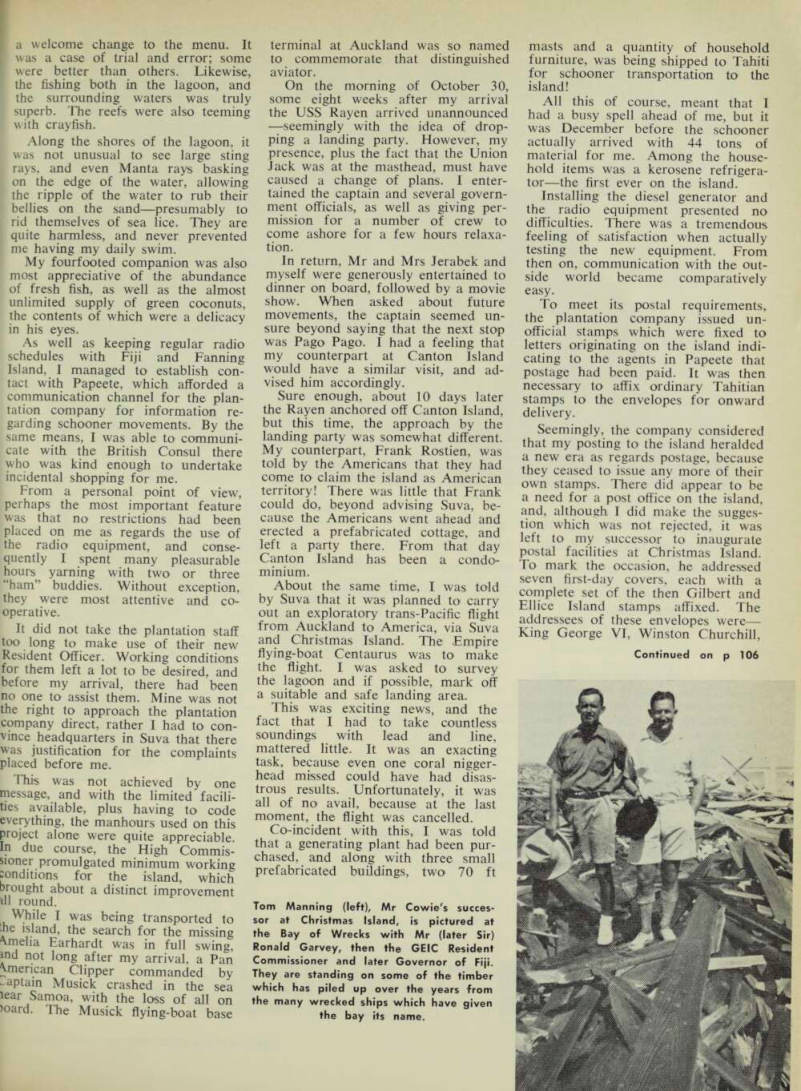
Tom Manning (left), Mr Cowie's succes sor at Christmas Island, is pictured at the Bay of Wrecks with Mr (later Sir) Ronald Garvey, then the GEIC Resident Commissioner and later Governor of Fiji.
They are standing on some of the timber which has piled up over the years from the many wrecked ships which have given the bay its name.
President Roosevelt, Sir Arthur Richards (the then Governor of Fiji), Godfrey Garrick (a philatelist in Fiji), Miss F. M. Thomas (who is now my wife) and himself.
Ever an optimist, 1 even experi mented with gardening, particularly for vegetables, but unfortunately coral sand and a somewhat poor rain fall beat me. Even so, I was suf ficiently convinced about the possi bilities to suggest that my successor should be allowed to bring a number of bags of rich Fiji soil which could be emptied into a large packing case, and the experiment carried on from there. The alternative was hydro ponics.
Some soil was transported, and I learned later, that the experiment was a success. There were fresh water wells on the island, but at the house I was restricted to storage tanks, which did not permit of heavy usage.
While some might view such a life as too isolated, too dull, truth to tell I found the 12 months’ sojourn on the island most interesting, because there was such a variety of things to be attended to, so time did not drag.
My relief, the late Tom Manning (he died in Honiara in 1962) arrived in HMS Wellington. Because I had suggested it some time previously, it had been agreed that Tom’s wife and child should join him on the island.
Our return trip in the Wellington was scheduled to make calls at Malden Island, some 400 miles south of Christmas, and at Puka Puka, or Danger Island as it is sometimes called. Malden was an extraordinary place.
In its day it had been a flourishing source of guano. Seemingly, when the deposits became depleted, thus making it uneconomical to operate, the company controlling it simply abandoned the island leaving every thing standing.
For example, there were three per fectly good motor launches in the boatshed, and the settlement in general was in reasonably good shape: yet there was not a soul on the island. We stopped long enough to go ashore and nail a notice at the base of the flagpole near the jetty, indicating on behalf of His Maiesty that the island had been visited by the Wellington that day.
When Britain exploded its atomic bomb in mid-Pacific, Christmas Island was the operational base, and Malden was the scene of the explosion. One wonders what the place looks like now.