Opposition
pp. 35-37 · Read in the full issue
leader challenges the princes
From Felise Va’a in Apia
What are the chances of the Tama Aiga (royal princes) being ousted in a fight for power in Western Samoa? Prime Minister Fiame Mat aafa survived one such bid in the closing weeks of 1973. But will he survive another contest when the general elections are fought next year?
Western Samoa (population 150,000) is a country with traditions which date back before the time of Christ. It is also a country which is trying to adapt itself to the modern world.
Behind the facade of complacency, there is a deep-rooted desire among Samoans to own palagi (European) houses, cars, refrigerators, electric stoves and radios.
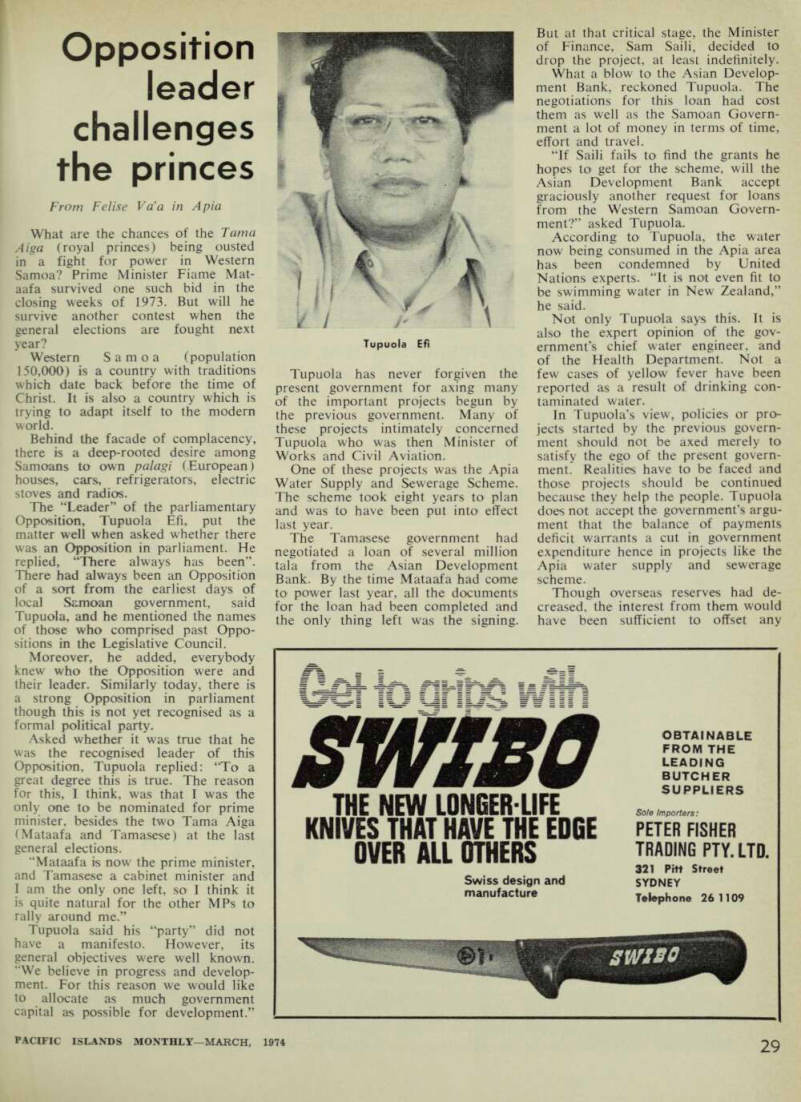
The “Leader” of the parliamentary Opposition, Tupuola Efi, put the matter well when asked whether there was an Opposition in parliament. He replied, “There always has been”.
There had always been an Opposition of a sort from the earliest days of local Samoan government, said Tupuola, and he mentioned the names of those who comprised past Oppo sitions in the Legislative Council.
Moreover, he added, everybody knew who the Opposition were and their leader. Similarly today, there is a strong Opposition in parliament though this is not yet recognised as a formal political party.
Asked whether it was true that he was the recognised leader of this Opposition, Tupuola replied: “To a great degree this is true. The reason for this, I think, was that I was the only one to be nominated for prime minister, besides the two Tama Aiga (Mataafa and Tamasese) at the last general elections.
“Mataafa is now the prime minister, and Tamasese a cabinet minister and I am the only one left, so I think it is quite natural for the other MPs to rally around me.”
Tupuola said his “party” did not have a manifesto. However, its general objectives were well known.
“We believe in progress and develop ment. For this reason we would like to allocate as much government capital as possible for development.”
Tupuola has never forgiven the present government for axing many of the important projects begun by the previous government. Many of these projects intimately concerned Tupuola who was then Minister of Works and Civil Aviation.
One of these projects was the Apia Water Supply and Sewerage Scheme.
The scheme took eight years to plan and was to have been put into effect last year.
The Tamasese government had negotiated a loan of several million tala from the Asian Development Bank. By the time Mataafa had come to power last year, all the documents for the loan had been completed and the only thing left was the signing.
But at that critical stage, the Minister of Finance, Sam Saili. decided to drop the project, at least indefinitely.
What a blow to the Asian Develop ment Bank, reckoned Tupuola. The negotiations for this loan had cost them as well as the Samoan Govern ment a lot of money in terms of time, effort and travel.
“If Saili fails to find the grants he hopes to get for the scheme, will the Asian Development Bank accept graciously another request for loans from the Western Samoan Govern ment?” asked Tupuola.
According to Tupuola, the water now being consumed in the Apia area has been condemned by United Nations experts. “It is not even fit to be swimming water in New Zealand,” he said.
Not only Tupuola says this. It is also the expert opinion of the gov ernment’s chief water engineer, and of the Health Department. Not a few cases of yellow fever have been reported as a result of drinking con taminated water.
In Tupuola’s view, policies or pro jects started by the previous govern ment should not be axed merely to satisfy the ego of the present govern ment. Realities have to be faced and those projects should be continued because they help the people. Tupuola does not accept the government’s argu ment that the balance of payments deficit warrants a cut in government expenditure hence in projects like the Apia water supply and sewerage scheme.
Though overseas reserves had de creased, the interest from them would have been sufficient to offset any
Tupuola Efi
Challenge to princes
loans made, which in any case were for expansion purposes.
“How can the government decide to cut down expenditure when the Asian Development Bank, the Inter national Monetary Fund, the World Bank and other world finance institu tions have given their expert opinion that Western Samoa has not even used up 50 per cent of its capacity to make loans?” asked Tupuola.
He accused the present government of underselling the country. “If I have a house worth $B,OOO, I do not go to the bank for purposes of a loan and say it is only worth $4,000,” he said.
Asked why he thought his “no confidence” motion had failed to materialise in the last parliamentary session, Tupuola said it was because the government had offered “goodies” to some of his supporters. In one case, intimidation by government was suspected.
“The government has been trying everything possible to dry up sources of information to the Opposition, but I think they have failed in this.
Though the government has managed to cut off appointment of Opposition members to many positions in com
mittees and other bodies, the Oppo sition, however, have members in the Public Accounts Committee,” said Tupuola.
Tupuola’s observations are in general quite sound. He is right about the history of parliamentary Oppo sition in Western Samoa, for instance.
He is also right about government ex penditure. All world financial authori ties agree that the Western Samoan economy is still capable of absorbing more overseas loans and the best of the local financial experts, for example, Leota Pita, MP (Bachelor of Arts in Economics), Aumua loane (previous Financial Secretary) and Lauofo Meti (previously Secretary to Government) all think the same.
Sam Saili (professional accountant) seems to be alone in his opinion that the Western Samoan economy is des perate and that therefore many pro jects have to be cut, import alloca tions limited, credit made hard to get, etc, etc.
On the political side, Tupuola still has a hard fight. He does not hold a Tama Aiga title like Malietoa, Tuimalealiifano, Mataafa and Tama sese.
Despite that, Tupuola is winning a lot of conservatives over to his side.
He has good men with him, and he believes that ability, not inheritance.
should be the criterion for electing a prime minister.
Another disadvantage is that he is a Nelson, and the Nelsons in Samoa have many enemies, not least of which are some of the Tama Aiga.
Their enemies suspect them of trying to control the country economically
and politically.
Tupuola is aware of these dis advantages, so he has relied more and more on his own personal image.
He wears the native dress, lavalava, at times, and he goes around bare foot, though he is a wealthy Nelson heir.
He is a “sinner” though a sincere Catholic, he admits.
His heart, like that of his father, the late Head of State Tupua Tama sese Meaole, is with the people and he fights for the people, not so much for the matai (chiefs) and perhaps this is one reason why he is not liked by many of the conservatives.
However, if it is true that the people deserve their leader, then un doubtedly when the right time comes, Tupuola will be the leader.
But when that will be is hard to say. Right now with the general dis satisfaction against the Mataafa gov ernment, some observers say Tupuola’s chances of becoming prime minister in the general elections next year are very high.