platform in
pp. 31-33 · Read in the full issue
Rising prices: a common platform in the Solomons
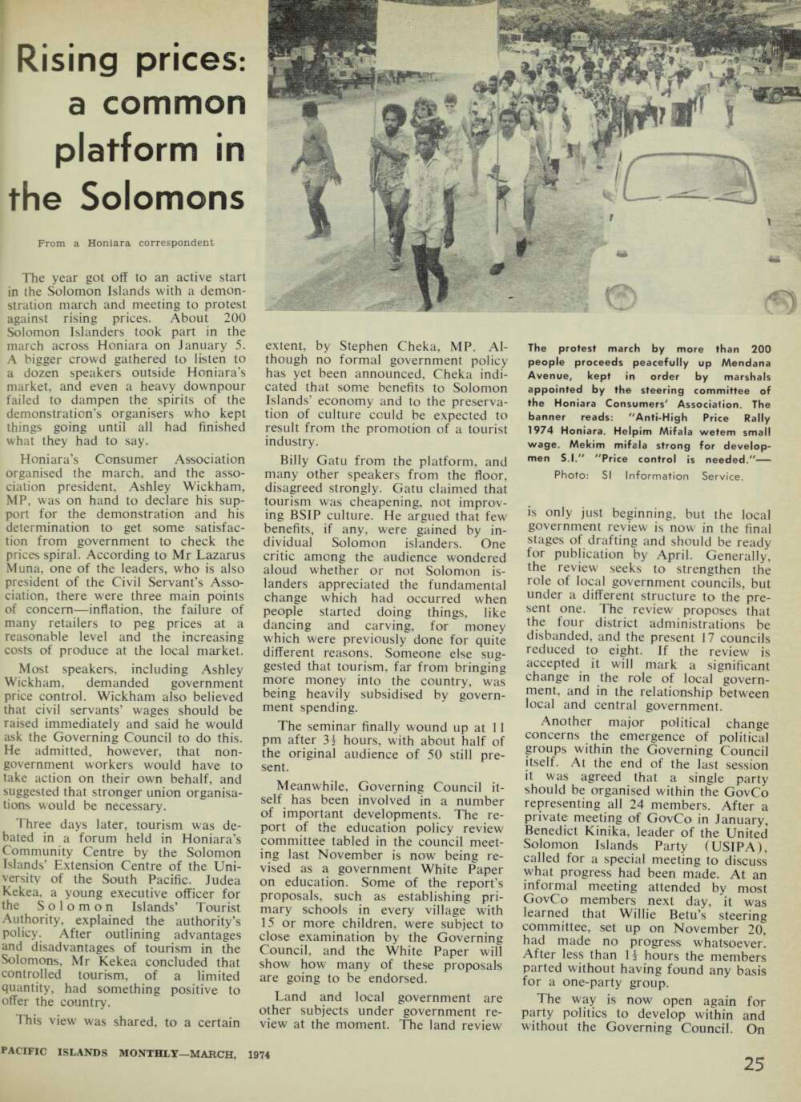
From a Honiara correspondent The year got off to an active start in the Solomon Islands with a demon stration march and meeting to protest against rising prices. About 200 Solomon Islanders took part in the march across Honiara on January 5.
A bigger crowd gathered to listen to a dozen speakers outside Honiara’s market, and even a heavy downpour failed to dampen the spirits of the demonstration’s organisers who kept things going until all had finished what they had to say.
Honiara’s Consumer Association organised the march, and the asso ciation president, Ashley Wickham, MP, was on hand to declare his sup port for the demonstration and his determination to get some satisfac tion from government to check the prices spiral. According to Mr Lazarus Muna, one of the leaders, who is also president of the Civil Servant’s Asso ciation, there were three main points of concern—inflation, the failure of many retailers to peg prices at a reasonable level and the increasing costs of produce at the local market.
Most speakers, including Ashley Wickham, demanded government price control. Wickham also believed that civil servants’ wages should be raised immediately and said he would ask the Governing Council to do this.
He admitted, however, that non government workers would have to take action on their own behalf, and suggested that stronger union organisa tions would be necessary.
Three days later, tourism was de bated in a forum held in Honiara’s Community Centre by the Solomon Islands’ Extension Centre of the Uni versity of the South Pacific. Judea Kekea, a young executive officer for the Solomon Islands’ Tourist Authority, explained the authority’s policy. After outlining advantages and disadvantages of tourism in the Solomons, Mr Kekea concluded that controlled tourism, of a limited quantity, had something positive to offer the country.
This view was shared, to a certain
extent, by Stephen Cheka, MP. Al though no formal government policy has yet been announced, Cheka indi cated that some benefits to Solomon Islands’ economy and to the preserva tion of culture could be expected to result from the promotion of a tourist industry.
Billy Gatu from the platform, and many other speakers from the floor, disagreed strongly. Gatu claimed that tourism was cheapening, not improv ing BSIP culture. He argued that few benefits, if any, were gained by in dividual Solomon islanders. One critic among the audience wondered aloud whether or not Solomon is landers appreciated the fundamental change which had occurred when people started doing things, like dancing and carving, for money which were previously done for quite different reasons. Someone else sug gested that tourism, far from bringing more money into the country, was being heavily subsidised by govern ment spending.
The seminar finally wound up at 11 pm after 3J hours, with about half of the original audience of 50 still pre sent.
Meanwhile, Governing Council it self has been involved in a number of important developments. The re port of the education policy review committee tabled in the council meet ing last November is now being re vised as a government White Paper on education. Some of the report’s proposals, such as establishing pri mary schools in every village with 15 or more children, were subject to close examination by the Governing Council, and the White Paper will show how many of these proposals are going to be endorsed.
Land and local government are other subjects under government re view at the moment. The land review
is only just beginning, but the local government review is now in the final stages of drafting and should be ready for publication by April. Generally, the review seeks to strengthen the role of local government councils, but under a different structure to the pre sent one. The review proposes that the four district administrations be disbanded, and the present 17 councils reduced to eight. If the review is accepted it will mark a significant change in the role of local govern ment, and in the relationship between local and central government.
Another major political change concerns the emergence of political groups within the Governing Council itself. At the end of the last session it was agreed that a single party should be organised within the GovCo representing all 24 members. After a private meeting of GovCo in January, Benedict Kinika, leader of the United Solomon Islands Party (USIPA), called for a special meeting to discuss what progress had been made. At an informal meeting attended by most GovCo members next day, it was learned that Willie Betu’s steering committee, set up on November 20, had made no progress whatsoever.
After less than U hours the members parted without having found any basis for a one-party group.
The way is now open again for party politics to develop within and without the Governing Council. On
The protest march by more than 200 people proceeds peacefully up Mendana Avenue, kept in order by marshals appointed by the steering committee of the Honiara Consumers' Association. The banner reads: "Anti-High Price Rally 1974 Honiara. Helpim Mifala wetem small wage. Mekim mifala strong for develop ment S.I." "Price control is needed."— Photo: SI Information Service.
present indications USIPA has 10 firm supporters, plus another three un certain ones—enough to give it a majority. USIPA’s chief rival is Solomon Mamaloni’s People’s Pro gressive Party (PPP) with six firm supporters and one uncertain sup porter. The remaining four GovCo members were still making up their minds at the time of writing.
Although USIPA seems likely to gain a majority in the council, and therefore to be in a position to secure election of one of their members as chief minister, it is by no means cer tain that all five or six new ministers will come from USIPA. More prob able is the emergence of a coalition led by USIPA and including some PPP ministers.
Coalition politics look like being the keynote of the pre-self-government period in a second Melanesian State.