Tropicalities
pp. 25-29 · Read in the full issue


’Dumping 9
in Noumea
Noumea hotelkeepers, concerned at cancellation “fallout” from a likely third nuclear boycott this year, are still recovering from the effects of last year’s action while also bitterly criticising the alleged “dumping tariffs” practised at the new 250 rooms of the Chateau Royal.
Noumea is now equipped with eight comfortable bay-side hotels, which offer 600 rooms, half of them at the Chateau Royal. However, most of them have had difficulty maintaining even a 50 per cent rate of occupancy during the recent summer season.
During this time, the Chateau, sup ported by UTA airlines to which it is linked, has been offering week-long holidays, airfare and room included, for SAI6B which is less than the regular economy airfare alone. This promotional offer to launch the new Chateau rooms has resulted in what other hotelkeepers are regarding as be!ow-the-belt competition.
In what may be regarded as a bluff to get in on the UTA deal, some Noumea hoteliers have indicated they are thinking of organising “inclusive tours” through Air Nauru. However, this airline has only a small capacity on its twice weekly technical stop overs at Tontouta airport.
Meanwhile, as Noumea considers the effects of a likely third boycott, the only encouraging touristic gleam on the horizon is the Chateau Royal casino, with an opening planned for the end of this year. Authorised games will include baccarat, chemin de fer, roulette and blackjack. Entry fee will be 400 CFP per day or 1,500 frs per week, with a year-long entry card at 25,000 frs (SA2OO) for the real mordus —hard-bitten gamblers.
Another move suggested by the hoteliers is that the territory should subsidise their operations until better times for tourism come again. In the
past, when nickel earnings have dropped as they have now, Paris has urged the Caledonians to make a bigger effort for tourism as the island’s second industry. So the hoteliers are likely to remind Paris that now is the time to come to the aid of the party.
Another solution could be to take a leaf out of the shipping companies’ books and, if there’s another cancel lation fallout demand an indemnity like the one the shippers got as com pensation for the bomb boycott.
New Hebrides
iolS airstrip
A man died in the New Hebrides recently—and soon afterwards Tbn goa Island airstrip closed down. Why?
Tongoa airstrip is on land ap parently jointly owned by people from two villages, Pele and Worafiu.
At least that was the case until the single Worafiu owner died. From that moment on, according to scanty evidence to hand, the Condominium Government then began to pay rent due on the airstrip site to the six Pele village claimants to its owner
ship.
Not surprisingly, Worafiu people
felt an injustice had been done some where. So they laid barbed wire across the airfield, putting a stop to incom ing aircraft to this tiny island in the Shepherd Group north-west of Efate.
Adding to the complications, re ports suggest that all is not well in the Pele camp either. One man— by the name of Kakae—is said to have been pocketing all the rent, according to a report in the New Hebrides newspaper Nakamal. Kakae, to whom the rent was apparently being paid for distribution to the other five Pele owners, is reported to have said that payment was “so small that he thought it was for his part of the airfield alone.”
Predictably, the people of Wora fiu, as well as asking that they be put back on the creditors’ list, are demanding more for the land of the deceased. There was no mention of a will.
UiV§ not so laiiir on rilraini The Pitcairn islanders celebrated Bounty Day on January 23, the date cn which it’s believed the mutineers burned the Bounty, eight days after they had landed on the island. As they believe January 23 is a more authentic date than January 15, the great day is January 23. This year, however, there was a happening, an other fire, which will go down in the annals of the island.
Two days before the celebrations began, the Pitcairners fought to save Adamstown from destruction by fire which broke cut in Mrs Lila Young’s cottage and threatened the whole settlement.
“It probably broke out when Mrs Young, who is advanced in years, failed to close the door to her wood ourning range and a firebrand popped out onto the floor,’’ radio officer Tom Christian told the Seventh-day Ad ventist Church radio centre in Cali fornia in his weekly chat over the air.
“The ship’s bell (used to summon the community) rang the alarm and soon all the men were battling the fire. It leapt to a utility pole and that was put out. Then it got into nearby dry sugar cane and a firebreak was cut to prevent the spread to other nearby homes.”
The last fire to destroy a house on the island was in the 19605.
A week later, however, there was a much happier happening—the first birth on the island for nearly 18 months. The proud father is radio officer Tom himself.
The child, Raelene Rare Christian, and mother Betty, are “both doing just fine”, Tom reported. Raelene is the seventh generation from Fletcher Christian. The 2.9 kg (61 lb) dark haired newcomer brings the popula tion to 69 Pitcairners and 11 “foreigners”.
Ko trust in
Trust Goveriimout
The people of Bikini have little love for the Trust Territory Govern ment, particularly over the adminis tration of the $300,000 Bikini Trust Fund. They have filed a suit asking the court to remove the government as trustee of the fund. They allege the government mismanaged the fund and failed to give the people an adequate account of how money was used.
The fund is now worth only $200,000. The government admitted in the past that there was a decrease
in the principal fund because of the method used in investing. But the Bikini people claim they have not had an adequate explanation of why the decrease was allowed to occur; they also fear that continued govern ment control will see the principal continue to diminish.
Another allegation is that the gov ernment has been “lacking in zeal in upholding the Bikinians’ rights”, and has been unconcerned about rights and matters which the Bikinians con sider important. The Bikini Rehabili tation Project created hostility be tween people and the government, and “erased any confidence that the plaintiffs might have had in defendant as trustee”.
According to a 1956 agreement the trust fund is to be administered by the High Commissioner till it can be administered by a qualified institu tion. The Bikini people claim there are now such institutions, but the government has failed to transfer ad ministration of the fund.
It could be an interesting case when it gets to court.
Another adventnre
for Martinet
Henri Martinet, 67, pioneer of New Caledonia aviation and head of Air Caledonie, his wife, and a companion were floating on a raft recently about the time the Paris Press was announc ing Martinet’s probable death at sea.
The three people were picked up by a French minesweeper after 23 hours on a raft. Their single-engined Morane aircraft ran out of fuel while battling strong headwinds when on a flight to Matthew Island from New Caledonia and Martinet had to ditch it in rough seas.
After a spectacular landing in the seas the aircraft sank in 40 seconds. The adventurous trio had to move quickly to launch and inflate the life raft. They were able to send out radio-detector signals, and were located from the air between the Isle of Pines and Walpole Island. The minesweeper was directed to them.
It was a frustrating incident for Mr Martinet. The Morane was carry ing a replacement propeller to Matthew Island to repair another air craft he abandoned there when he damaged it in landing in September, 1973. He had waited four months for the propeller. The September flight was made to prove a regular link between New Caledonia and Matthew Island was possible.
Will he try again?
Schooll»€»v paints
for i he Queen
The cargo sheds facing the wharf at Point Cruz in the Solomons have a new, and very artistic look—strik ing custom murals which, it was hoped, would catch the Queen’s eye when she stepped ashore in Honiara on February 19 to begin her four-day tour of the Protectorate.
And in the crowd at the wharf to see the Queen was, no doubt, a proud, 13 - year - old Government Primary School pupil, Eddie Daydi, who has good reason to be proud.
He painted the murals and probably became the youngest person anywhere to be commissioned by a government agency—this time the Solomons Port Authority—to do an official job.
He’s a born artist and with some body behind him to use a bit of in fluence he’s likely to become one of the Solomons’ leading artists.
The commission didn’t awe him.
Working without any preliminary drawings, Eddie laid his pictures straight on the wall with a brush and black and white house paint.
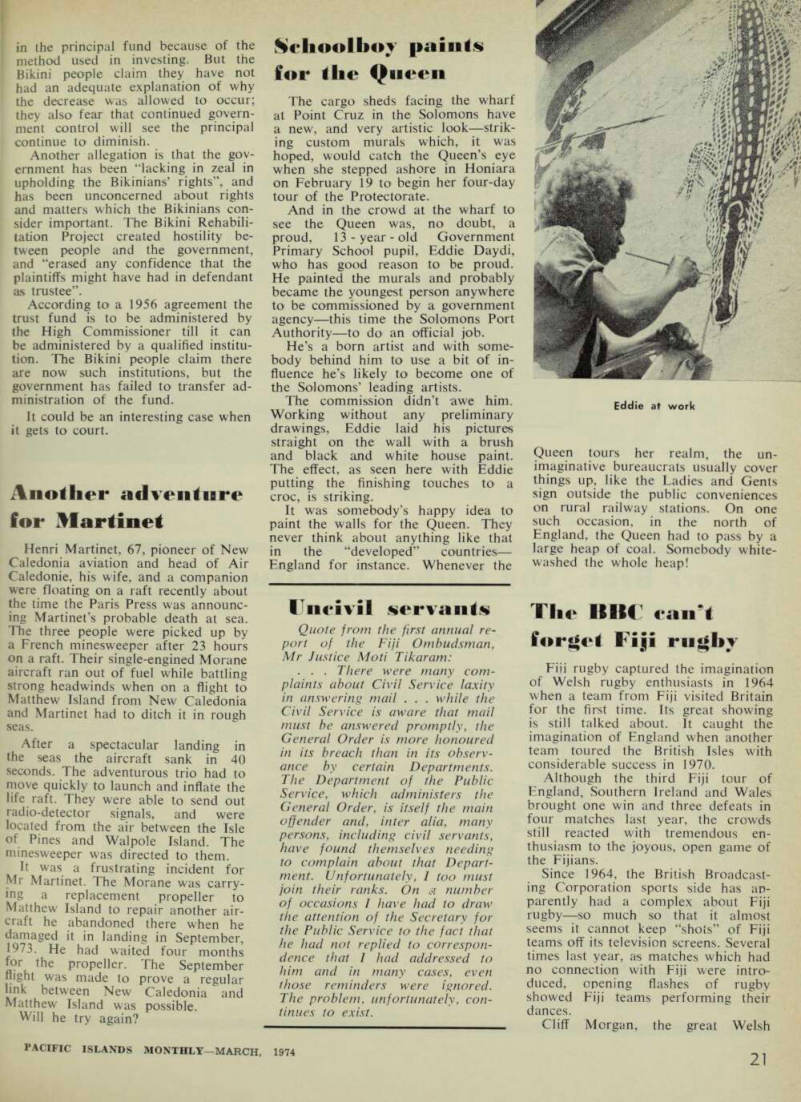
The effect, as seen here with Eddie putting the finishing touches to a croc, is striking.
It was somebody’s happy idea to paint the walls for the Queen. They never think about anything like that in the “developed” countries— England for instance. Whenever the
Queen tours her realm, the un imaginative bureaucrats usually cover things up, like the Ladies and Gents sign outside the public conveniences on rural railway stations. On one such occasion, in the north of England, the Queen had to pass by a large heap of coal. Somebody white washed the whole heap!
The HIM can’t
forget Fiji rugby
Fiji rugby captured the imagination of Welsh rugby enthusiasts in 1964 when a team from Fiji visited Britain for the first time. Its great showing is still talked about. It caught the imagination of England when another team toured the British Isles with considerable success in 1970.
Although the third Fiji tour of England, Southern Ireland and Wales brought one win and three defeats in four matches last year, the crowds still reacted with tremendous en thusiasm to the joyous, open game of the Fijians.
Since 1964, the British Broadcast ing Corporation sports side has ap parently had a complex about Fiji rugby—so much so that it almost seems it cannot keep “shots” of Fiji teams off its television screens. Several times last year, as matches which had no connection with Fiji were intro duced, opening flashes of rugby showed Fiji teams performing their dances.
Cliff Morgan, the great Welsh
Eddie at work
player now commentator for big tele vised matches, usually manages to get in something about “The breath of fresh air” that Fiji brought to British rugby.
In January, the BBC did it again.
Prefacing a new popular quiz pro gramme about sports, called “A Question of Sport”, flashes on the screen showed quick “shots” of several sports in action—and there among them was yet another of a Fiji team, at Twickenham, entertain ing the crowd with a dance.
If nothing else, the BBC is keeping Fiji rugby “on the map” 12,000 miles from its homeland.
Tourist bait
wanted in PK(«
Duty free shopping is a bait for tourists. Some administrations realise this more quickly than others. One of the slower ones is Papua New Guinea. The latest move for duty free came from the New Britain ’Jburist Association, which advised the Fi nance Minister. Mr Julian Chan, that more cruise ships would call at Papua New Guinea if passengers were offer ed duty free facilities.
More than 40 cruise ships are scheduled to call at Rabaul in 1974, carrying at least 15,000 tourists. The association sees lack of duty free shopping as a stumbling block to in creased tourism from shipping. Visi tors would not only buy duty free goods; they would spend much money on accommodation, food and trans port.
The association concedes that for the whole of Papua New Guinea to have duty free facilities would initially cause a loss of government revenue.
But with development of the indus try, turnover would be increased, and losses would eventually be eliminated.
The experience of most duty free countries dealing largely with impor ted goods, was that an initial loss of customs revenue, was soon offset by higher income and company tax.
The PNG Government has indi cated it will look at duty free shop ping when other priorities have been attended to.
Kiddie of the
Laughing* Death
A unique case of Kuru—the “Laughing Death” disease peculiar to New Guinea—has thrown doubts on the theory that it results from ritual cannibalism.
A Kuru patient has been found in
Rabaul on New Britain who does not come from the Fore ethnic group to which the sickness is confined. And more significant is the fact that the male patient, aged 25 has no heredi tary history of Kuru in his family or
village.
He is from Asaro, which is more than 60 miles from the Fore, and has lived away from his village since 1960 spending eight years in Madang and five in New Britain as a domestic servant for a patrol officer.
The new discovery was made by the district health officer for East New Britain, Dr Vincent Zigas, an epidemiologist who first isolated Kuru in 1957.
Dr Zigas says that until now all cases studied had hereditary connec tions with the Fore people who once practised ritual cannibalism.
It was believed that the suppression of the practice of cannibalism among the Fore through government and mission influence, was the reason for the virtual disappearance of child victims of Kuru under pubity, he said.
“It now seems, after 17 years of intensive study, we may still be on the wrong track,” Dr Zigas said.
He said it appeared that the disease struck in waves, or plagues.
Kuru is a fatal, progressive neuro
logic disease caused by a slow-acting virus, for which no treatment leading to a cure or even to the arrest of the disease has yet been discovered.
Dr Zigas said early symptons were unsteady gait, tremors of the arms, legs, trunk and finally the head. This was followed by uncontrollable, emo tional and pathological giggling.
The last stages were loss of con trol of the bowel, bladder, the in ability to sit up without support and to swallow. Death usually followed.
Dr Zigas said it was restricted to the Fore and those of their neigh bours in the Eastern Highlands with whom they intermarried (a total population of about 30,000).
Usually fatal after six to nine months after onset, Kuru accounted for more than half the deaths beyond infancy in the most affected villages.
Dr Zigas said reprisal murders of sorcerers suspected of causing the disease was the second most frequent cause of death in the region.
He is preparing a paper on his latest findings for the Medical Jour nal of Australia.
Ais i‘xi k rri«c‘
with a message
A massive operation of para troopers, commandos, armoured cars and helicopters swung into action in New Caledonia late January during the island's annual Alize manoeuvres.
The French aircraft carrier, the Jeanne d’Arc, transported troops, while for the first time a contingent of men flew out from the Compagnie Guepard (Cheetah Cat company) based in southern France. This emergency force is claimed to be on the alert to fly off to action in any part of the globe at 10 or 20 hours’ notice.
The Noumea press brought graphic presentations of the combatants and
their military operation straight into
Noumea homes. The action was directed at rebels who had supposedly risen up in the New Hebrides and Loyalty Islands (Ouvea and Lifou).
Press details of the landing of com mandos and their repulse of the enemy gave a fearsome impression of French forces annihilating any rebel elements.
What a pity the Jeanne d’Arc hadn’t landed a contingent of French doctors and nurses in Vila, where the new, air-conditioned French hospital, complete with streamlined medical equipment, has yet to open its doors for business. It isn’t that there’s a shortage of sick people, merely a lack of staff.