Pago Pago
p. 19 · Read in the full issue
That governor business in Pago Pago
Frcm a Pago Pago correspondent Members of the United States House Committee on Interior and Insular Affairs, and representatives from the Department of the Interior, were in American Samoa for a four day visit in January. The lawmakers, who have Congressional authority over American Samoa, were on a tour that included American Samoa, Guam, and Micronesia.
The delegation was led by Congress man Phillip Burton, of California, and included Congresswoman Patsy Mink, of Hawaii, and Congressmen Lloyd Meeds and Tom Foley, both from Washington State. Delegate-at- Large A. U. Fuimaono, who represents American Samoa in Washington, DC, was also with the group.
Chairman Burton said the committee was there to “get a first hand im pression of the island, to meet with the Samoan leaders, and to discuss the idea of an elected Samoan governor”. Burton was the author of a bill calling for the election of a Samoan governor, which was intro duced in the United States Congress several years ago. Local elections were held on the issue in 1972 and, again, in 1973. Both times a large majority of the voters were against the idea of an elected Samoan governor. The governor of American Samoa is ap pointed bv the Secretary of the Interior.
Members of the committee held a series of public meetings with the leaders of the American Samoa com munity, as well as a meeting with both houses of the American Samoa Legislature.
At all meetings the idea of a Samoan governor was generally pro moted, but the idea of a directly elected Samoan governor met with opposition. Most of the speakers favoured a Samoan governor selected by the “representatives of the Samoan people”, in accordance with Samoan custom. It was not made clear if the “representatives of the Samoan people” were to be the chiefs or the Legislature.
Calling such an idea “inconsistent with the democratic system”, Con gresswoman Patsy Mink said it was very “important for the idea and the
principle of an elected Samoan governor to be put to the people”. She told the Samoan leaders that they could not “impose a new system of government on the people of Ameri can Samoa without a popular vote”.
Congressman Foley said that a move to select rather than to elect a governor by the people’s popular vote, would "raise questions in Con gress, especially as the Samoan people have voted down the idea for a second time, only recently”.
When asked if the committee would recommend that a governor be selected rather than elected, Con gressman Meeds replied that the idea was “inconsistent”. He said that the people of American Samoa would have to make that decision them selves. He added that he “would not vote for the selection of a governor, rather than the election of a governor”.
Chairman Burton said that he also felt that it was very imnortant for there to be “some expression of the people of American Samoa”.
It was rather obvious in both the public meetings and in the meeting with the Legislature that the com mittee members favoured direct popular election of a Samoan governor, or at least a favourable voter response to the idea of a Samoan governor.
The American Samoa Legislature is now expressing interest in attempting to amend the constitution by their own vote, rather than by popular referendum, to allow for the election of a Samoan governor.
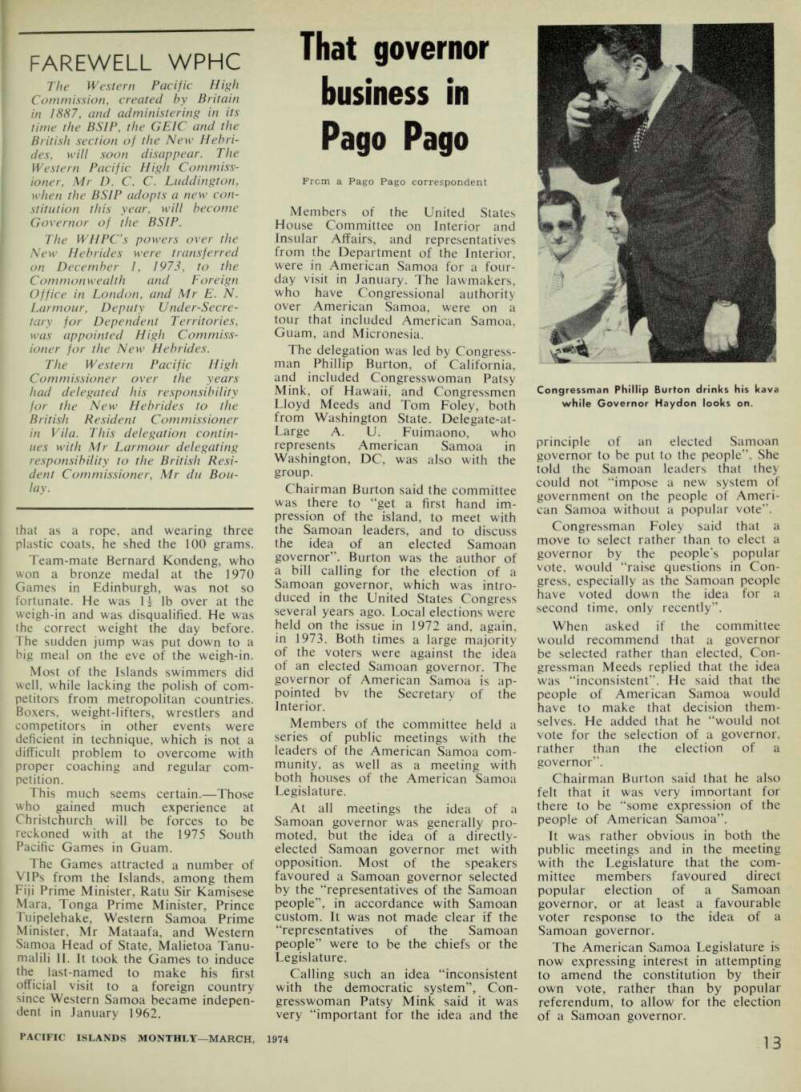
Congressman Phillip Burton drinks his kava while Governor Haydon looks on.