Business and Development
pp. 103-105 · Read in the full issue

U. S. CHICKEN IS CHEAP, SO AUSTRALIA
Gets The "Bird" From Micronesia
From DES McKIBBIN in Majuro
When the devaluation of the United States dollar was announced in February and the Australian govern ment decided to sit pat, there were many unhappy faces in the Micro nesian business community.
It had been a blow when Australia revalued upwards unilaterally in December. Importers who had been building up quite a trade with Aust ralia then began thinking of going back to their old suppliers in the United States and elsewhere. Aust ralian goods were getting too ex pensive.
In cold figures, the further monetary troubles in February mean that Australian goods can now be 25 per cent dearer to island buyers than they were in November, 1972.
The Republic of Nauru can’t be too happy about the situation either.
The government-owned (or what amounts to the same thing, the Nauru Local Government Council-owned) Nauru Pacific Line vessels MV Eigamoya and the newer fleet edition, Cenpac Rounder, have been heavily subsidised to establish trade routes through from Australia to the TT port of Majuro. The Australian Government’s monetary policy could put paid to that enterprise and the line advisers might have to think of using the ships elsewhere where local money has not become so dear in international terms as that of Australia.
Things are going to be very diffi cult for Australian manufacturers not only in the US Trust Territory but m other parts of the Pacific as well.
Many goods, especially food, from the United States are becoming at tractive to buyers. As only one ex ample—frozen chicken. US chicken is the finest in quality in the world and even before December was cheaper in the TT than the Aust ralian ‘chook’.
The Nixon administration is anxious
to push exports from last year’s four per cent of production to five per cent. This increase of just one per cent will add over SUSII billion to value of exports—more than enough to take care of last year’s US trade deficit of $6.4 billion.
The US can now deliver cheaper to the TT also. Freight from the United States to Kwajalein is SUS 42 a ton; general cargo rate Sydney- Majuro on Nauru Pacific Line is SA41 —in terms of US dollars at mid- March rate, SUSSB.
I visited the US Trust Territory, Nauru and the Gilberts just after the latest devaluation of the US dollar and spoke with businessmen on the outcome of the Australian Govern ment’s decision not to follow suite.
Mr Ronald Levy, general manager of Robert Reimers Enterprises, Majuro, which had been importing food lines from Australia said the company had considered cutting back after the Australian revaluation in December but had reconsidered as the supply position was better from Australia. However, the company has
had to think again since the US de valuation. What it means in hard cash for consumers is that a can of Australian corned beef now costs SUSI.2O at Majuro.
As a result of the hike in prices for all Australian imports this com pany has cancelled about 80 per cent of its Australian orders.
Mr Joseph Kramer, a director of the Marshall Islands Development Authority, said that before revaluat ion, his companies had been looking to Australia as a main source of supplies. They had been importing even before there was direct shipping and the advent of the Nauru Pacific Line ships had been very welcome.
As a result, goods had been landed from Australia and sold in Majuro at much lower prices than similar goods imported from the United States. Now the picture had, of course, changed and it was doubtful whether they woud be importing from Aust ralia more than a fifth of what they had been getting six months pre viously.
Mr Kurtley Pinho, manager of Is-
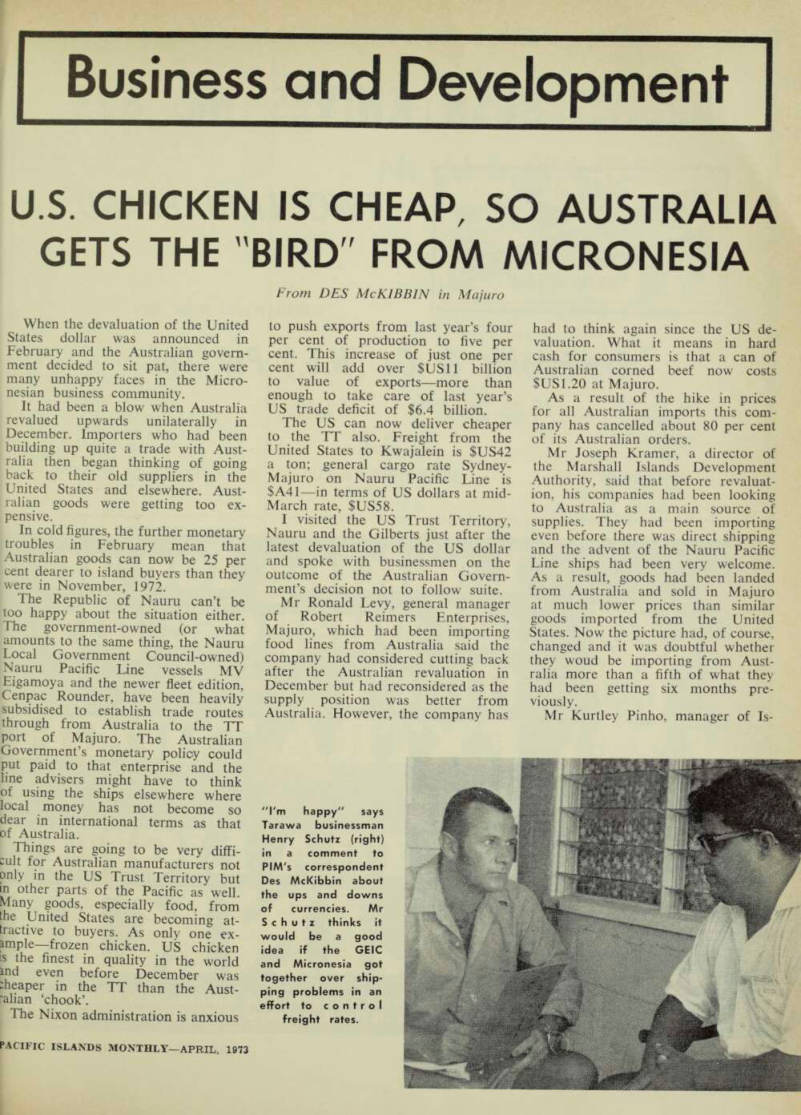
"I'm happy" says Tarawa businessman Henry Schutz (right) in a comment to
PIM's correspondent
Des McKibbin about the ups and downs of currencies. Mr Schutz thinks it would be a good idea if the GEIC and Micronesia got together over ship ping problems in an effort to control freight rates.
land Construction Co, which distri butes machinery, building material and hardware said that his company “had been caught with its pants down.” A large steel consignment of high-value cargo like stainless steel sinks and generating equipment, was on the water at the time of the US devaluation and it was going to be impossible to pass on all the price increase to customers. He said that, as an example, it was unrealistic to expect anyone to pay $6O for a sink when a competitor down the road was selling a similar product, but made in the US, for $5O. He had cancelled all outstanding orders in Australia.
There was talk in the Trust Terri tory of placing a local ship on the Australia-TT run. This would help to some extent as a TT or US-based charter could be paid for in US dollars. Although this might be a partial solution for Australian sup pliers, the prospect is not likely to make the owners of the Nauru Pacific Line very happy.
I found that the only person in the Micronesian area who was happy with the various revaluations and de valuations was Mr Henry Schutz, of Schutz and Wilder, whose headquarters are at Tarawa, in the Gilberts. He has been trying to open a shipping service between the Gilberts and the Mar shalls. He said that already some Australian goods were cheaper when obtained through Trust Territory than when shipped direct to Tarawa. If they could get together with the Micronesians they could control their own freight rates.
He thought the United States, in an effort to get some of its own dollars back from the TT where the budget now totals $7O million plus, would subsidise freight rates to one port in the Trust Territory rather than to all TT ports as the territory was spread out over three million square miles of ocean. He could see that one port becoming a distri bution port for the whole area, tran hipping goods from the United States, Australia, China, Taiwan (which ms the cheapest cement in the vorld), Japan, and others. At the ame time, the Trust Territory itself lad big plans for local shipping and he funds available to see them hrough. I think the Gilberts and the "rust Territory should be closely issociated in the future, for their (Ritual benefit. • Ninety-five Corriedale and tomney Marsh sheep from Australia KiH k e used in research at Bena Bena ivestock station, near Goroka, PNG, 3 see if they can provide another ource of meat.