Hews
pp. 99-100 · Read in the full issue
Boac
Pacific Jet
Planeman's guide to photography
(BOAC Supplement—Advertisement)
Terry Fincher, four times the British and Commonwealth Photo grapher of the Year, has flown the world with his camera, without losing his sense of wonder and excitement.
Here he gives some professional hints on taking shots from aircraft for those who share his zest for visual adventure.
The Captain called our attention to the view from the port side of our BOAC 707 aircraft. I had been asleep since take-off from Tokyo several hours earlier. We were flying the Polar route on our return to London.
The scene was one of magnificent splendour, with Alaska lying below us in crystal clear air. The first winter snows of this wild part of the world were tinted by the mellow Alaskan sun. Mount McKinley stood up with a dimensional challenge, even though it was many miles away.
It is a scene I will always remem ber, a scene to be filed in my memory bank but, unfortunately, not with my colour slides.
I was returning from a three-week long and tiring photographic assign ment, shooting from dawn to dusk, with more than a hundred exposed colour films in my bag, and all I wanted to do on the way home was to sit and look at this wonderful view.
Usually I would be one of the first to have my camera out recording this scene but, as so many air travellers know, great pictures are missed by either being too tired, or not having a camera handy at the right moment. You may even have run out of film!
To me, views can probably tell
just as much of a story as people.
In fact, the power of a magnificent view photographed properly is some thing that gives great satisfaction, not only to the taker but also to the viewer.
Aircraft are probably one of the finest platforms for truly great scenes (that is if you are lucky enough to be in a good window seat). Taking off and landing can give you some of the clearest views. For instance, flying in to Hong Kong on the city approach, the scene is really un believable with, directly below, the crowded tenements of Kowloon and Hong Kong Island in the background.
The London approach over the city on a clear day is a very similar ex perience though perhaps the view is not quite so spectacular.
I think I have experienced most types of aerial photography, from the comforts of a modern jet to being strapped to the side of a giant helicopter flying around London’s Post Office tower, or covering some disaster at sea. I have made parachute jumps with cameras fixed to my boots
and arms, and have flown in combat aircraft in Vietnam and other war torn places around the world.
Still, it always comes back to the view, and if you are a keen photographer and have a decent camera and also a real sense of feeling for what you are taking, then it is probably the most easy form of photography. The hardest part is getting into a position to be able to take a particular picture.
A couple of years ago I under took on my own an expedition in the Himalayas with two Sherpas and a guide, on a month-long walk. I had to walk many miles and it was really very hard work especially in the first week. In fact it was murderous even though I had trained for it.
Averaging 10 miles a day un and down mountains was pretty hard go ing. I was carrying my own pack, and with film stock, three cameras and lenses to add to the weight.
Today it rates with some of the most rewarding photographic work I have done—walking along those mountain paths high in the Himalayas under the
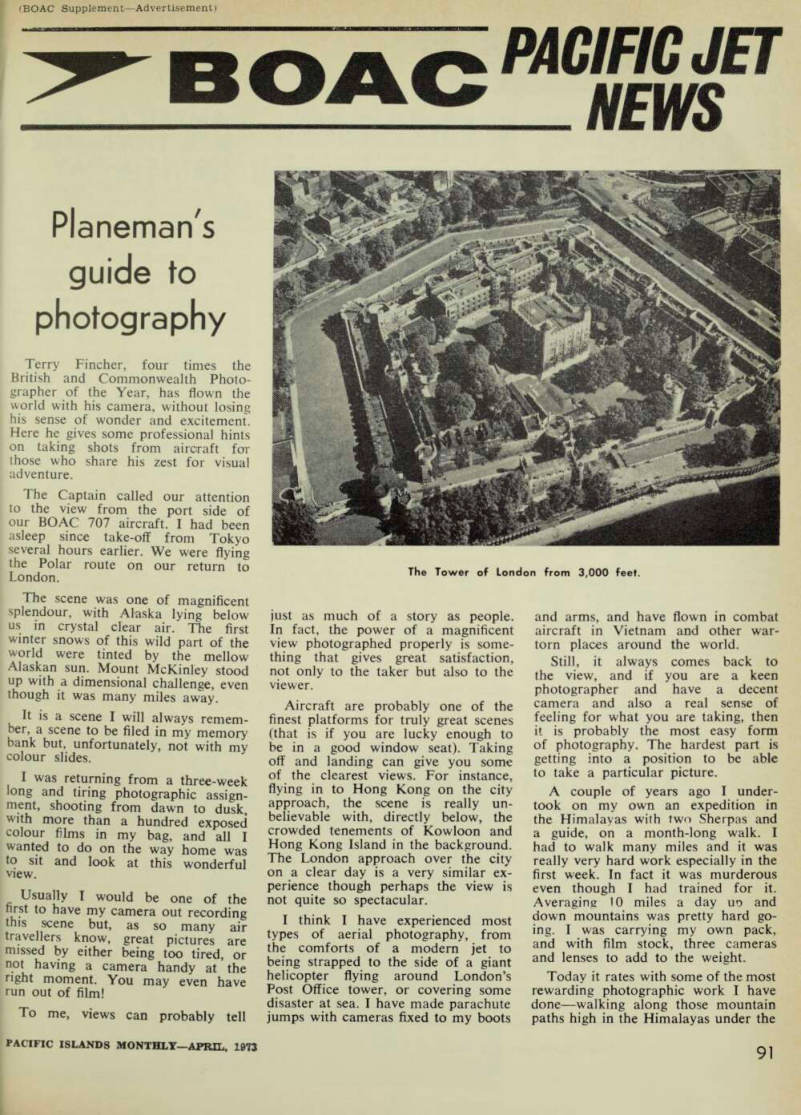
The Tower of London from 3,000 feet.
shadow of Annapurna and Dhaulagiri, and to see them through the open tent flaps as I lay in my sleeping bag and the first sunlight hit the highest tips at the start of a new day; to look down into the lush green valleys or at a water-hole where the local women in their colourful clothes meet to discuss the usual village gossip.
This is a hard part of the world; no tourist ever ventures this far, yet it is one of the most friendly and fascinating parts it has been my pleasure to visit. My camera recorded many hundreds of beautiful views and my memory will always recall the wonderful experience of staying in a Tibetan inn and being greeted with great hospitality.
In the villages food was in short supply, but on meeting a village chief (and for most of his villagers I seemed to be the first white man they had seen) they insisted on givine me some of their rice and, if a chicken was to spare, one would go in the pot to make a delicious curry for the evening meal.
Fellow travellers who are keen photographers may like a few tips.
Many may have fully automatic cameras or some may rely on an ex posure meter, which I personally pre fer for true readings. You cannot stick it out of the aircraft window, of course, but if you can use a small manual meter after a period of time you will start to understand the value of light more than work ing fully automatic through a camera. Also in very tricky lighting, and if the subject is good enough, you should ‘bracket’. This is a pro fessional term meaning several ex
posures but varying your aperture in both directions. You may think this is a bit hit-and-miss or a waste of film, but it is not really. You will get the finest result, as professionals are always expected to do.
If your camera has no exposure meter and you do not own one of any kind keep the exposure guide from the film packet. This inform ation is usually pretty accurate, but it is still worth taking notes of your own on the lighting situation.
You will see your mistakes or suc cesses once the film comes back from developing, then you have your notes for reference.
Hand baggage can always be a pro blem, and if your camera bag is pretty small take the films out of the boxes (if it is Koda-chrome don’t throw away the mailing bag). Keep films in their cans but make sure after exposure that you wind the film fully back into cassettes or else mark ‘exposed’, otherwise you will get your exposed film and unexposed film mixed up. 1 use a lot of Koda-chrome film so I always put mine into mail ing bags.
If travelling in hot climates put all exposed film into a cool drawer.
Do not carry it around with you all the time. U.V. filters are a must for all colour. 1 keep one on all the time. You will lose no film speed and it protects the lens and helps to cut out unnecessary ultra-violet light.
Next week I will be on my way to South America; next year—who knows where? One thing I do know, I will always be thrilled by the Great View.