Pacific Shipping
pp. 88-95 · Read in the full issue

Tonga And Nauru Clear Decks
For Regional Shipping Line
A regional shipping line for the Pacific Islands came a stage nearer with a recent meeting in Nukualofa between representatives of Nauru Pacific Line and Tonga’s Pacific Navigation Co Ltd. Leaders of the delegations were the President of Nauru, Chief Hammer Deßoburt, and the Prime Minister of Tonga, Prince Tuipelehake.
A positive interim step, pending the outcome of any inquiry by the South Pacific Bureau for Economic Co-operation (set up by the South Pacific Forum) was agreement that both shipping lines will co-operate in routing ships, integrating schedules and allocating cargoes to meet con sumers’ needs.
The delegations agreed that “since the Union Steam Ship Co has curtailed the number of services supplied to the region, steps would be taken to ensure that the trade between New Zealand and the Islands in the region would not be disrupted for lack of adequate shipping services”.
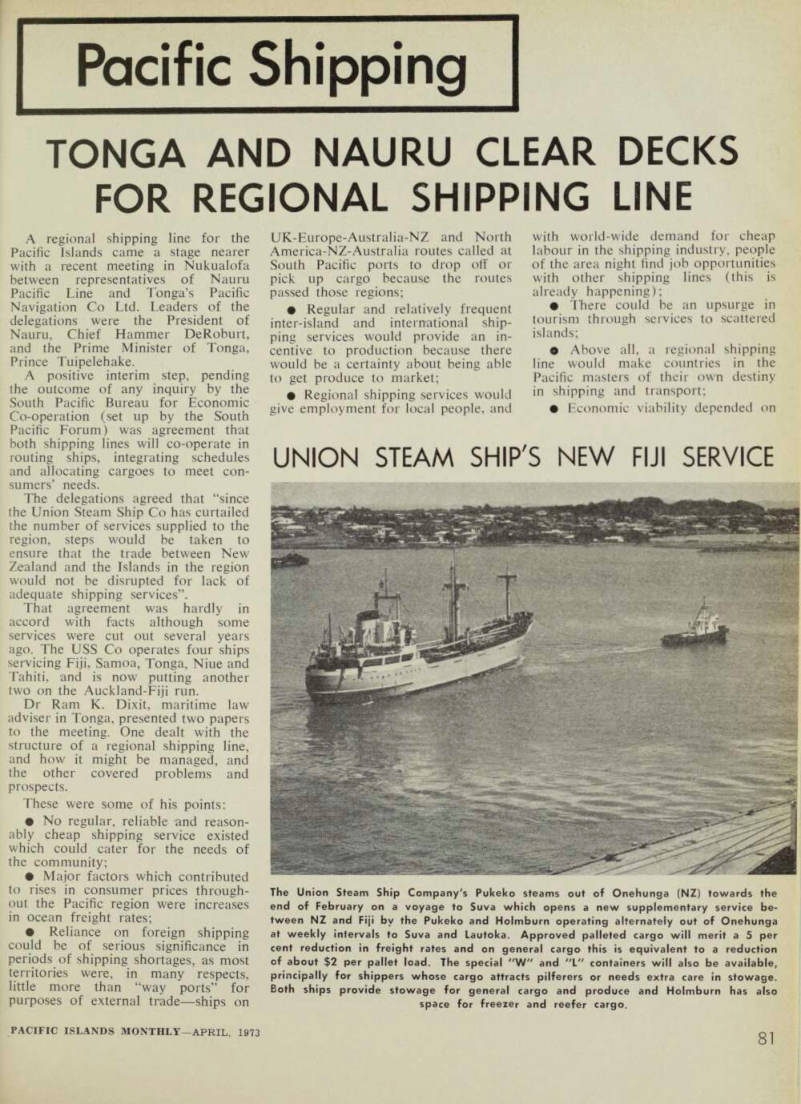
That agreement was hardly in accord with facts although some services were cut out several years ago. The USS Co operates four ships servicing Fiji, Samoa, Tonga, Niue and Tahiti, and is now putting another two on the Auckland-Fiji run.
Dr Ram K. Dixit, maritime law adviser in Tonga, presented two papers to the meeting. One dealt with the structure of a regional shipping line, and how it might be managed, and the other covered problems and prospects.
These were some of his points: • No regular, reliable and reason ably cheap shipping service existed which could cater for the needs of the community; • Major factors which contributed to rises in consumer prices through out the Pacific region were increases in ocean freight rates; • Reliance on foreign shipping could be of serious significance in periods of shipping shortages, as most territories were, in many respects, little more than “way ports” for purposes of external trade—ships on
UK-Europe-Australia-NZ and North America-NZ-Australia routes called at South Pacific ports to drop off or pick up cargo because the routes passed those regions; • Regular and relatively frequent inter-island and international ship ping services would provide an in centive to production because there would be a certainty about being able to get produce to market; • Regional shipping services would give employment for local people, and
with world-wide demand for cheap labour in the shipping industry, people of the area night find job opportunities with other shipping lines (this is already happening); • There could be an upsurge in tourism through services to scattered islands; o Above all, a regional shipping line would make countries in the Pacific masters of their own destiny in shipping and transport; • Economic viability depended on
\ sufficient cargo being available, but the business could be geared to meet [ the demands of the Pacific com munity; • A regional shipping service should be equipped with modern reefer ships and bulk carriers if demands dictated,
A New Port
For Cruise Ships
Mitiaro in the Cook Islands, was added to the tourist map of the South Pacific when the West Star called there early in February. It was dif ficult to say who was the most excited —the local people or the tourists. The costuming of the well-drilled dancers was excellent.
There was an exchange of gifts, with Tiki Tetava Ariki presenting a kumete and carved handle to Captain Blackwell, master of the West Star, and a pate and beater to Mr Arie von Tol, chairman/chief executive of Westour, who was one of the pas sengers. Captain Blackwell, in return, presented Tiki Tetava Ariki with a ship’s wheel barometer.
As a parting gesture 100 large bal loons were given to a party, which boarded the West Star, to take back to island’s children. With night closing in the balloons made a colourful sight floating above two boats heading hack to the island.
Hydrofoils And
Jetfoils For Fiji
Fiji’s projected hydrofoil service, linking Lautoka and Suva, via the Fijian Hotel and Korolevu, and later Deuba, is now a projected jetfoil service. The service is not yet “skim ming the waves’’, but the managing director of Fiji Hydrofoil Ltd, Mr I. E. Bracey, of Sydney, is hopeful it will be in operation in about two months.
The overall plan involves a series of dovetailed operations, which will cover Fiji, the New Hebrides and the Barrier Reef. Key to the project is to launch the hydrofoil service, carry ing 130 passengers in Fiji. Then Mr Bracey hopes to launch 75-seater hydrofoil services in the New Hebrides.
Should everything go to plan a Boeing jetfoil will go into service in Fiji about the middle of 1975. The j 130-seat hydrofoil (return services starting daily at Lautoka and Suva are envisaged) will then be transferred to the New Hebrides and the 75-seaters will go to the Barrier Reef to cater for tourists.
The Boeing jetfoil is designed to [operate in unprotected waters. The |first is now being built in Seattle and lis an adaptation of a navy craft. It
has fully retractable foils which allow access to shallow water ports. It has a speed of 45 knots, the overall length is 85 feet, the beam is 30 feet and it has gas turbine motors.
The foils drop 16 feet, and leave three or four feet between the surface of the water and the bottom of the boat. It is designed to take 250 com muter passengers or 190 passengers with luggage. It has two decks.
The first commercial jetfoil will go to Hong Kong to operate a service between Hong Kong and Macao.
Mr Bracey, looking into the future, says that as the jetfoil has a range of 500 miles without refuelling, it could be used in Fiji in tourist ventures in
Lau, the Yasawas, Cakaudrove and Kadavu. aidcca ccAoru AIKotA btAKLn
For Fish Catcher
Ships and aircraft controlled from the Air Sea Rescue Co-ordination Centre in Guam, searched for nearly four days recently before locating a fishing ship, the Dublon, which ran into bad weather. The captain-navi gator, Captain Yank Kaseroff died as the ship ran into the bad weather (see “Deaths of Islands People”), The four Trukese seamen maintained a steady course for Truk, The Dublon made radio contact
with the search party and other ships, but it was difficult for searching planes to find it because of radio location problems and bad weather.
When found, the Dublon was about 160 miles from Guam. The Dublon was then towed to Truk by the Wan dank, one of the searching ships.
King Of The Ocean
Goes To Work
The Fiji Government’s newest ship, the Tui Ni Wasaliwa (King of the Ocean), is a fisheries research vessel, which will be able to reach the more distant waters of the country. The ship was built for the Ministry of Agriculture, Fisheries and Forests to a design in accordance with the rules of Lloyd’s Register and the Fiji Marine Board.
The 180 tons Tui Ni Wasaliwa is a welded all steel ship with a hull 81 ft 6 in, overall and 22 ft 8 in. moulded breadth. She has a General Motors motor developing 340 shaft hp and a service speed of knots.
There is accommodation for four officers and eight seamen.
The ship can operate live bait pole and line fishing and experimental stern trawling, and has limited capa city for small-scale oceanographic re search. There are bait wells, portable bait tanks and an 1,800 cu ft (about 30 tons) insulated fish hold.
This Job Could
Go With A Bang
World War II depth charges which Trust Territory authorities hope to recover from a sunken Japanese ship in Truk lagoon, will be used for blasting channels in reefs around the island. A demolition team expected to remove about 300 of the charges and about two tons of small arms ammunition and projectile fuses from a ship, believed to be the Sankisan Maru.
The project, to cost $U525,000, was to have been launched early in March, provided finance was available.
Peter S. Aiken, an expert on ex plosive ordinance disposal was lent to the Trust Territory by the US Navy, to take charge of the project.
He was to be helped by the TT Marine Resources Diving Officer, Mr John U. Oakes, and 20 men.
A training session was arranged for divers. The project was expected to take three or four weeks to com plete.
Chief Aiken found the depth charges in May, 1972, while search ing for explosives in the lagoon. He found a bomb nearby and was about to explode it when, having second thoughts, he decided to search the
Continued on p 86
ship and found the depth charges.
Had he exploded the bomb it might have set up a chain reaction and blown the whole shipment, and him self, sky-high. There could have been fatal consequences for people on a nearby island.
Higher Freight
Rates For Png
Freight rates from Australian ports to Port Moresby, Lae, Madang and Rabaul were increased by 121 per cent halfway through March. The new rates were negotiated by the Aus tralian Shippers’ Council and four companies operating to PNG Karlander, Conpac, New Guinea Aus tralia Line and New Guinea Express Line. The reason —increased stevedor ing and operating costs.
The last time shipping freight rates to Papua New Guinea were increased was in July, 1971, when they went up 9 per cent. That raise followed a 15 per cent increase only four months earlier—in March, 1971.
This big increase in freight rates could be a double-edged weapon for the shipping lines. There could be a drop in tonnage, particularly of food stuffs, as New Zealand has been taking full advantage of recent cur rency movements to get into some of Australia’s traditional markets in the Islands. One of these is Papua New Guinea.
New Zealand can undersell Aus tralia in such commodities as biscuits, canned fruit, apples, potatoes and meat, even before the projected rise in cargo charges, which will probably be in May. Having to pay higher charges will put Australian products in an even worse competitive position.
That is hardly the affair of the shipping companies, which have to operate at a profit or go out of business. But a drop in cargoes could quickly lead to too much space for too little cargo. . , The rise in freight rates is just ahead of an increase of 6 per cent in wages for PNG watersiders, due in May. This rise is the second part of a wage agreement, which came; into force in 1972. The first part of the increase was 9 per cent, applied! in 1972. The shipping companies! absorbed that increase.
The upshot of these increases, particularly if Australian exporters lose some of their markets, could be; a move to some sort of containen service for Papua New Guinea.
Internal shipping freight rates in Fiji have risen by 171 per cent. This follows higher wages for officers and seamen and other operating costs; The last blanket increase was about two years ago, except for Lau, whicH
had to pay higher rates from January, 1972. Passage rates have also been [ increased.
Freight rates between Britain and Fiji and Japan and Fiji have gone up by about 11 per cent. Both increases were made to offset devaluation of the US dollar and revaluation of the Japanese yen.
Fiji Dockworkers
Want Big Rise
Fiji dockworkers want a basic SI an hour, and that is what they will ask employers for when they negotiate a new pay agreement in August. The present is 46c an hour for regular workers guaranteed 40 hours a week, and 50c for casual workers. Those rates were achieved after the crippling strike of 1971 when the Prime Mini ster, Ratu Sir Kamisese Mara, virtu ally became the arbiter.
The wharfies want $1 an hour be cause the cost of living has risen by more than 100 per cent since the last pay agreement, says Taniela Veitata, the Fiji Dockworkers’ and Seamen’s Union’s general secretary.
He expects support from the South Pacific Dockworkers’ Council, which was formed in Suva early in Febru ary. Countries and territories repre sented on the council are Australia, NZ, Fiji, Tahiti, New Caledonia and Papua New Guinea.
The union announced its demand early to warn shipping companies and the government, and will not go on strike unless forced. There could be an interesting round of negotiations ahead—behind closed doors.
Nz Exporters
Have Problems
New Zealand exporters are pleased with the Union Steam Ship Com pany’s increased shipping services to Fiji and they intend to take full advantage of them, Mr Lloyd Brown, president of the Wellington Manu facturers’ Association said recently.
At a meeting of the Export Institute of New Zealand Mr Brown said he was only disappointed that the in creased services would operate only out of Onehunga. “The problems facing exporters outside Auckland are still present”, said Mr Brown.
Carpenters Sell
Shipping Agency
W. R. Carpenter has sold Carpenter Shipping Agencies in Papua New Guinea, and has acquired an interest in a new company, in which 20 per cent of the shareholding is reserved for local people. The new company is Robert Laurie-Carpenter Ltd, with
the Robert Laurie and Carpenter
groups holding equal shares.
The new company will incorporate the activities of the old Carpenter Shipping Agencies at Port Moresby, Lae, Rabaul, Madang and Kieta, and the stevedoring work of the Robert Laurie organisation. Robert Laurie activities were previously confined to Kieta and Lae, but will now be ex tended to take in Port Moresby and Rabaul. Robert Laurie-Carpenter will act as customs and forwarding agents at Port Moresby, Lae, Rabaul and Madang.
Mr J. H. Beer has been transferred from New Guinea Co Ltd to Robert Laurie-Carpenter as general manager.
Strike May Hit
Shipping From Usa
American Samoa is taking a pessi mistic view about shipping links with the US West Coast. With memories of the crippling 100 days’ strike in 1972 by 16,000 West Coast long shoremen, the government and local firms have been warned to prepare now for another breakdown in ship ping.
The contracts for the longshore men, who work for the members of the Pacific Maritime Association will end on July 1. Other major contracts /or transport workers are running out, and a strike by any of the unions involved could disrupt shipping.