Osilek And Oreng: A Love Story
pp. 71-72 · Read in the full issue
By Santos Ngodrii
SILEK was a very well-known chief Jot a rock island, Ulong. He had lany big pieces of Palauan money he h did not"
'he cousins he lived whh 3 his needs faithftdfv bm is wealth he wa nnhani! d Pte Fishine was nsMWmn.tinn nd he spent all dav verv fiction! all day tending the very )ng tish net (made with coconut usks) which surrounded his fishing pot called Biduul on a sea called oh Big turtles, sharks and many ther kinds of fish went inside his et, and every day he killed them and istnbuted the meat to his relatives nd *""?-hers of his clan. , „., o n ng th f re j ived a c X ery beautirJci 'f n % ?be was so [tractive that Osilek decided to win fw u ,° sl]lek knew very eii mat she didn t want to marry im oecause ot his oldish character,
so he decided to use wealth to overcome her objections.
Orena HiH rw uv- n c ;i o v wanted to stay away from him, but there was no way ° ut - ° silek brag- B ed to her fals ,y of his sexual triumphs. He killed turtles and sharks and told his sisters: “ Take the meat to oren B’ s home, f °r she will become my wife » Oreng tried her best to avoid taking anything provided by Osilek, because hy accepting things she incurred a B«at obligation to him. But she could not resist Osilek’s sisters, who always msisted upon giving her everything Provided by Osilek.
One day, Oreng’s parents sympathetically said to her: “Poor Oreng, we have tried everything we could to protect you from Osilek, but they just haven’t worked out. It is only you who can solve the problem.”
Soon it became clear that Oreng was obligated to marry Osilek.
T T was customary practice of all the f youngsters of Ulong and Metu kru!kull (Mother rock island) to meet dur mg the full moon and spend the night playing. Since she was not yet married, Oreng continued to attend such gatherings, and on one such occasion a vnun? man from Mptn kruikull named Mariar became in terest ed in her Soon they saw much of eac h other and dedded to eet carried Orene’s auction for MaiSj J£™ d - and she never lik dt b y Dart fr ?, m him shark and turtle meat openly to Oreng’s home to reinforce her obligation to marry him. Mariar, who had made many trips to Oreng’s home, discovered the relationship between Oreng and Osilek and was frightened. When the
next occasion came for the youngsters to meet and spend the night playing.
Mariar wasn’t there, because he was afraid that Osilek would detect his relationship with Oreng.
Oreng waited for him but he never showed up. She became very sad and after they finished playing she told the girls from Metukruikull: “When you go back home, remind Mariar to check the mamel in the fish trap at Biduul.” (Mamel is a rare and delicious fish in Palau, to be eaten only by royalty. Oreng’s beauty made her a rare catch indeed, one to be found in Osilek’s trap at Biduul. Oreng said it this way so the girls wouldn’t discover her secret re lationship with Mariar, but if Mariar got the message, he would know that Oreng wanted to see him per sonally.) So Mariar went secretly to see Oreng. When he found her, he said: “On the second day, go out to the beach. When you see a sailing canoe coming from Metukruikull go to it and pick up a coconut husk floating on the sea.” After this, they said goodbye and departed for their homes.
Two days later, Mariar put a piece of Palauan money inside a coconut and told his younger brother: “Take this and start sailing for Ulong. As soon as you see a canoe coming out from Ulong sail close to it, put the coconut husk in the sea, and sail back home.”
Mariar’s brother followed the in structions. They saw a sailing canoe departing from Ulong, so they ap proached it and put the coconut husk on the sea. The piece of Palauan money inside the coconut husk symbolised the end of Mariar’s re lationship with Oreng. (The gesture is usually used to end only a formal relationship, so Mariar’s action show ed the depth of his love for Oreng.) SOON after, Mariar again appeared before Oreng and said: “T am so broken hearted that I will die because of it; you will be the to bury me.” Oreng was filled with sadness and sorrowfully sang this song as her tribute to Mariar: Mariar, Mariar,
I’m not really Osilek’s wife and never want to be.
He bragged to me falsely of his sexual triumphs.
And forced me to take his fish.
Several days later Mariar died—it was said from a broken heart. Oreng told Osilek of Mariar’s death and asked to go to his funeral. Osilek, upon hearing the news of his “wife’s” lover, rejoiced and permitted her to go. Oreng then collected flowers from a Kelau tree and made a lei and started out for Mariar’s funeral.
When she arrived, the funeral had finished and the people were only waiting for Oreng to see Mariar’s body before they buried him. Oreng didn’t say anything to anyone, but when the people asked her what she wanted, she replied: “I want to ask you to let me join Mariar’s body and cover me with a piece of his mat for a while. When I wake up, then he will be prepared for burial.”
THE people all agreed, but as soon as she lay down next to Mariar’s
body, she died. The people wei not aware of her sudden death. The were waiting for her to wake u but to their surprise, as they n moved the mat, they found her dea< The people went back and told Osile and Oreng’s parents of Oreng’s deat!
It was decided that the two woul have one grave.
This old Palauan love story is sti recounted today often in the fori of a poetic chant. A story of your love and tragic death, it also two lessons: bragging about sexu prowess is considered improper; ai it is never possible to “buy” lov as Osilek tried to do by imposh on Oreng with his gifts of food. (This story was published in Palam Legends ; Cheldecheduch er Bela edited by Katherine Kesolei ai published by the Palau Communi Action Agency, Koror, Palau, Car line Islands, Micronesia as part < a programme of collecting and r cording oral history and culture both Palauan and English.)
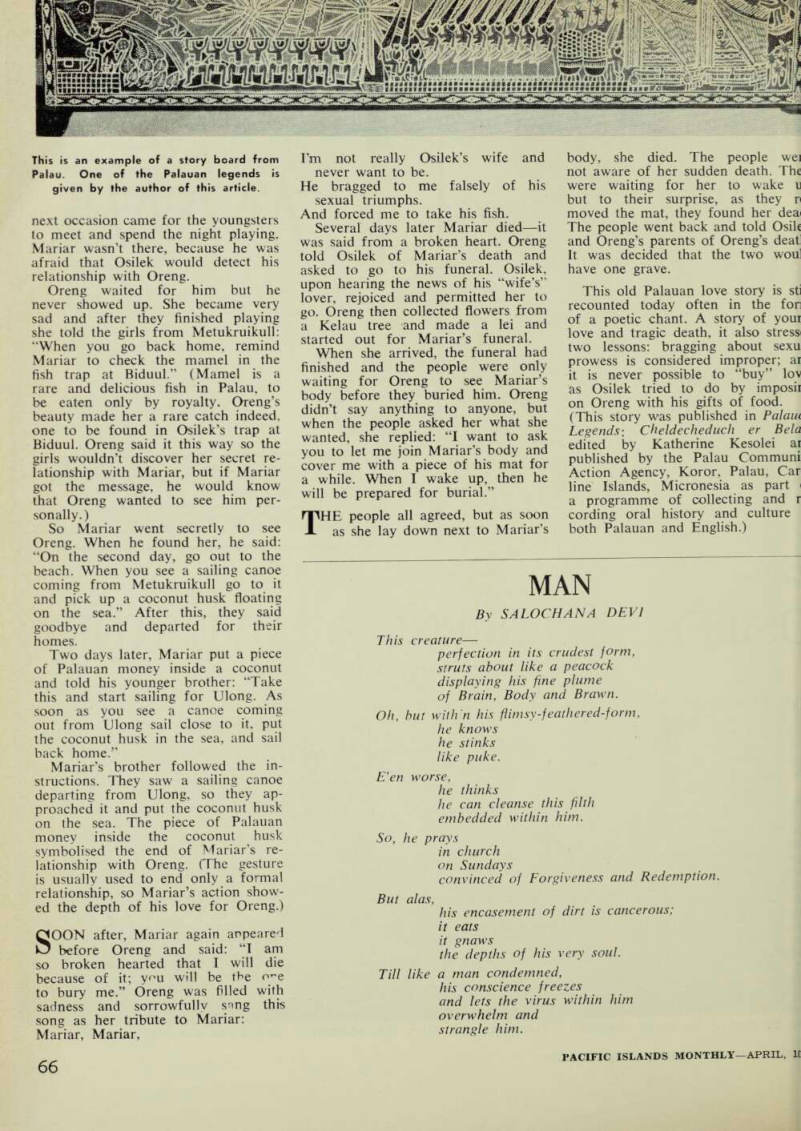
This is an example of a story board from Palau. One of the Palauan legends is given by the author of this article.