Builds His Athens
pp. 44-49 · Read in the full issue

A Modern Socrates
By Stuart Glauberman
When you leave his Atenisi College, Futa Helu is likely to say that should you return to Tonga, the doors of Atenisi will always be open. That is his way of speaking.
Futa chooses his English words carefully, curiously, and in his soft spoken way, turns simple statements and scraps of information into poesy.
Atenisi College has no doors.
Rather the portals through which Futa hopes you will return are meta phorical, metaphysical or, perhaps, futuristic. Ten years after its begin ning, Atenisi is still being built, and doors may be only days away.
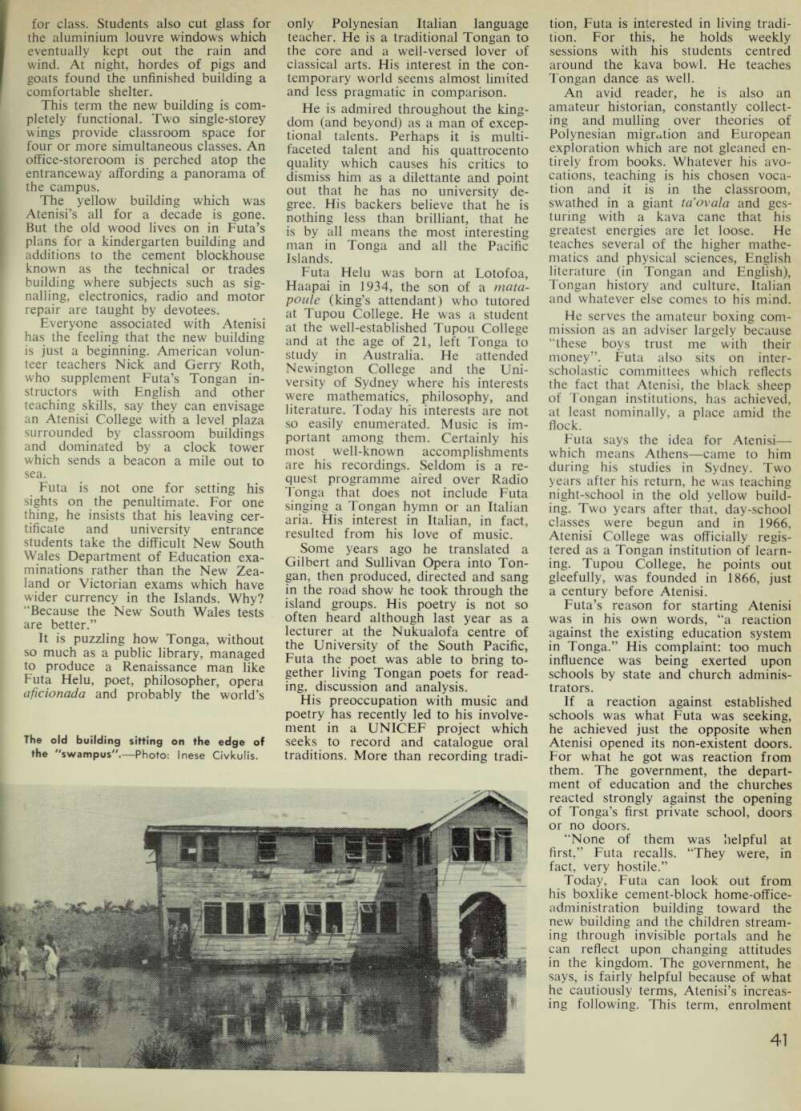
Atenisi’s campus, best described as a “swampus”, is in a low-lying fre quently-flooded Kolomotu’a site, with in a mile of Nukualofa’s Royal Palace. Six months ago, the college consisted of one building which was falling down and another which was going up. A glance at the old build ing was enough to appreciate the story of Atenisi’s past. It was completely without foundations —little more than a frame of half-rotten timbers sitting in a swamp.
The building was originally situated just outside town in Nukualofa’s main street, where it was used for Futa’s first project, a night school for civil servants. Somehow it withstood removal to Kolomotu’a on land given to him by an early backer as it was too swampy for successful copra cul • The author, a freelance writer now living in Melbourne, taught English as a volunteer at Atenisi last year.
tivation. There, with flaking yellow paint, broken windows and gapinj holes in the wooden floors, it restec upon a dream.
Between classes, students upstair; in the upper forms would amusi themselves by throwing paper through the floor at lower-forn students who were equally absorbe< in trying to catch fish from water be low the floor. Then in November while Higher Leaving Certificat examinations were on, the old build ing was torn down. Not with a ban; and a wrecker’s ball, but lovingl> piece by piece, by its former students The new building is not Futaesqu although it was the headmastei administrator-lecturer himself wh modified the architect’s original plan: Futa also provided the lion’s shar of the financing from fees earne: during a lecture tour of the US ii 1970.
The new building rose quickly du ing the last two school terms pro vie ine a roof —but at times little shelte —for leaving certificate and unive: sity entrance classes. One of the difll culties with the old building was th it filled with water during heavy rail forcing cancellation of lower-for classes. The new building, while st: unfinished, had an advantage in thi the rain and wind howled through tl building, disturbing without disruptir upper-form class schedules.
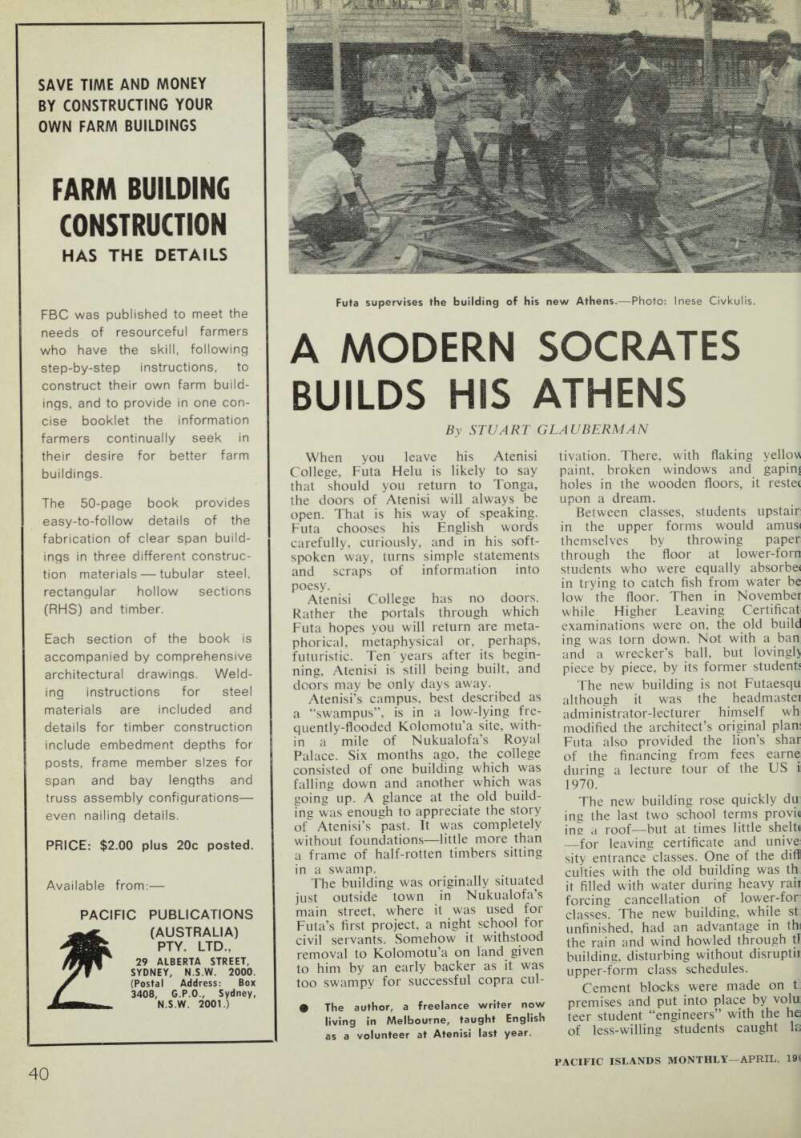
Cement blocks were made on t; premises and put into place by volir teer student “engineers” with the he of less-willing students caught la
Futa supervises the building of his new Athens.—Photo: Inese Civkulis.
for class. Students also cut glass for the aluminium louvre windows which eventually kept out the rain and wind. At night, hordes of pigs and goats found the unfinished building a comfortable shelter.
This term the new building is com pletely functional. Two single-storey wings provide classroom space for four or more simultaneous classes. An office-storeroom is perched atop the entranceway affording a panorama of the campus.
The yellow building which was Atenisi’s all for a decade is gone.
But the old wood lives on in Futa’s plans for a kindergarten building and additions to the cement blockhouse known as the technical or trades building where subjects such as sig nalling, electronics, radio and motor repair are taught by devotees.
Everyone associated with Atenisi has the feeling that the new building is just a beginning. American volun teer teachers Nick and Gerry Roth, who supplement Futa’s Tongan in structors with English and other teaching skills, say they can envisage an Atenisi College with a level plaza surrounded by classroom buildings and dominated by a clock tower which sends a beacon a mile out to sea.
Futa is not one for setting his sights on the penultimate. For one thing, he insists that his leaving cer tificate and university entrance students take the difficult New South Wales Department of Education exa minations rather than the New Zea land or Victorian exams which have wider currency in the Islands. Why?
“Because the New South Wales tests are better.”
It is puzzling how Tonga, without so much as a public library, managed to produce a Renaissance man like Futa Helu, poet, philosopher, opera aficionado and probably the world’s
only Polynesian Italian language teacher. He is a traditional Tongan to the core and a well-versed lover of classical arts. His interest in the con temporary world seems almost limited and less pragmatic in comparison.
He is admired throughout the king dom (and beyond) as a man of excep tional talents. Perhaps it is multi faceted talent and his quattrocento quality which causes his critics to dismiss him as a dilettante and point out that he has no university de gree. His backers believe that he is nothing less than brilliant, that he is by all means the most interesting man in Tonga and all the Pacific Islands.
Futa Helu was born at Lotofoa, Haapai in 1934, the son of a mata poule (king’s attendant) who tutored at Tupou College. He was a student at the well-established Tupou College and at the age of 21, left Tonga to study in Australia. He attended Newington College and the Uni versity of Sydney where his interests were mathematics, philosophy, and literature. Today his interests are not so easily enumerated. Music is im portant among them. Certainly his most well-known accomplishments are his recordings. Seldom is a re quest programme aired over Radio Tonga that does not include Futa singing a Tongan hymn or an Italian aria. His interest in Italian, in fact, resulted from his love of music.
Some years ago he translated a Gilbert and Sullivan Opera into Ton gan, then produced, directed and sang in the road show he took through the island groups. His poetry is not so often heard although last year as a lecturer at the Nukualofa centre of the University of the South Pacific, Futa the poet was able to bring to gether living Tongan poets for read ing, discussion and analysis.
His preoccupation with music and poetry has recently led to his involve ment in a UNICEF project which seeks to record and catalogue oral traditions. More than recording tradi
tion, Futa is interested in living tradi tion. For this, he holds weekly sessions with his students centred around the kava bowl. He teaches Tongan dance as well.
An avid reader, he is also an amateur historian, constantly collect ing and mulling over theories of Polynesian migration and European exploration which are not gleaned en tirely from books. Whatever his avo cations, teaching is his chosen voca tion and it is in the classroom, swathed in a giant ta’ovala and ges turing with a kava cane that his greatest energies are let loose. He teaches several of the higher mathe matics and physical sciences, English literature (in Tongan and English), Tongan history and culture, Italian and whatever else comes to his mind.
He serves the amateur boxing com mission as an adviser largely because “these boys trust me with their money”, Futa also sits on inter scholastic committees which reflects the fact that Atenisi, the black sheep of Tongan institutions, has achieved, at least nominally, a place amid the flock.
Futa says the idea for Atenisi— which means Athens—came to him during his studies in Sydney. Two years after his return, he was teaching night-school in the old yellow build ing. Two years after that, day-school classes were begun and in 1966, Atenisi College was officially regis tered as a Tongan institution of learn ing. Tupou College, he points out gleefully, was founded in 1866, just a century before Atenisi, Futa’s reason for starting Atenisi was in his own words, “a reaction against the existing education system in Tonga.” His complaint: too much influence was being exerted upon schools by state and church adminis trators.
If a reaction against established schools was what Futa was seeking, he achieved just the opposite when Atenisi opened its non-existent doors.
For what he got was reaction from them. The government, the depart ment of education and the churches reacted strongly against the opening of Tonga’s first private school, doors or no doors.
“None of them was helpful at first,” Futa recalls. “They were, in fact, very hostile.”
Today, Futa can look out from his boxlike cement-block home-office administration building toward the new building and the children stream ing through invisible portals and he can reflect upon changing attitudes in the kingdom. The government, he says, is fairly helpful because of what he cautiously terms, Atenisi’s increas ing following. This term, enrolment
The old building sitting on the edge of the "swampus".—Photo: Inese Civkulis.
has been boosted by nearly 50 per cent to 600.
Churches still tend to regard him suspiciously as he is often philoso phically irreligious, although never sacrilegious. His H year-old son and month-old daughter received the church’s blessings before they were born. And for reasons born of stub born traditionalism, Futa steadfastly opposes birth control, which puts him in the good graces of several Tongan religious bodies.
Ironically, he claims to be an ad herent of theories of child develop ment and modem teaching methods outlined by Dr Maria Montessori while, at the same time, he is a pro phet and practitioner of the hickory stick method of forcing progressive education upon his students. In keep ing with his traditionalism, however, the Tongan master prefers a kava stick for administering the swats of academic enlightenment.
This practice could change, he con cedes, if the students could be brought up in a Montessori environ ment from their earliest training.
Thus, his long-range plans include expanding the kindergarten and primary school and integrating them with tertiary classes. He also hopes to provide what he terms “internal educational opportunities” for stu dents with higher leaving certificate passes who can’t go overseas for further study.
This may be Futa’s way of laying the groundwork for what may some day become Atenisi University of Tonga.
What’s missing is money. Futa has the ideas. There are Tongans enough who believe in him and in Atenisi and are willing to teach their hearts out for bare-bones wages (even by Tongan standards). There are also volunteers like the Rotts who donate their talents to further what they feel is an exciting educational experiment.
And there are students who want what Atenisi has to offer—for some, freedom from school uniforms and regimentation; for others, the school’s remarkable record in accountancy, mathematics and science competitive examinations, and the opportunity to study under Futa. Each term they have come in increasing numbers from the kingdom’s every comer to the Kolomotu’a, to the school that Futa built without doors and without money.
The framework stands. Now Futa waits patiently for the benefactor who will bring the doors and the hinges, the books and the benches to fill the new building and the capital to build bigger buildings. Meantime, he teaches.
Being a classicist, Futa Helu knows that Athens was not built in a day.