a rugby
pp. 23-24 · Read in the full issue

The round ball in a rugby stronghold
From JACK NAIDU in Suva
South Pacific soccer players, who have wilted for years at the scornful retort from “football” players that their ball was the “wrong shape”, got rid of their complex recently in, of all places, New Zealand. They staged their first Oceania Soccer tournament in Auckland’s Newmarket Park and, attracting players from the host country and from Tahiti, Fiji, New Caledonia and New Hebrides, persuaded the New Zealanders that there was something to be said for the older sport.
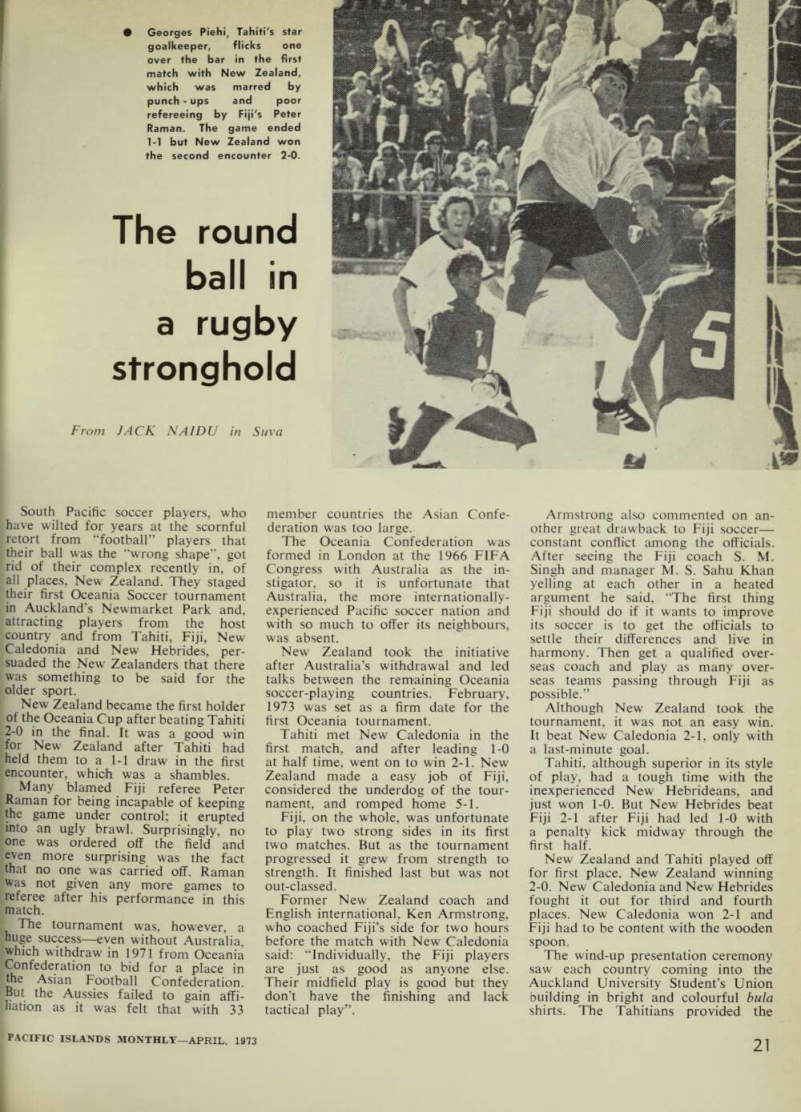
New Zealand became the first holder of the Oceania Cup after beating Tahiti 2-0 in the final. It was a good win for New Zealand after Tahiti had held them to a 1-1 draw in the first encounter, which was a shambles.
Many blamed Fiji referee Peter Raman for being incapable of keeping the game under control; it erupted into an ugly brawl. Surprisingly, no one was ordered off the field and even more surprising was the fact that no one was carried off. Raman was not given any more games to referee after his performance in this m^5 h - The tournament was, however, a . suc . cess —even without Australia, which withdraw in 1971 from Oceania Confederation to bid for a place in the Asian Football Confederation.
But the Aussies failed to gain affiliation as it was felt that with 33
member countries the Asian Confederation was too large.
The Oceania Confederation was formed in London at the 1966 FIFA Congress with Australia as the instigator, so it is unfortunate that Australia, the more internationallyexperienced Pacific soccer nation and with so much to offer its neighbours, was absent.
New Zealand took the initiative after Australia’s withdrawal and led talks between the remaining Oceania soccer-playing countries. February, 1973 was set as a firm date for the first Oceania tournament.
Tahiti met New Caledonia in the first match, and after leading 1-0 at half time, went on to win 2-1. New Zealand made a easy job of Fiji, considered the underdog of the tournament, and romped home 5-1.
Fiji, on the whole, was unfortunate to play two strong sides in its first two matches. But as the tournament progressed it grew from strength to strength. It finished last but was not out-classed.
Former New Zealand coach and English international, Ken Armstrong, who coached Fiji’s side for two hours before the match with New Caledonia said; “Individually, the Fiji players are just as good as anyone else.
Their midfield play is good but they don’t have the finishing and lack tactical play”.
Armstrong also commented on an other great drawback to Fiji soccer— constant conflict among the officials, After seeing the Fiji coach S. M.
Singh and manager M. S. Sahu Khan yelling at each other in a heated argument he said, “The first thing Fiji should do if it wants to improve its soccer is to get the officials to settle their differences and live in harmony. Then get a qualified over seas coach and play as many over seas teams passing through Fiji as possible.”
Although New Zealand took the tournament, it was not an easy win.
It beat New Caledonia 2-1, only with a last-minute goal, Tahiti, although superior in its style of play, had a tough time with the inexperienced New Hebrideans, and just won 1-0. But New Hebrides beat Fiji 2-1 after Fiji had led 1-0 with a penalty kick midway through the first half.
New Zealand and Tahiti played off for first place, New Zealand winning 2-0. New Caledonia and New Hebrides fought it out for third and fourth places. New Caledonia won 2-1 and Fiji had to be content with the wooden spoon, The wind-up presentation ceremony saw each country coming into the Auckland University Student’s Union building in bright and colourful bula shirts. The Tahitians provided the
• Georges Piehi, Tahiti's star goalkeeper, flicks one over the bar in the first match with New Zealand, which was marred by punch - ups and poor refereeing by Fiji's Peter Raman. The game ended 1-1 but New Zealand won the second encounter 2-0.
music. Sir William Walkley, donor of the Oceania Cup, was there in person to present the cup and other prizes. He said the tournament had been a great success and compli mented officials on their “sheer guts and determination” in making it so.
And now the tournament has proved itself, it is hoped that Aust ralia, which now has nowhere to play, may be persuaded to rejoin the Oceania Confederation and make the second tournament (in Fiji in 1977) truly representative of Oceania.