Tropicalities
pp. 15-16 · Read in the full issue
Troubled
Troubiands
The four warring Chiefs of Kiriwina, Trobriand Islands, were called into Port Moresby in mid- March to smoke the pipe of peace with Chief Minister Somare; a mobile unit was withdrawn from Kiriwina and the troubles of the islands were officially pronounced over. But are they?
In February-March Kiriwina looked like following the New Guinea Highlands, the Gazelle and Bougain ville into the business of ruining the idea of a united Papua New Guinea sweeping on into placid independence.
Trouble had been brewing for some time but reached a climax in early March when dissident Trobriands leader, John Kasaipwalova, usually described as a university student and sometimes as a poet was arrested and charged with “unlawfully laying hands on a police officer.”
Supporters are said to have stormed the sub-district office and had to be beaten off by police using tear gas.
Headlines appeared in newspapers as far away as Dunedin, New Zealand.
The Trobriands are unusual in Melanesian Papua New Guinea in that they have a system of hereditary chiefs. In the manner of chiefs every where, those in the Trobriands were fairly conservative and affairs generally went along in their old accustomed way until about two years ago.
That was when young Mr Kasaip walova, himself a Trobriand Islander, decided to put a few modern ideas into practice around Kiriwina. His first project was trade stores, which were set up in villages, sometimes in competition to established private enterprise trade stores, and staffed by school drop-outs.
The project seemed reasonably successful and towards the end of 1972 ideas turned towards politics.
It was Mr Kasaipwalova’s contention that the government-sponsored local government council was “irrelevant” in the Kiriwina context and so it was to launch an opposition jKabisawali (New Ways) People’s
Government. To this point most of the chiefs seemed to be with the idea but when Mr Kasaipwalova an nounced that the new “government” would levy taxes, which would be illegal, at least one of the chiefs took fright. Battle lines were then drawn— Chiefs Vanoi and Waibadi on one side and Chief Mwoyoyo and Mali butau remaining with Mr Kasaipwa lova.
It was the four chiefs who went to Port Moresby to confer with Chief Minister Somare. The official press release that was issued subsequently is remarkable in that it is a page and one half of platitudes without once mentioning Mr Kasaipwalova. Chiefs would now return to the island it said, to “bring a message of peace” and that only the “traditional leaders were able to reunite the people of Kiriwina”. Mr Somare, on his part, “gave assurances” while warning that infringements of the law must be dealt with in the normal process.
What now in the Trobriands? Does the Kasaipwalova lion lie down with the Vanoi tiger? Keep watching this column.
One of the interesting side-lights of the whole kerfuffle is the discovery by some journalists that the Trobriands or Kiriwina (it is not
clear which) means “Island of Love”.
We thought that that referred to Robert Langdon’s Tahiti and to old PNG watchers it all has overtones of Malinowski’s once famous “Sexual Life of Savages” which he wrote after a field trip to the Trobriands before World War I.
The “Sexual Life” was required reading once for anthropology students and was regarded as hot stuff by those who attended Sydney University in the thirties. One of the lecturers there long after regularly entertained his students with a parody of a coy and timid girl fronting the librarian and asking for the book.
University students are no longer coy and old Malinowski and his Trobriand savages and their sex practices are pretty tame stuff these days.
There’s money
in these slugs
The Fiji Department of Agriculture is trying to interest local Fijians— or anyone else—in reviving the beche de-mer (or trepang) industry, which flourished in the dominion up until the Pacific War. Since then there has been little interest, initially because
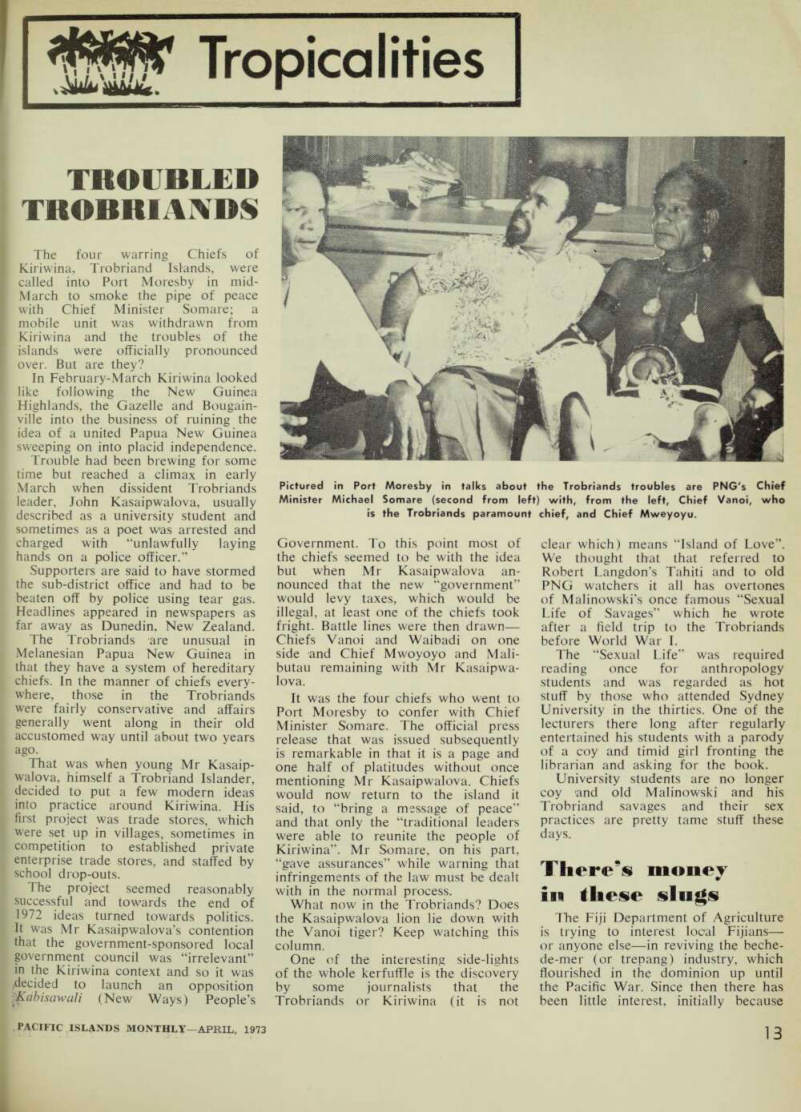
Pictured in Port Moresby in talks about the Trobriands troubles are PNG's Chief Minister Michael Somare (second from left) with, from the left. Chief Vanoi, who is the Trobriands paramount chief, and Chief Mweyoyu.
of low prices and not much demand.
Prices now are good and it is estimated that from 30 to 60 tons of dried beche-de-mer a month could find a market in Hong Kong. A bag of dried beche-de-mer of good quality was fetching $6O in Suva in December.
Preparation of beche-de-mer for export is not the most salubrious of industries but at least it needs little capital.
The department’s fisheries division is eager to give advice on curing to any interested parties. The slugs, which are harvested from coastal lagoons, have to be boiled, then gutted, cleaned and dried. When cured they can be stored for long periods without deterioration and one man can harvest 400-600 lb of the sea creatures in one day’s fishing in a good area. About 15 lb of dried beche-de-mer can be got from 100 lb of the raw slug.
Several firms in Fiji are now in the market and one is producing beche-de-mer granules ready for preparing instant-soup.
Harvesting beche-de-mer should be a useful addition to income in traditional copra producing areas which have suffered from low prices for that commodity. As yet local people have shown little interest in reviving the beche-de-mer industry.
But anyone who would like to know more should contact the local fisheries assistant or Agricultural Dept.
Huskiest husker
is in Tonga
Last year at the Fun in the Sun Carnival at Cairns, Queensland, a world championship coconut husking championship was held. The winner husked one coconut in six seconds and the result, then believed to be a world record, is to be entered in the Guinness Book of Records. Now comes news from Tonga that the real champion lives there. His name is Paula ‘Alo and he husked 54 nuts in five minutes, which works out at 5i seconds per nut.
Paula was discovered by Mr Len Barnes of Plantation Chinta, Brams ton Beach, North Queensland, who is the only commercial coconut grower in Australia. Mr Barnes and his wife were holidaying in Tonga when he became interested in the speed of the coconut buskers at the Tonga Coconut Board processing plant outside Nukualofa. He organised a competition, with startling results, and is thinking of sponsoring a visit of a Tonga champion at the next Fun in the Sun Festival at Oaims.
Lord Howe’s
foreign fish
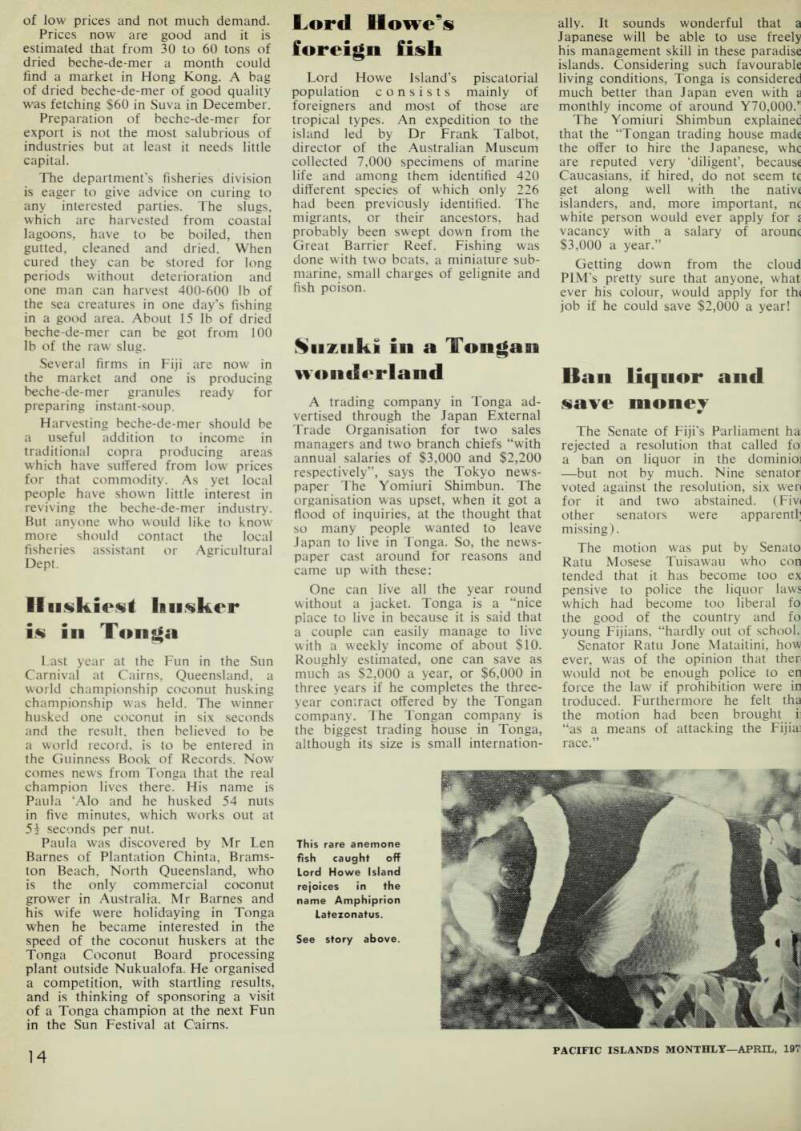
Lord Howe Island’s piscatorial population consists mainly of foreigners and most of those are tropical types. An expedition to the island led by Dr Frank Talbot, director of the Australian Museum collected 7,000 specimens of marine life and among them identified 420 different species of which only 226 had been previously identified. The migrants, or their ancestors, had probably been swept down from the Great Barrier Reef. Fishing was done with two boats, a miniature sub marine, small charges of gelignite and fish poison.
Suzuki in a Tongam
wonderland
A trading company in Tonga ad vertised through the Japan External Trade Organisation for two sales managers and two branch chiefs “with annual salaries of $3,000 and $2,200 respectively”, says the Tokyo news paper The Yomiuri Shimbun. The organisation was upset, when it got a flood of inquiries, at the thought that so many people wanted to leave Japan to live in Tonga. So, the news paper cast around for reasons and came up with these: One can live all the year round without a jacket. Tonga is a “nice place to live in because it is said that a couple can easily manage to live with a weekly income of about $lO.
Roughly estimated, one can save as much as $2,000 a year, or $6,000 in three years if he completes the three year contract offered by the Tongan company. The Tongan company is the biggest trading house in Tonga, although its size is small internation
ally. It sounds wonderful that a Japanese will be able to use freely his management skill in these paradise islands. Considering such favourable living conditions, Tonga is considered much better than Japan even with a monthly income of around Y70,000.’ : The Yomiuri Shimbun explained that the “Tongan trading house made the offer to hire the Japanese, whc are reputed very ‘diligent’, because Caucasians, if hired, do not seem tc get along well with the native islanders, and, more important, nc white person would ever apply for £ vacancy with a salary of arounc $3,000 a year.”
Getting down from the cloud PlM’s pretty sure that anyone, what ever his colour, would apply for the job if he could save $2,000 a year!
Ilan liquor and
save money
The Senate of Fiji’s Parliament ha rejected a resolution that called fo a ban on liquor in the dominioi —but not by much. Nine senator voted against the resolution, six wen for it and two abstained. (Fivi other senators were apparent!; missing).
The motion was put by Senato Ratu Mosese Tuisawau who con tended that it has become too ex pensive to police the liquor laws which had become too liberal fo the good of the country and fo young Fijians, “hardly out of school.
Senator Ratu Jone Mataitini, how ever, was of the opinion that then would not be enough police to en force the law if prohibition were in troduced. Furthermore he felt tha the motion had been brought ii “as a means of attacking the Fijiai race.”
This rare anemone fish caught off Lord Howe Island rejoices in the
name Amphiprion
Latezonatus.
See story above.