Passion
pp. 10-12 · Read in the full issue
A Time Of
From Percy Chatterton
in Port Moresby The March meeting of Papua New Guinea’s House of Assembly has been chiefly remarkable for the com mittees, study groups and ministers.
Some of them were extremely im portant; but the stimulus for im passioned oratory came not from any of them but out of the issue of
independence.
Australia’s Prime Minister Gough Whitlam and Minister for External Territories Bill Morrison have made it clear to us that they will brook no delay in the passage from internal self-government, due at the end of this year, to outright independence.
PNG’s United Party Opposition has reacted by calling for a referendum, Chief Minister Michael Somare, caught in the cross fire, has agreed with the conservatives that we should give .self-government a go befon deciding on a date for independence, but has opposed a referendum, or the grounds that the voters have given the House a mandate to decide the issue.
He admits that a referendun would probably result in a rejectioi of early independence, but argues tha this would be due to ignorance anc fear on the part of the voters. Merni bers of the House, he claims, are ij a better position than are the peopli they represent to understand tb issues and weigh the pros and cons.
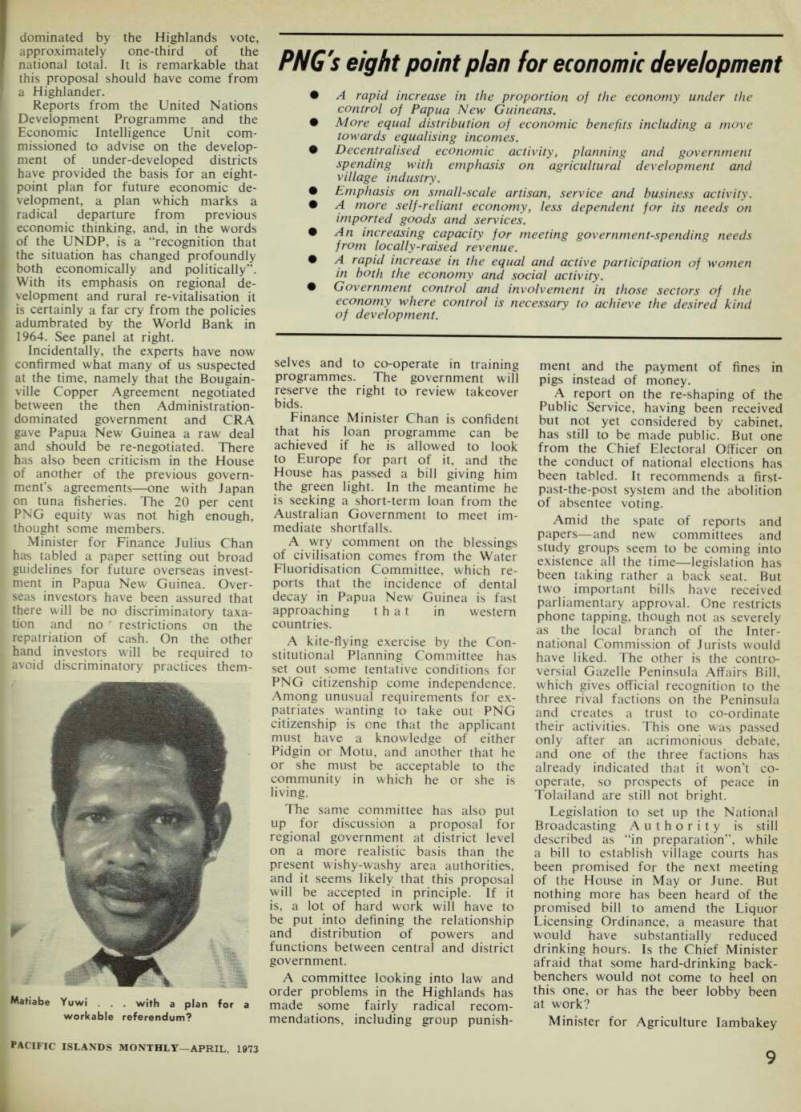
Mr Somare’s view prevailed, but onl after a sensational sitting which a one point had to be suspended b; the Speaker to allow passions to cool So a referendum is off, unless, a course, the House later on change its mind. This seems unlikely t: happen so long as the Nations Coalition is able to hold its majority But in the meantime, a Souther- Highlands member, the ebulliec Matiabe Yuwi, has come up with
idea which might well provide ai
acceptable pattern for any referen dum which might well provide at acceptable pattern for any referen dum which may be held in thi future.
He proposes that the result of referendum should be assessed by simple majority of votes in eao district, and at the national level ti a majority of districts. This pis would remove an objection frequent! advanced against the holding of referendum in Papua New Guine: namely that the result would I
dominated by the Highlands vote, approximately one-third of the national total. It is remarkable that this proposal should have come from a Highlander.
Reports from the United Nations Development Programme and the Economic Intelligence Unit com missioned to advise on the develop ment of under-developed districts have provided the basis for an eight point plan for future economic de velopment, a plan which marks a radical departure from previous economic thinking, and, in the words of the UNDP, is a “recognition that the situation has changed profoundly both economically and politically”.
With its emphasis on regional de velopment and rural re-vitalisation it is certainly a far cry from the policies adumbrated by the World Bank in 1964. See panel at right.
Incidentally, the experts have now confirmed what many of us suspected at the time, namely that the Bougain ville Copper Agreement negotiated between the then Administration dominated government and CRA gave Papua New Guinea a raw deal and should be re-negotiated. There has also been criticism in the House of another of the previous govern ment’s agreements—one with Japan on tuna fisheries. The 20 per cent PNG equity was not high enough, thought some members.
Minister for Finance Julius Chan has tabled a paper setting out broad guidelines for future overseas invest ment in Papua New Guinea. Over seas investors have been assured that there will be no discriminatory taxa tion and no • restrictions on the repatriation of cash. On the other hand investors will be required to avoid discriminatory practices them-
selves and to co-operate in training programmes. The government will reserve the right to review takeover bids.
Finance Minister Chan is confident that his loan programme can be achieved if he is allowed to look to Europe for part of it, and the House has passed a bill giving him the green light. In the meantime he is seeking a short-term loan from the Australian Government to meet im mediate shortfalls.
A wry comment on the blessings of civilisation comes from the Water Fluoridisation Committee, which re ports that the incidence of dental decay in Papua New Guinea is fast approaching that in western countries.
A kite-flying exercise by the Con stitutional Planning Committee has set out some tentative conditions for PNG citizenship come independence.
Among unusual requirements for ex patriates wanting to take out PNG citizenship is one that the applicant must have a knowledge of either Pidgin or Motu, and another that he or she must be acceptable to the community in which he or she is living.
The same committee has also put up for discussion a proposal for regional government at district level on a more realistic basis than the present wishy-washy area authorities, and it seems likely that this proposal will be accepted in principle. If it is, a lot of hard work will have to be put into defining the relationship and distribution of powers and functions between central and district government.
A committee looking into law and order problems in the Highlands has made some fairly radical recom mendations, including group punish
mem and the payment of fines in pigs instead of money.
A report on the re-shaping of the Public Service, having been received but not yet considered by cabinet, has still to be made public. But one from the Chief Electoral Officer on the conduct of national elections has been tabled. It recommends a first past-the-post system and the abolition of absentee voting.
Amid the spate of reports and papers—and new committees and study groups seem to be coming into existence all the time—legislation has been taking rather a back seat. But two important bills have received parliamentary approval. One restricts phone tapping, though not as severely as the local branch of the Inter national Commission of Jurists would have liked. The other is the contro versial Gazelle Peninsula Affairs Bill, which gives official recognition to the three rival factions on the Peninsula and creates a trust to co-ordinate their activities. This one was passed only after an acrimonious debate, and one of the three factions has already indicated that it won’t co operate, so prospects of peace in Tolailand are still not bright.
Legislation to set up the National Broadcasting Authority is still described as “in preparation”, while a bill to establish village courts has been promised for the next meeting of the House in May or June. But nothing more has been heard of the promised bill to amend the Liquor Licensing Ordinance, a measure that would have substantially reduced drinking hours. Is the Chief Minister afraid that some hard-drinking back benchers would not come to heel on this one, or has the beer lobby been at work?
Minister for Agriculture lambakey
Matiabe Yuwi . . . with a plan for a workable referendum?
Okuk has given the news media a drubbing, and has advocated govern ment control of press and radio. But he didn't get away with this un challenged. The opposition replied that a free press is the watchdog of government honesty, while censorship would pave the way for dishonesty, graft and corruption.
On one issue the government suffered defeat. The House carried a motion asking the Department of Education to revert to the former system of selection of pupils for entry to high schools on the basis of examination results alone, in place of the recently-introduced system by which primary school management boards make the selection after con sidering examination results, teachers’ assessments and other relevant factors. This reversal shows that a majority of our parliamentarians have a faith in the magic of examina tion marks not shared by those of us who have had experience in set ting and marking examinations.
Outside the House, consultations have been going on, and are to be continued, between the PNG and Australian governments on the country’s future defence requirements and how they are to be paid for.
What took place during these dis cussions has not been revealed, but in the meantime, also outside the House, Speaker Barry Holloway has had some outspoken things to say about the Pacific Islands Regiment, which he appears to regard as too small to be of any use for national defence but quite big enough to pose a threat to democracy in the new nation.
Also outside the House, but having repercussions within it, the National Coalition Government has established a new department, comprising the Chief Minister’s Office and the Divisions of District Administration and Local Government. Twenty-six year old Boyamo Sali, the govern ment’s youngest minister, exchanges his local government portfolio for one of “Minister of State” in charge of the new department, the formation of which marks a further substantial transfer of powers from Canberra to Port Moresby.
Back inside the House, members have decided that they can do their work just as well in their shirt sleeves, and have made the wearing of jackets optional. But they have made the rather odd proviso that coats must be worn for prayers.
They appear to take the view that God regards with special favour those who appear before him in lounge suits —a very dubious propo sition.