Sailing over
pp. 127-135 · Read in the full issue
Letters
Sailing over a volcano
The news of Miss Isobel Bennett’s retirement from the Department of Zoology at the University of Sydney reminded me of our encounter with a volcano on the first occasion that we met—in the Solomons in 1963.
Since then she has written what must be the most splendidly-illustrated volume ever published on the Barrier Reef, as well as several other out standing illustrated marine biology volumes.
My wife and I had the pleasure of entertaining the faculty members from Stanford University—and Isobel Bennett—when the 135 ft steel hulled research schooner Te Vega visited Honiara on Guadalcanal in September that year. The ship was well equipped with oceanographic paraphernalia and a classroom, among other things. Ten post-graduates were studying while on this world cruise.
After stretching their legs in Hon iara town they returned in late after noon to the ship which stood along side the main wharf surrounded by admiring locals: a tall ship of this size was a rarity.
I was also on board when she
cast off and sailed into the sunset showing brightly above the silhouet ted volcanic mountains of Western Guadalcanal. A talk on the Solomons that night was followed by one on symbiosis next morning as we headed for the submarine volcano, then un named, now known as Kavachi, south of New Georgia Group—long known for the fire on the water, the violent explosions, and for ruby-red incandes cent lava outpourings into a steaming, bubbling ocean. This cone was more than 6,000 ft high, all of it beneath the surface of the sea at this time.
At noon we approached from the east in a rolling blue-grey sea. Three echo sounders were recording simul taneously. At noon the depth had shallowed from 2,100 to 500 meters, the profile getting steeper and steeper.
Ten minutes later observers were call ing loudly the meter depths to a silent company in an atmosphere of increasing tension broken only by “Fifty!” “Thirty ” “Fifteen!”
“Ten!” Not prepared to risk it further, the captain swung hard to starboard to clear the area, although lookouts at the masthead could not discern any change in colour of the sea.
The area was circled slowly dur ing lunch before the captain once again set course for the volcano, this time from the south. The echo sounders gave the same steepening profile to a depth of 20 meters before the ship swung and again circled.
The freshening breeze had revealed a distinctive surface slick—probably due to dissolved ejectamenta—and this re mained stationary marking the exact
O Continued on p. 123.
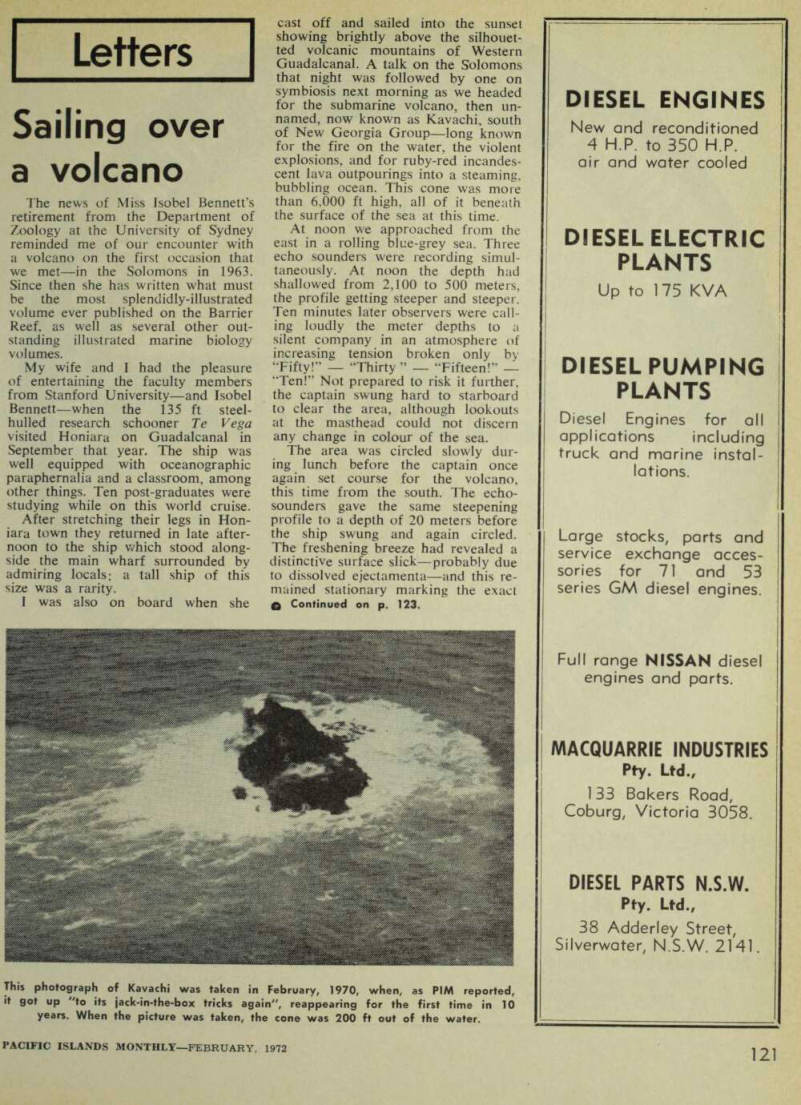
This photograph of Kavachi was taken in February, 1970, when, as RIM reported, it got up "to its jack-in-the-box tricks again", reappearing for the first time in 10 years. When the picture was taken, the cone was 200 ft out of the water.
position of the active volcanic vent just below the surface. No signs of impending outbursts deterred us, and no shallows could be seen from the masthead, so it was decided to sail across it. The ship moved slowly over a crater rim 18 meters below the surface.
Five crossings were made, samples being dredged from inside the crater by heavy trawl net, collecting speci mens of vesicular black basaltic rock, some coated, suggesting the proximity of gaseous emanations. Sands were collected outside the rim by special grab.
In these five traverses across, com pleted without incident, the echo grams showed a large composite vol canic profile with caldera diameter of less than two miles. Isobel Bennett was aft examining the materials as they were brought up, and the ther mometer: the sea temperatures only differed by O.2°C inside the caldera: a large body of water in a strong current was moving westward.
All of us on board, while crossing and recrossing the volcano were able to spare a thought for the less fortun ate Japanese scientists whose ship was caught and raised out of the sea on an emerging molten lava spine some years previously, and destroyed with all on board.
Oceanographic samples were collec ted from stations, profile observations were made, lectures delivered between times by people of acknowledged world class, to an attentive audience.
Next morning early, the Te Vega hove-to several miles off Munda Bar, New Georgia, and I was taken ashore by flat-bottomed fibreglass Boston whaler. The ship then sailed for Bougainville, and her world cruise.
Along with Miss Bennett’s friends in other parts of the world I would like to add my good wishes to her in her active retirement years.
J. C. Grover
Sydney.
Drunks In New Hebrides
Tessa Fowler made a big noise (PIM, April, p. 55) about the drunks of Santo and Vila and blamed the position on the numerous bars. But the joint Administration is well aware of the situation and as it issued two new licences since December, 1970, it seems it has no intention of putting on the brakes.
Regrettable incidents have occurred at closing time in one of these estab lishments. Two natives were hospital
ised, one for a month and the other for a week after being assaulted. But. why doesn’t Tessa Fowler also refer to the big stores and many Chinese shops which have liquor licences?
In the same article, she quotes Dr. Karl Schmidt as recommending the sale of kava in bars as an altern ative to alcohol. She stresses that kava in the New Hebrides is very strong and that a single drink gives a person the feeling of being at peace with the world. I really can’t see bars selling kava as I visualise their clients collapsing behind the counter like a bunch of flies after a fly-tox bomb, and the bar tender finding himself with a pile of custom ers sleeping the sleep of the dead, impossible to chuck out of the place without the help of the police, fire brigade, ambulance, commandos etc. etc.
Miss Presa,
Santo, New Hebrides
Bar owner.
• Kava is non-intoxicating; a mild narcotic. There are many kava saloons in Fiji, the majority of them well conducted.
Advice To Islanders
As an incipient Aussie, may I say that PIM shows great empathy with the feelings and aspirations of the Islands people, be they French, Ameri can or Aussie-controlled.
Having worked in the US Trust Territories and Puerto Rico, may I advise those who wish to cut loose from US protection or Common wealth status, send your observers to Guam and Puerto Rico first and assess their plans for elevating them selves by pulling on their own boot straps. For those in French and Aussie areas I would advise tax in centive laws to accomplish the same magic. The mother countries involved can well absorb any disadvantage in price and tax of products com petitively produced under such laws to energise and improve these shame fully neglected Islands.
One point in particular which comes to mind during this crucial time in history when the great USA must eat crow” in its international in volvements. The US taxpayer has contributed to the hopeful but mis guided democratisation of South Viet nam, pouring in 23 billion dollars a year over the last five years. With the wind-down of the US war effort and repatriation of the troops, there is a bonanza waiting for the Island people in the shape of US war material.
trucks, hospital furniture and the rest.
If previous wars are any guide, you can be sure none of this material will be repatriated to the US before the US bases are abandoned.
Much of it will be sold at bid prices—perhaps $5 million-worth for $50,000. Add another $1 million in shipping costs to the Islands, and the territories of the Pacific Islands will have all the equipment they need for another step forward into the 20th century.
What better way is there than for America to salvage something from a misguided venture?
Best wishes to your magazine. Such publications are of the essence of de mocracy.
Gilbert H. Bishop
(Captain)
MV Redonda, Port Moresby.
Mi. Lamington Pictures
Having lived on the slopes of Papua’s Mt. Lamington for six years, I have a deal of interest in it and in the big 1951 eruption. While look ing through the PIM file in Sydney’s Mitchell Library yesterday I chanced upon a report in the March, 1951, issue, headed “Operation Volcano”, which dealt with a Qantas Dragon aircraft which flew from Lae to Popondetta with First Officers Bid dulph and Barlogie in command.
The report states that they were actually taking photographs of the steam and ash rising from the moun tain when the eruption occurred, and that “. . . pilots and passengers watched while the township of Higa tura was enveloped with volcanic ash and pumice dust.”
The report also mentions Captain Jacobsen in his DC3 at 8,000 ft, above the clouds. Photographs taken by Jacobsen are famous. One ap peared, I think, in the 1950-51 Papua Annual Report, and several are in Taylor’s book on the eruption.
However, I cannot recall ever seeing any of those taken from the Dragon, and surely these, being taken below the cloud layer and being “be fore and during” photos, would have been of more interest. It may be they did not turn out, or, if they did, were confiscated. A friend with DCA at the time said there were restrictions on photography, especially of the casualties.
John R. Horne
Leadville, NSW. • Anybody throw any light on this?
The Old Casino Hotel
Your story (Nov., p. 96) about the decision to remove Apia’s old Casino Hotel needs correction. I am sure that it was built before 1900, and it most certainly was not built as a rest home for the aged. I was ap pointed Receiver in 1915 of the Deutsche Handels und Plantagen Ges. der Sud-See-Inseln zu Hamburg, better known as the DHPG or “Long Handle Firm”, and I lived in the Casino from 1916 until I returned to New Zealand early in 1918 to re enlist.
It was the living quarters of the manager, Mr. Hansen, and family, also for the European staff of the DHPG, They had excellent accommo dation and a plentiful supply of ser vants controlled by a housekeeper, Fraulein Wegener. The hotel was well maintained and looked after by Cap tain Steffany, a naturalised American.
Along with me lived Mr. R. M.
Watson, acting Judge of the Supreme Court, and we had our own staff so did not have to associate with the German “tusi tusis”, though I think Miss Wegener kept an eye on things.
It may interest you to know I was best man at Aggie Grey’s wedding to Gordon Hay-Mackenzie. She was ' Aggie Swann then.
W. M. Matheson
Mira House, Dornie, Kyle, Ross-Shire, Scotland.
The Ninigoes
Tb at . art^c^e b y Sheree Lipton on the Nmigoe islands in New Guinea’s west was interesting. I went there to live in 1925, and standing on the chip's deck I saw, as I thought, palms growing out of the water . . . groups of them dotted about here and there, rim. I thought. Looks very peculiar.
A woman standing in front of me umed to “Richie” Richards, then =°mg to Madang, and asked, “Who s going to these islands?”
Richie, ever polite and with a slight tutter, replied, “G-God knows >-some poor bastard aboard this sh hip!
However, I liked the islands, the >eople there and the coral gardens, md the fast canoes on the big 20 mile agoon. Even the isolation wasn’t too ad.
F. P. Archer
> a haul, New Guinea.