The VC10 is—oh! so comfortable
pp. 104-105 · Read in the full issue
The British-built V C 1 0 has nrnvvrJ itcpli thp most nrmptoveci itself the most popular passenger aircraft in the
world. Its comfort, quietness,
and smoothness have made it a Ti • . , • , ;r talking point among air travellers
everywhere.
Of it, Mrs. Shirley Barker, who recently’ returned to Fiji by VC 10, said: “Someone recently remarked to me that the air-conditioning aboard a VC 10 is noisier than the engines.
While such a fine distinction has escaped me, I must confess it’s the quietest and most soothing aircraft Fve travelled in.
“The VC 10 has style; from the look of it as you cross the tarmac and see that elegantly-soaring tail, to the service you get aboard. Pure imagination, I’m sure, but I always feel that BOAC puts its best cabin crews on the VC 10s.”
The seats, which Shirley also said
she liked so much, were scientifically designed and are undoubtedly the most comfortable aircraft seats in the world. But then they have to be —on a long journey a passenger may sit for seven or eight hours, far longer than normal, even at home.
The legroom offered is much greater, because the base of the seat does not have a bar to get in the way of stretched-out legs. When a lever in the armrest is pressed, the seat sinks back hydraulically to the angle required for complete relaxation.
Built-in tables fold down in two parts from the rear of the seat in front. The first position offers a ledge for drinks, cocktail snacks or magazines. It opens again to twice that size to offer a full table for use as a working desk and for meals.
The air-conditioning is so good that even when the VC 10 is parked at a tropical airport in 120 degrees fahrenheit, the interior remains com-
fortable. Not only that, but the temperature is even—no more cold feet and hot faces or vice versa.
The cabin too, is light and spacious.
The cabin decor of the VClO— work of English designer Robin Dav—solves a problem common to all high-flying jets; the effect of brilliant eight-mile-high sunlight on a colour scheme, While the VClO’s pastel shades are attractive and restful, the blends of colours are chosen so that they will not be “washed out” by the strong light. Colours of seat covers, head rests, seat belts and carpets are chosen to contrast with the softer back
ground colours.
Much research went into the choice of materials too.
Plastic wall linings, for examp e, with the wrong type °i B rain > bold onto stains, while a proper y chosen covering washes easily an
thoroughly.
The enclosed overhead racks are
a feature in BOAC aircraft, and were a “first” in the industry. Now BOAC passengers can safely dispose of the small luggage which is so often cluttered around their feet, saving valuable legroom.
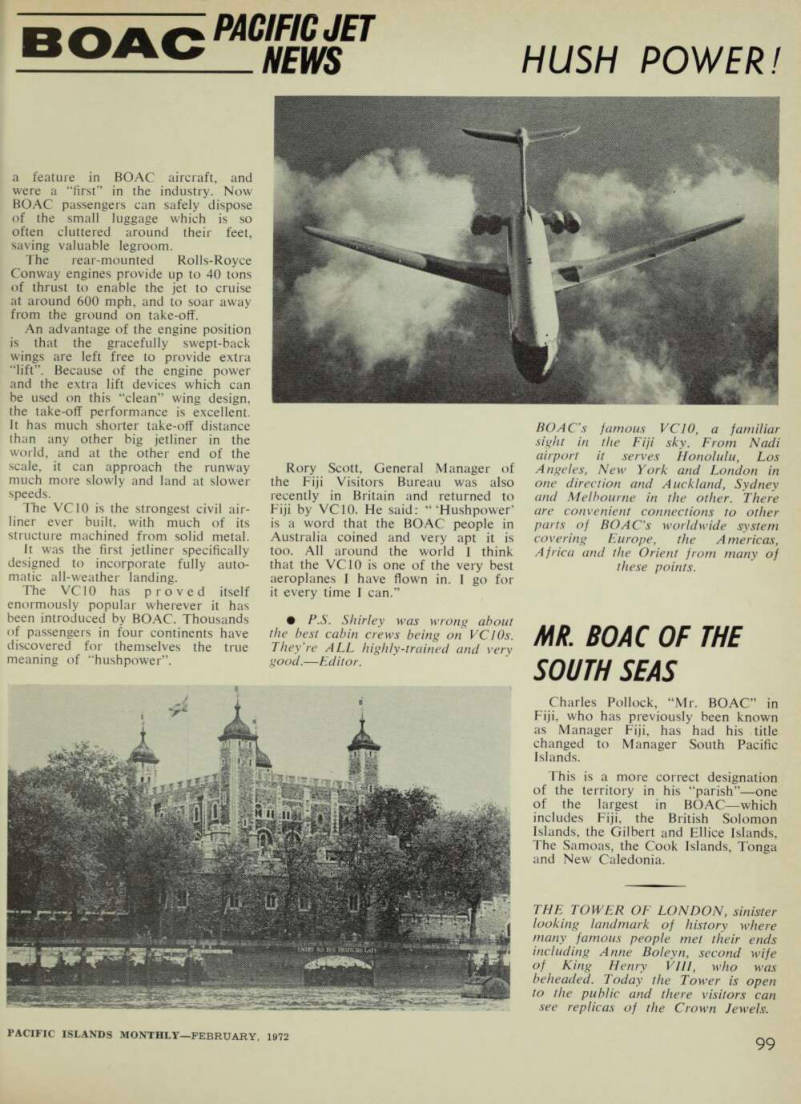
The rear-mounted Rolls-Royce Conway engines provide up to 40 tons of thrust to enable the jet to cruise at around 600 mph, and to soar away from the ground on take-off.
An advantage of the engine position is that the gracefully swept-back wings are left free to provide extra “lift”. Because of the engine power and the extra lift devices which can be used on this “clean” wing design, the take-off performance is excellent.
It has much shorter take-off distance than any other big jetliner in the world, and at the other end of the scale, it can approach the runway much more slowly and land at slower speeds.
The VC 10 is the strongest civil air liner ever built, with much of its structure machined from solid metal.
It was the first jetliner specifically designed to incorporate fully auto matic all-weather landing.
The VC 10 has proved itself enormously popular wherever it has been introduced by BOAC. Thousands of passengers in four continents have discovered for themselves the true meaning of “hushpower”.
THE TOWER OF LONDON , sinister looking landmark of history where many famous people met their ends including Anne Boleyn, second wife of King Henry VIII, who was beheaded. Today the Tower is open to the public and there visitors can see replicas of the Crown Jewels.