Fiji Freight Rates Up, But Png
pp. 97-99 · Read in the full issue
Govt Puts The Brake On
Shipping companies’ New Year “present” to Fiji importers was another hike in freight rates.
The Fiji-Australia Line and Karlan der, on January 15 introduced a new general cargo rate of $A33.70 (up $2.10) from Sydney and Brisbane to Suva and Lautoka. Other rates, ranging from a minimum of $5 to $5O, depending on the type of cargo, were raised by $2 a ton.
The Tonga Shipping Agency was reported to be considering new rates.
Karlander also lifted its Sydney-Mel bourne-Fiji charges to bring them into line with the Nauru Pacific Shipping charges. Nauru Pacific Shipping on November 15 lifted the Melbourne-Fiji rates by 22\ per cent, to about $29.30 a ton and the Sydney-Fiji rate by 15 per cent, to about $33.69.
Rising costs in handling cargo on the Australian and Fiji waterfronts were blamed for the increases. In Fiji, because of congestion in the wharf sheds, discharging of cargo is often interrupted, and this adds to costs. Fiji importers are allowed free storage on the wharf for a certain period after discharge, and they take full advantage of this privilege, even though it causes con gestion and delays ships at the wharf.
Within Fiji, too, freight rates con tinue to rise. The latest rises were imposed by the Maritime Co-op.
Shipping Association Ltd., which operates the Uluilakeba between Suva and the Lau islands. Hie operating company is owned by co-op. societies in Suva and Lau.
The new rates a ton, from Suva, are: To Northern Lau. $18.40 (up $3); to southern Lau, $2O (up $3); to Vatoa and Ono-i-Lau, $2O (up $2). Fares have also been increased, depending on distance, by up to $2.
As a result of a compromise between the PNG Government and the ship ping lines, coastal freight rate in creases announced by Burns Philp (NG) Ltd. and Steamships Trading Co. in November have been whittled down slightly.
When they announced their in
• Continued on p. 94
creases, the government stepped in and warned that unless they could justify increases of up to 34 per cent. the Administrator, Mr. L. W. Johnson, would fix the maximum freight rates for the coastal trade.
After a get-together between the shipping lines and the government, it was announced in January: “On examination of the figures made available to it, the Administration concluded that a general rise—the first since 1961—could not be reasonably denied, but that certain rates considered to be anomalous—those with increases well in excess of the average rise—should be negotiated with the companies.”
Cuts were made in the rises.
Agreed rates with the original rates in brackets, are: • Port Moresby to Samarai/ Alotau, $16.83 ($19); • Port Moresby to Abau, Dedele, Robinson River, Baubaguina, $l5 ($15.50); • Port Moresby to Kikori, Airds Hill, Veiru, $lB ($l9).
There will be no increase on the Port Moresby to Hula, Wainapuna service.
Later, the Administrator told the companies—no doubt as a result of the compromise—that he did not pro pose, in the circumstances to use his powers to fix maximum freight rates for the outport trade, but that the Administration reserved the right to
review the situation in the light of any subsequent developments.
Karlander had also some good news to impart, however. It an nounced on January 17 cuts in the freight rates from Australia to Wewak as a result of a reduction in operational costs with the comple tion of the new wharf at Wewak.
Rates for all outward cargo, ex cluding bagged flour, rice and sugar, will be reduced by $1.50 per manifest ton, and for bagged flour, rice and sugar by $2.50 a ton.
Twenty-One Survive
Foundering Off Papua
Twenty-one people including two women—the entire complement of the vessel—survived when the 200-ton Papua New Guinea coastal vessel Sumiho had to be abandoned in heavy seas about 20 miles off Samarai, Papua, on January 11, They took to a 10-man inflatable raft and were picked up after more than 17 hours by a fishing trawler, the Gloria Maris, about 25 miles off Samarai.
The stricken vessel was owned by Bishop’s Shipping Services Pty.
Ltd., and her master was Brian Thompson, 27, of Newcastle, NSW.
Among those aboard were his wife.
Dale, the engineer, Brian McKinnell, 32, of Brisbane, and 17 New Guineans.
Sumiho was en route from Lae to Port Moresby when she radioed that she had developed a 20 degree list in heavy seas after her cargo shifted.
Cyclone Carlotta was then moving towards the area.
Captain Thompson said that waves began battering the ship and finally rolled her over, throwing everybody into the water. A life-raft had floated free of the ship and all managed to assemble around it and climb aboard.
The Sumiho was last seen drifting, overturned.
A plane sent out by the PNG Civil Defence organisation located the drifting raft, and dropped supplies, and the captain of the Gloria Maris, Jack Burnett, found the survivors “exhausted and thoroughly chilled” after nearly 17 hours in the cyclone.
They had drifted about 40 miles.
Salvage Attempt In
The Carolines
In mid-January, attempts were being made to salvage the Japanese operated, Somalia-registered freighter Solar Trader, 7,145 tons, aground on a reef at the West Fayu atoll, about 400 miles east of Yap, in the Carolines. The atoll is part of the US Trust Territory, and uninhabited.
Solar Trader, owned by the Union
Pacific Shipping Company of Hong Kong, and under charter to Yamashita Shinnohon Kisen of Tokyo, was en route from Nagoya to Sydney when she struck the reef at 3.15 a.m. on December 21.
The TT field vessel Hafa Adai arrived on the scene on December 22, but found the seas too rough to be able to approach the stranded vessel and take the crew off directly.
Instead Captain Hideo Tell took the Hafa Adai through the narrow channel into the atoll lagoon and anchored.
His rescue party then waded across the reef and rigged a bosun’s chair between a rock and the Solar Trader, three quarters of which was grounded.
The entire crew of 33, all Korean, was recovered without injury.
Captain Kaechun Lee, of the Solar Trader, said the ship went aground because of a radar error. She was carrying a valuable cargo of 263 motor vehicles and some general merchandise.
Within a fortnight of the rescue a joint salvage venture for the ship was formed by Transco Shipping Co., of Truk, and Micronesia Interocean Line Inc., which chartered the TT' vessels Pacific and Wandank to assist.
Captain Douglas Echols, chairman of MILI’s new management com mittee, said if the hull proved in salvageable, steps would be taken to remove the vessel’s fuel oil and all accessible cargo. If she could be salvaged she would be brought to port and turned over to her owners.
The People Who
Control Mili
PIM in January received the fol lowing letter about the reconstruction of MILI: Sir, —As a Class B (non-Micro nesian), non-Marine Chartering Co., Inc. shareholder in Micronesia Inter ocean Line, Inc. (MILI), I am privy to the actualities of the recent re organisation and, thus, would like to enlarge upon the “facts” as con tained on p. 103, PIM, January, regarding the resignation of president/ general manager Gilbert Hofling.
To summarise my point at the out set, “local Micronesian control” of MILI is far from complete; to the contrary, executive functions have been assumed largely by US/TT gov ernment employees, viz. a viz.: The management committee (who, Mr. Hofling asserted, had usurped areas of decision beyond the authority originally granted them by the board of directors) is now chaired by Mr.
Douglas Echols, replacing Mr. Pedro Tenorio of Saipan who resigned in protest. Mr. Echols (from San Francisco Waterfront Clerks Local 34) has served as a SIOO a day
consultant to the TT Government of Transportation since Of the remaining five members of the management committee, two more are foreigners: Messrs. Wayne Thiessen, Director of Transportation (from Hawaii) and Richard Miyamoto, Attorney General (also from Hawaii). The remaining three are Micronesians: Mr. Elias Okamura, Acting Chief of Transportation and Communication for the TT government, and two members of the MILI board of directors, not connected with the government, namely, Messrs. Benjamin Okurum of Koror, and Bernard Helgenberger of Ponape both of whom seldom find themselves in Saipan Mr. Masatoki 'Stephen (elected to replace Hofling as MILI president) operates from his residence in Truk, E. Caroline Islands; while Mr. C. L.
Dodd (a retired United States Line employee) replaced Hofling as general manager in Saipan.
The “old” MILI board of directors consisted of seven Micronesian and five US businessmen, all shareholders on a 50 per cent. Micronesian/50 per cent, foreign capital basis. The present board consists of seven Micronesian shareholders and five Trust Territory, non-shareholding, government employees, also Microne ?i an - • PS.: The management committee also dispensed with the Annual Review Board, set up to guard the interests of the Micronesian consumer.
Holger Peters.
San Anselmo, California.
Png Tuna Future
T 0 Be Negotiated
£ Thr , ee . commercial fishing surveys £ or s^ * una J. n . tbe Bismarck a area of , N e w Guinea have now n ■ . com pl etec h ar *d the PNG Administration expects to negotiate ,n March ™ th th e companies con cerned over future operations in PNG
waters -
A group of senior Australian and Papua New Guinea government officers was in Japan in late January to discuss the whole question of PNG fisheries development. . , Meanwhile the Administration has ?^ n , de ;, cha I rt ,5 r the S , ta L' K ,‘ St J°^ ds (PNG) Pty. Ltd. vessel Redonda for a ,u ? a survey in the Solomon and £? ral seas ; c She IS . operating from lota “ and . Samaral - an , d expects to l^ e job by April 1.
PNG Minister for Agriculture, Stock and Fisheries, Tei Abal, says particular attention is being paid to the feasibility of introducing purse seine techniques to the PNG tuna industry, and the Redonda survey may be followed by commercial fishing in the area with a commercial purse seine vessel. • Vila’s new wharf, to provide 700 ft of berthing space in 35 ft of water, and modern cargo handling facilities with 350,000 cubic ft of storage space, is due to be completed in M ay. The opening of the wharf sho uld coincide with the delivery of a tug being built in Australia for work in Vila harbour.
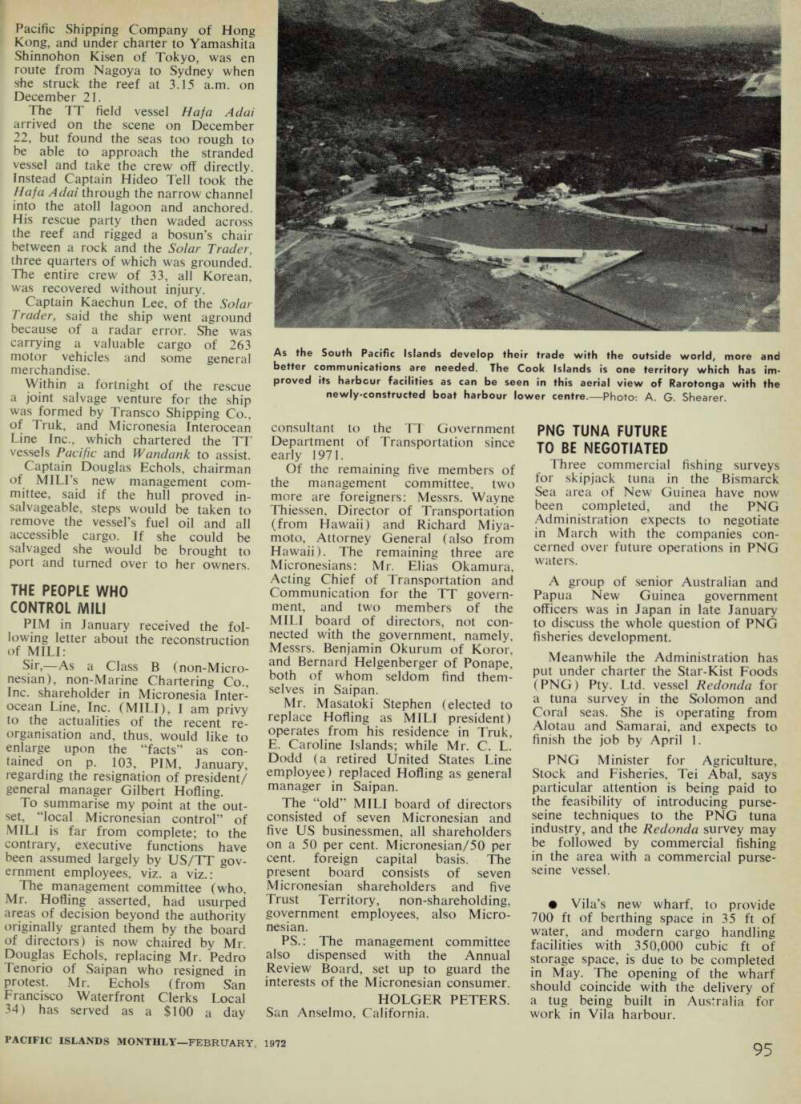
As the South Pacific Islands develop their trade with the outside world, more and better communications are needed. The Cook Islands is one territory which has im proved its harbour facilities as can be seen in this aerial view of Rarotonga with the newly-constructed boat harbour lower centre.—Photo: A. G. Shearer.