Pacific Shipping
pp. 93-97 · Read in the full issue
Storm over Palau police 'naval' action
The Greek freighter Pacific Paul, under charter to Micronesian Inter ocean Line Inc., in January was the storm centre of serious charge and counter charge at Palau, in the Caro lines.
The trouble started on December 28 when a party of about a dozen Palau police boarded the vessel while she was unloaded at the Koror dock and, after a search, arrested three crew members, all Greeks, and charged them with theft of cargo on the high seas. A fourth man was ar rested and charged with having at tempted to sell stolen goods to Palau citizens.
District Attorney James White said a good deal of contraband was found in the search, and that the police had a search warrant.
Meanwhile, with the men in cust ody, the Pacific Paul remained in the harbour, and the captain, in a written statement, protested that his ship was illegally searched, that he and his en tire crew had been held “at gun point” for several hours, that he was prevented from seeking counsel, that the MILI agent in Palau had done nothing to help him but had support ed the search and that the ship’s logs were stolen.
Public Defender Arthur Rothen berg, of Yap, who went to Palau to represent the charged men, alleged that the situation was an “outrage”, that the search had been illegal and the captain had been intimidated; that the ship was being held in Palau because the radio operator was being held in protective custody by the police as a material witness.
Rothenberg also claimed that the local police and MILI had staged the raid because they had believed for some time that crew members were stealing cargo.
The District Attorney replied that the police had been armed but he was not aware guns had been pointed “in any specific direction”. The ship’s
logs had been taken for examination and later returned.
He said the ship was remaining in Palau “pending a request for permission to clear port by the master”, and added that he would be glad to see the case publicised “as a warning to other ship operators that the Trust Territory intends to fully enforce its laws regarding cargo theft”.
The next development was a further search of the ship by police, when a further five crewmen and the captain, Vassilios Gianoutsos, were charged with stealing cargo. Three of these were kept in custody, unable to p ost bail A court hearing began on January 12 in Palau, on a motion by Rothenberg asking the court to suppress evidence obtained by police in the original raid on the ground that the raid was illegal. Captain Gianoutsos told the court that the crew were kept at gunpoint for five hours while the ship was being searched. He said he had been emotionally upset by the attitude of the police.
The next day, in court Mike Maione, of Saipan, who is Micronesia correspondent for Guam’s Pacific Daily News, was served with a subpoena to supply to the court any written statement made by the captain to him as a result of an interview Malone had had with him (and which
had resulted in a story in his news paper).
Malone in court declined to say where the statements and notes were and said he would decline to produce them if requested by the court. He believed that a reporter’s notes were privileged information.
Judge Arvin H. Brown warned Malone that he could be dealt with for contempt of court and stood him down, ordering him to remain in Palau for the next few days, • The case was proceeding at the time of going to Press, uss roros MAY rnM r Tn K , AMnc
T 0 Islands
Pacific Islands ports may be ser viced by Union Steam Ship Co. roll on, roll-off ships (roros) if required, The new owners of the company, Tasman Union Ltd., plan to consult governments in the Pacific on this point.
The chairman of Tasman Union, Sir Peter Abeles, said in Wellington early in January that the USS Co. operations might be extended to French possessions.
The company will study new routes and the need for more ships to operate them. If there is an im mediate need for more ships they will be chartered or ordered.
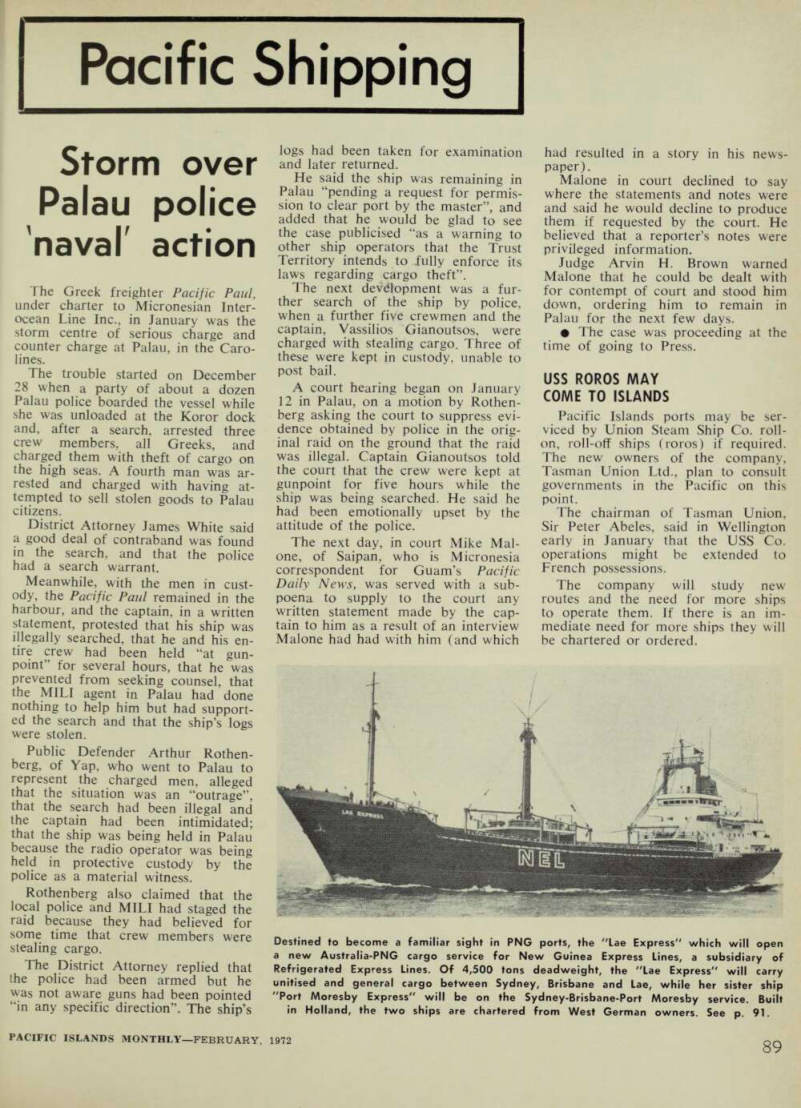
Destined to become a familiar sight in PNG ports, the "Lae Express" which will open a new Australia-PNG cargo service for New Guinea Express Lines, a subsidiary of Refrigerated Express Lines. Of 4,500 tons deadweight, the "Lae Express" will carry unitised and general cargo between Sydney, Brisbane and Lae, while her sister ship "Port Moresby Express" will be on the Sydney-Brisbane-Port Moresby service. Built in Holland, the two ships are chartered from West German owners. See p. 91.
Rel Has No Fear
Of Profit Carve-Up
Refrigerated Express Lines has little fear that, in a free-for-all carve up of profits from cargo carrying be tween Australia and PNG, its new subsidiary, New Guinea Express Line, will go short.
PIM reported in January that ship ping circles had doubts about the ad vent of a new service at a time when cargoes were scarce, but REL had no doubts at all, especially with new ships admirably suited for the ser vice, with fast cargo-handling equip ment and capable of a speedy turn round.
“REL has operated successfully be tween Australia and the East and West coasts of America with a simi lar service for the last four years,” said its spokesman.
“The company is going into this trade because we feel we can give better service than before. We have something not before used on this run—brand new ships ideally suited for a unitised service.”
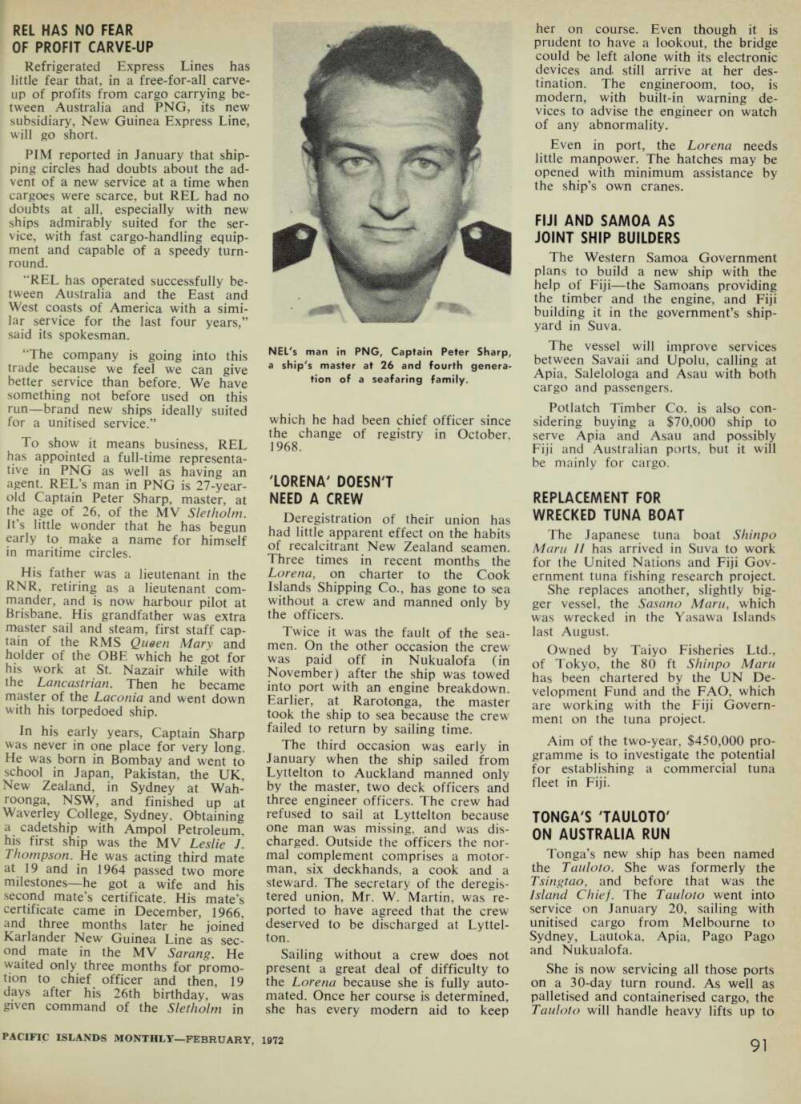
To show it means business, REL has appointed a full-time representa tive in PNG as well as having an agent. REL’s man in PNG is 27-year old Captain Peter Sharp, master, at the age of 26, of the MV Sletholm.
It’s little wonder that he has begun early to make a name for himself in maritime circles.
His father was a lieutenant in the RNR, retiring as a lieutenant com mander, and is now harbour pilot at Brisbane. His grandfather was extra master sail and steam, first staff cap tain of the RMS Queen Mary and holder of the OBE which he got for his work at St. Nazair while with the Lancastrian. Then he became master of the Laconia and went down with his torpedoed ship.
In his early years, Captain Sharp was never in one place for very long.
He was born in Bombay and went to school in Japan, Pakistan, the UK, New Zealand, in Sydney at Wah roonga, NSW, and finished up at Waverley College, Sydney. Obtaining a cadetship with Ampol Petroleum, his first ship was the MV Leslie J.
Thompson. He was acting third mate at 19 and in 1964 passed two more milestones—he got a wife and his second mate’s certificate. His mate’s certificate came in December, 1966, and three months later he joined Karlander New Guinea Line as sec ond mate in the MV Sarang. He waited only three months for promo tion to chief officer and then, 19 days after his 26th birthday, was given command of the Sletholm in
which he had been chief officer since the change of registry in October. 1968.
'Lorena' Doesn't
Need A Crew
Deregistration of their union has had little apparent effect on the habits of recalcitrant New Zealand seamen.
Three times in recent months the Lorena, on charter to the Cook Islands Shipping Co., has gone to sea without a crew and manned only by the officers.
Twice it was the fault of the sea men. On the other occasion the crew was paid off in Nukualofa (in November) after the ship was towed into port with an engine breakdown.
Earlier, at Rarotonga, the master took the ship to sea because the crew failed to return by sailing time.
The third occasion was early in January when the ship sailed from Lyttelton to Auckland manned only by the master, two deck officers and three engineer officers. The crew had refused to sail at Lyttelton because one man was missing, and was dis charged. Outside the officers the nor mal complement comprises a motor man, six deckhands, a cook and a steward. The secretary of the deregis tered union, Mr. W. Martin, was re ported to have agreed that the crew deserved to be discharged at Lyttel ton.
Sailing without a crew does not present a great deal of difficulty to the Lorena because she is fully auto mated. Once her course is determined, she has every modern aid to keep
her on course. Even though it is prudent to have a lookout, the bridge could be left alone with its electronic devices and still arrive at her des tination. The engineroom, too, is modern, with built-in warning de vices to advise the engineer on watch of any abnormality.
Even in port, the Lorena needs little manpower. The hatches may be opened with minimum assistance by the ship’s own cranes.
Fiji And Samoa As
Joint Ship Builders
The Western Samoa Government plans to build a new ship with the help of Fiji—the Samoans providing the timber and the engine, and Fiji building it in the government’s ship yard in Suva.
The vessel will improve services between Savaii and Upolu, calling at Apia, Salelologa and Asau with both cargo and passengers.
Potlatch Timber Co. is also con sidering buying a $70,000 ship to serve Apia and Asau and possibly Fiji and Australian ports, but it will be mainly for cargo.
Replacement For
Wrecked Tuna Boat
The Japanese tuna boat Shinpo Maru // has arrived in Suva to work for the United Nations and Fiji Gov ernment tuna fishing research project.
She replaces another, slightly big ger vessel, the Sasano Maru, which was wrecked in the Yasawa Islands last August.
Owned by Taiyo Fisheries Ltd., of Tokyo, the 80 ft Shinpo Maru has been chartered by the UN De velopment Fund and the FAO, which are working with the Fiji Govern ment on the tuna project.
Aim of the two-year, $450,000 pro gramme is to investigate the potential for establishing a commercial tuna fleet in Fiji.
Tonga's 'Tauloto'
On Australia Run
Tonga’s new ship has been named the Tauloto. She was formerly the Tsingtao, and before that was the Island Chief. The Tauloto went into service on January 20, sailing with unitised cargo from Melbourne to Sydney, Lautoka. Apia, Pago Pago and Nukualofa.
She is now servicing all those ports on a 30-day turn round. As well as palletised and containerised cargo, the Tauloto will handle heavy lifts up to
NEL's man in PNG, Captain Peter Sharp, a ship's master at 26 and fourth genera tion of a seafaring family.
20 tons. Rough or awkward cargo will be pre-slung and stowed in No. 1 hold. The Tauloto also has 100 tons of refrigerated space.
The Tauloto was built in 1954, and has a service speed of 16 knots.
She was converted to a unit type vessel in 1968, when she was trading on the Australia-New Guinea service as the Island Chief.
Facilities in the Tauloto include two sideport loading platforms, which combine with deck openings to enable a forklift truck operating on the wharf to deliver or accept cargo in dependently of tide movements.
“With reduced manual handling there will also be less risk of loss, damage and pilferage,” the agents, Burns Philp and Co., point out.
"Enna G" Trouble
Nauru Pacific Shipping’s Enna G, 10,000 tons, struck two kinds of trouble in Suva in January. She underwent engine repairs, and then put to sea en route for Australia, but broke down and began drifting 20 miles out of Suva. She was towed back to port to have a main engine turbo charger replaced.
She was scheduled to leave Suva again on January 26—but without seven Fijian seamen who were dis missed after disobeying orders not to go ashore in Suva. The Fiji Seamen’s Union intervened unsuccess fully.