Islands Brothers-In-Law Now
pp. 32-119 · Read in the full issue

The first South Pacific judicial con ference was held in January in Apia and Pago Pago, attended by judges and law officials from the Islands, Australia and New Zealand.
Total number of delegates, official and unofficial, was approximately 130. A more accurate count is impossible, as there were late and unannounced arrivals and early departures.
In a pre-conference session the delegates voted, 22-21, to exclude the Press from all conference ses sions. This movement was led by Sir
Richard Wild, Chief Justice of the Supreme Court of New Zealand, with the endorsement of Barrie C. Spring, Chief Justice of the Supreme Court of Western Samoa.
As it developed, the Press ban was mostly pro forma. But it was the sentiment of the magistrates and judges present that they could not speak freely in the presence of the Press. One can interpret the move as the difference in the attitude toward the Press that one finds in British territories and in the United States.
Delegates from the US and from US
possessions inclined toward admitting the Press to all sessions, while those from Australia and New Zealand, and from Island states tied in some way to those countries, favoured keeping the Press out.
One of the more interesting dis cussions in the plenary session was on the subject of a regional court of appeal. This was an open discussion chaired by Sir Garfield Barwick, Chief Justice of the High Court of Australia. This idea—a regional court of appeal serving all the islands of the South Pacific—has been knocking around for at least a decade.
As Justice Marsack noted during the discussion, a quasi regional court of appeal has been sitting for some time in Suva, Fiji, where it hears appeals not only from the Supreme Court of that country but from the Solomon Islands and the Gilbert and Ellice Islands as well.
Since Western Samoa gained independence in 1962, it has thrice lodged appeals to that appellate court in Fiji, all in the year 1964. But, as Barrie Spring pointed out, the costs were prohibitively expensive, not just to Western Samoa but to the ap pellant, since it was felt necessary to send three judges from New Zealand to sit on Fiji’s regional appellate bench.
In summing up the discussion on this issue, Sir Garfield Barwick made reference to these points: e It was the consensus of the countries represented at the con
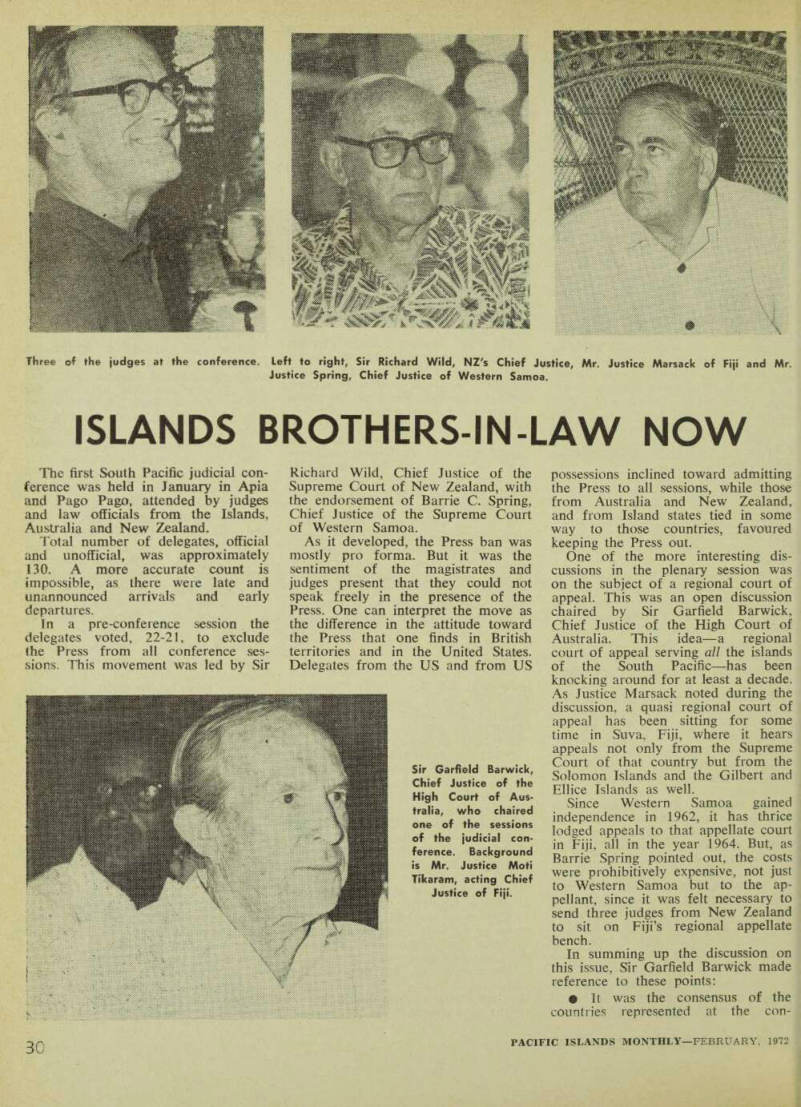
Three of the judges at the conference.
Left to right, Sir Richard Wild, NZ's Chief Justice, Justice Spring, Chief Justice of Western Samoa.
Mr. Justice Marsack of Fiji and Mr.
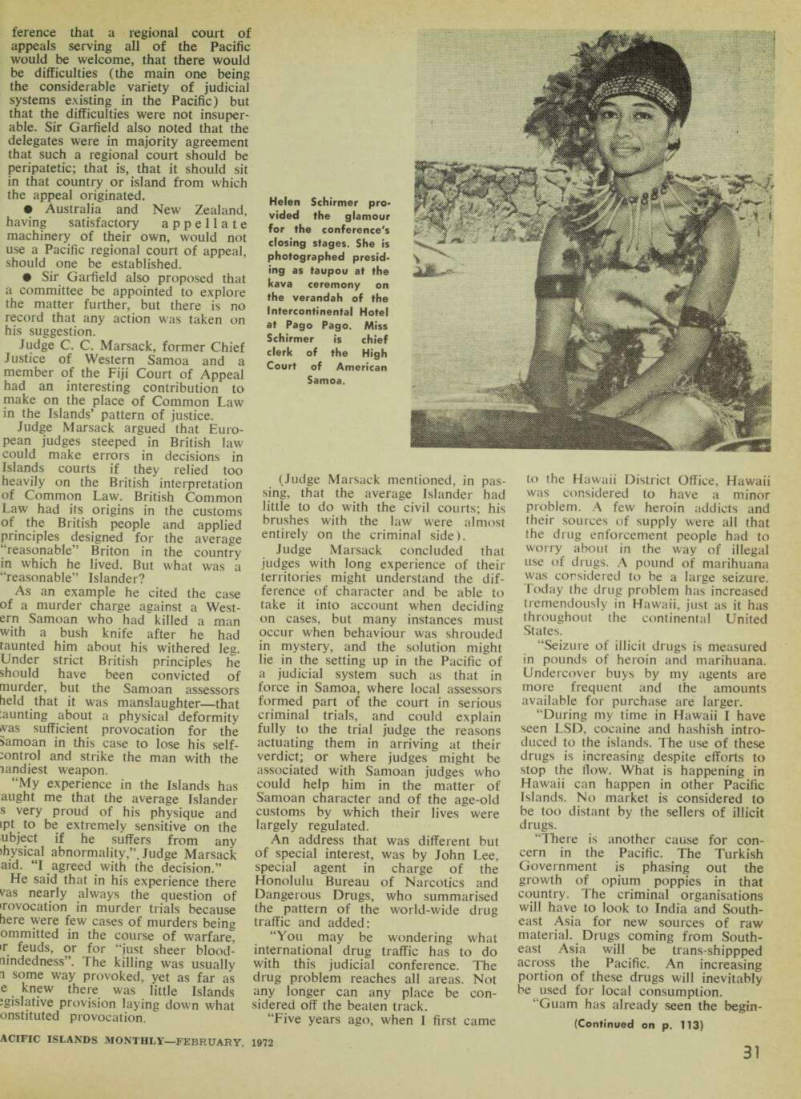
Sir Garfield Barwick, Chief Justice of the High Court of Aus tralia, who chaired one of the sessions of the judicial con ference. Background is Mr. Justice Moti Tikaram, acting Chief Justice of Fiji.
ference that a regional court of appeals serving all of the Pacific would be welcome, that there would be difficulties (the main one being the considerable variety of judicial systems existing in the Pacific) but that the difficulties were not insuper able. Sir Garfield also noted that the delegates were in majority agreement that such a regional court should be peripatetic; that is, that it should sit in that country or island from which the appeal originated. • Australia and New Zealand, having satisfactory appellate machinery of their own, would not use a Pacific regional court of appeal, should one be established. • Sir Garfield also proposed that a committee be appointed to explore the matter further, but there is no record that any action was taken on his suggestion.
Judge C. C, Marsack, former Chief Justice of Western Samoa and a member of the Fiji Court of Appeal had an interesting contribution to make on the place of Common Law in the Islands’ pattern of justice.
Judge Marsack argued that Euro pean judges steeped in British law could make errors in decisions in Islands courts if they relied too heavily on the British interpretation of Common Law. British Common Law had its origins in the customs of the British people and applied principles designed for the average “reasonable” Briton in the country in which he lived. But what was a “reasonable” Islander?
As an example he cited the case of a murder charge against a West ern Samoan who had killed a man with a bush knife after he had taunted him about his withered leg.
Under strict British principles he should have been convicted of murder, but the Samoan assessors held that it was manslaughter—that ;aunting about a physical deformity vas sufficient provocation for the Samoan in this case to lose his self :ontrol and strike the man with the
landiest weapon.
“My experience in the Islands has aught me that the average Islander s very proud of his physique and ipt to be extremely sensitive on the übject if he suffers from any
ihysical abnormality,” Judge Marsack
aid. “I agreed with the decision.”
He said that in his experience there vas nearly always the question of 'revocation in murder trials because here were few cases of murders being ommitted in the course of warfare, t feuds, or for “just sheer blood nindedness”. The killing was usually i some way provoked, yet as far as e knew there was little Islands jgislative provision laying down what onstituted provocation.
(Judge Marsack mentioned, in pas sing, that the average Islander had little to do with the civil courts; his brushes with the law were almost entirely on the criminal side).
Judge Marsack concluded that judges with long experience of their territories might understand the dif ference of character and be able to take it into account when deciding on cases, but many instances must occur when behaviour was shrouded in mystery, and the solution might lie in the setting up in the Pacific of a judicial system such as that in force in Samoa, where local assessors formed part of the court in serious criminal trials, and could explain fully to the trial judge the reasons actuating them in arriving at their verdict; or where judges might be associated with Samoan judges who could help him in the matter of Samoan character and of the age-old customs by which their lives were
largely regulated.
An address that was different but of special interest, was by John Lee, special agent in charge of the Honolulu Bureau of Narcotics and Dangerous Drugs, who summarised the pattern of the world-wide drug traffic and added; “You may be wondering what international drug traffic has to do with this judicial conference. The drug problem reaches all areas. Not any longer can any place be con sidered off the beaten track.
“Five years ago, when I first came
to the Hawaii District Office, Hawaii was considered to have a minor problem. A few heroin addicts and their sources of supply were all that the drug enforcement people had to worry about in the way of illegal use of drugs. A pound of marihuana was considered to be a large seizure.
Today the drug problem has increased tremendously in Hawaii, just as it has throughout the continental United States.
“Seizure of illicit drugs is measured in pounds of heroin and marihuana.
Undercover buys by my agents are more frequent and the amounts available for purchase are larger.
“During my time in Hawaii I have seen LSD, cocaine and hashish intro duced to the islands. The use of these drugs is increasing despite efforts to stop the flow. What is happening in Hawaii can happen in other Pacific Islands. No market is considered to be too distant by the sellers of illicit drugs.
“There is another cause for con cern in the Pacific. The Turkish Government is phasing out the growth of opium poppies in that country. The criminal organisations will have to look to India and South east Asia for new sources of raw material. Drugs coming from South east Asia will be trans-shippped across the Pacific. An increasing portion of these drugs will inevitably be used for local consumption.
“Guam has already seen the begin
(Continued on p. 113)
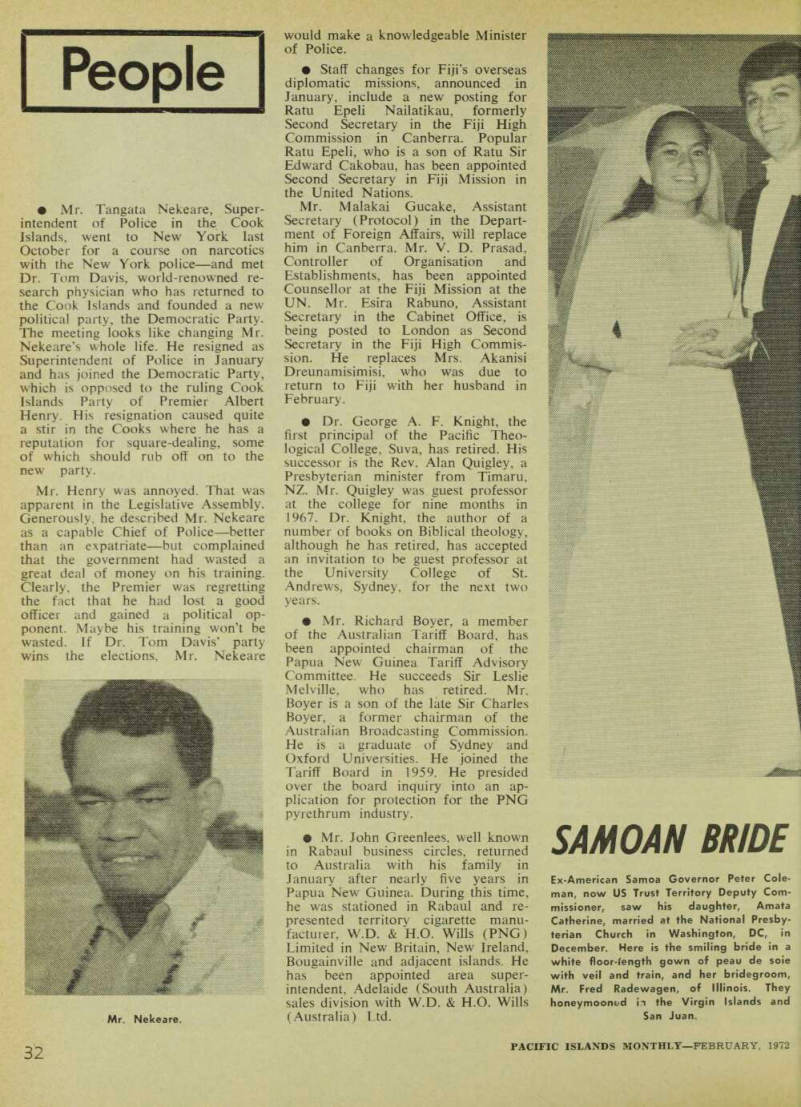
Helen Schirmer pro vided the glamour for the conference's closing stages. She is photographed presid ing as taupou at the kava ceremony on the verandah of the Intercontinental Hotel at Pago Pago. Miss Schirmer is chief clerk of the High Court of American Samoa.
ning of this. In one case last year officials in Guam seized 20 lb of opium and three lb of morphine.
Another case resulted in the seizure of 80 lb of marihuana. All of these drugs were destined for local con sumption.
“Although drug abuse is often con sidered a local problem, its scope is international and the eventual con trol of the drug problem will require international co-operation.”
At the conference’s final business session, in the Pago Pago Inter- Continental Hotel in American Samoa, delegates took up the matter of making the South Pacific Judicial Conference a regular affair. With a single (and unidentifiable) dissenting vote, the delegates voted to do so.
In other voice votes, Barrie Spring was appointed to be the conference’s continuing chairman (Chief Justice Donald H. Crothers, of the High Court of American Samoa, who with Spring was responsible for conceiving and organising this first conference is returning to the United States in February); and it was agreed un animously that the conference should meet again within three years.
At the kava ceremony that closed the conference, the taupou was Miss Helen Schirmer, who is also chief clerk of the High Court of American Samoa, and very attractive, too.
This first conference was a con siderable success. It achieved its purpose, which was to assemble Representatives of the three indigenous
south Pacific cultures, Micronesia,
Polynesia, and Melanesia, to discuss Troblems that concern them all.