Change is
pp. 29-30 · Read in the full issue
welcomed by local opinion
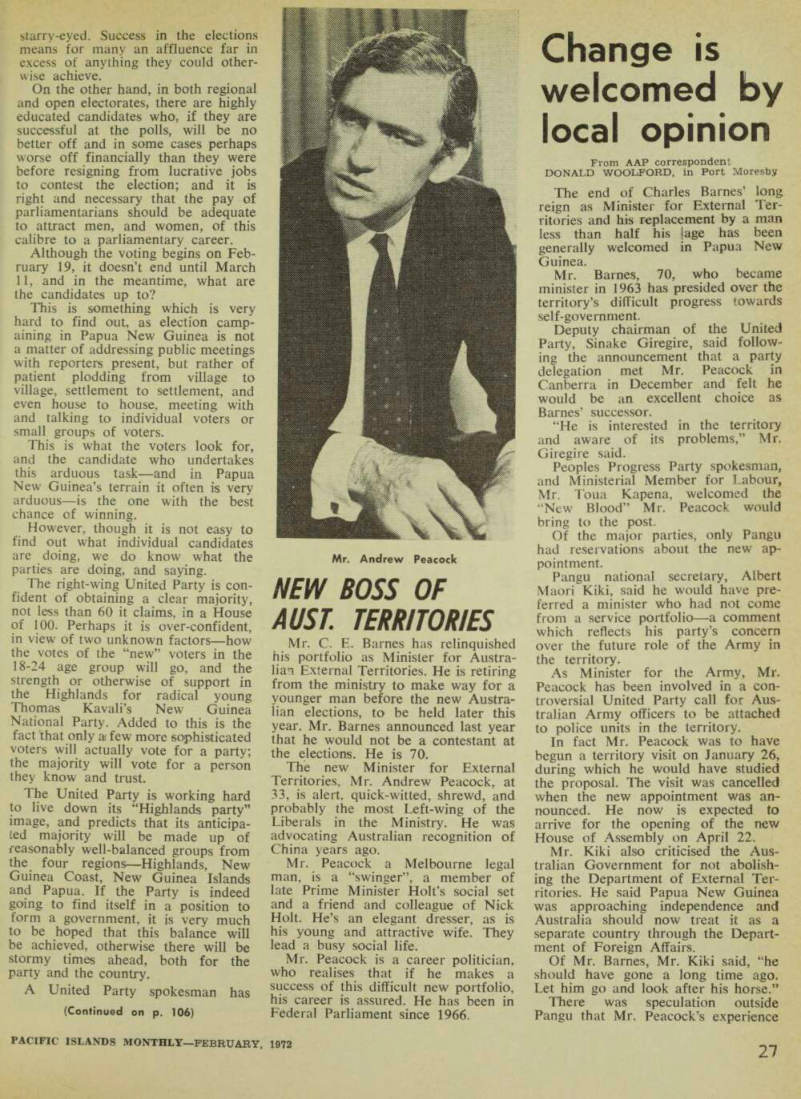
From AAP correspondent DONALD WOOLFORD, in Port Moresby The end of Charles Barnes’ long reign as Minister for External Ter ritories and his replacement by a man less than half his (age has been generally welcomed in Papua New Guinea.
Mr. Barnes, 70, who became minister in 1963 has presided over the territory’s difficult progress towards self-government.
Deputy chairman of the United Party, Sinake Giregire, said follow ing the announcement that a party delegation met Mr. Peacock in Canberra in December and felt he would be an excellent choice as Barnes’ successor.
“He is interested in the territory and aware of its problems,” Mr.
Giregire said.
Peoples Progress Party spokesman, and Ministerial Member for Labour, Mr. T’oua Kapena, welcomed the “New Blood” Mr. Peacock would bring to the post.
Of the major parties, only Pangu had reservations about the new ap pointment.
Pangu national secretary, Albert Maori Kiki, said he would have pre ferred a minister who had not come from a service portfolio—a comment which reflects his party’s concern over the future role of the Army in the territory.
As Minister for the Army, Mr.
Peacock has been involved in a con troversial United Party call for Aus tralian Army officers to be attached to police units in the territory.
In fact Mr. Peacock was to have begun a territory visit on January 26, during which he would have studied the proposal. The visit was cancelled when the new appointment was an nounced. He now is expected to arrive for the opening of the new House of Assembly on April 22.
Mr. Kiki also criticised the Aus tralian Government for not abolish ing the Department of External Ter ritories. He said Papua New Guinea was approaching independence and Australia should now treat it as a separate country through the Depart ment of Foreign Affairs.
Of Mr. Barnes, Mr. Kiki said, “he should have gone a long time ago.
Let him go and look after his horse.”
There was speculation outside Pangu that Mr. Peacock’s experience
in the Army portfolio may have been one of the factors that determined his appointment.
One of the delicate tasks facing the Australian Government is the handover of resnonsibilitv for the armed forces to locaTfu horitv whne safeeuardina as far We The r
Iwafty to tL civ lian govZmen
The y will soon announce major changes in the
here,"which w°f.
Mr. Peacock being a Liberal, while Mr. Barnes was a Country Party member.
Some local politicans, most recently Mr. Paulus Arek (Ijivitari), have accused the Country Party of deliberately retarding sugar and rice industries here so Australian producers would not face extra competition.
As if symbolising this change, Mr.
Bill Yates a New South Wales Country Party organiser who had been seconded to the United Party, flew home permanently yesterday.
Mr. Peacock’s appointment was a so seen m some quarters as completmg the new look of the territory Administration, the basis for which was laid in the middle of 1970, when
Mr. L. W. Johnson became administrator and Mr. D. O, Hay moved to Canberra as permanent departmental head in place of Mr. George Warwick Smith. hlle u commenta ‘o r s were unan,mous that a V oun ß country needed a younse f r {“£ tha P Mr ' Bames 1 ’ some 1°”°“ feU ‘ he Cha " ge may be *°° The Department of External Ter J' . furthermore, some senior public service sources pointed out that Mr.
Peacock, as a y°oog ajid ambitious P°htican who would fully realise the danger of burning his fingers m his new Job ,’ m ,. lgbt therefore be no more P re Pared for innovation that his predecessor.
A promising career could easily be damaged m the maelstrom of confllctm * d ! mand . ( that will be the P ° l,t,CS m the y . .
Mataungan Association leader Oscar Tammur said the Tolai people were disgusted at Mr. Barnes’ resignation.
Mr. Barnes had blundered repeatedly in the territory, in particular in
the Gazelle, and now he had thrown the ball into someone else’s court, Mr. Tammur said.
“Mr. Barnes is pulling out now that he has instituted dozens of policies that don’t take into con sideration the customs of the people of Papua New Guinea,” Mr. Tammur said. “All our troubles have emerged during his term of office.
“He has mucked up our education system, allowed Japanese to fish our waters, ruin our economy and made our country like a police state.
“The least he could have done was stay around until he straightened up his blunders.
“As far as I am concerned, as leader of the Mataungan Association, I say Mr. Barnes is a coward,” he said. He knew little about the new Minister for External Territories, Mr.
Peacock, except that he understood Mr. Peacock was a shrewd and hard man.
Mr. Tammur earlier had com plained to police at Kokopo that he had heard rumours that plantation labourers, two men in particular, intended to kill him. Police in Rabaul later confirmed that Mr. Tammur had made the complaint; however, the Mataungan leader would not com ment on the allegations.