becoming a
pp. 102-104 · Read in the full issue
New Caledonia's becoming a place to fly in
Concentrated exploration of New Caledonia’s mineral re sources, in the ground, is now
being matched by increased
activity in the air, in the sphere of aviation.
Apart from the commercial air lines, at the end of last year no less than 42 aircraft were based in the territory. This included six helicopters.
The aircraft are nearly all operated by mining interests, five craft being attached to large Paris-based com panies.
Independent Caledonian business men own 22 light aircraft, the leading Caledonian mine operator, Mr. Edou ard Pentecost, being proprietor of seven, including his recently acquired second helicopter.
Most popular helicopter is the French Alouette. Among the other light aircraft, most numerous in the local fleet, are the Cessna, Piper, and Morane.
According to civil aviation authori ties, the territory now has 22 airports for public use and seven operated pri vately, mainly for mining activity.
Principal airports are, of course, the international facilities at Tontouta, some 50 miles from Noumea, and the domestic airport at seaside Magenta, in the capital. Other aerodromes are sprinkled along the east and west coasts, as well as on offshore islands.
The growth of such facilities inland has encouraged the formation of local aero clubs throughout the island.
Along both coasts, Caledonians now operate eight aero clubs, with 10 planes between them.
Among the latest new facilities for flying is the helicopter pad reserved in the city centre, behind the Gaston Bourret Hospital, where emergency landings of patients are now possible.
The first company to base a heli copter in New Caledonia was the Societe Le Nickel, which introduced such transport for its mining person nel in 1955. Among the latest to ac quire a helicopter has been the Gen darmerie Nationale service, which in cludes this equipment in its rescue and traffic control operations.
An island approximately 300 miles long and 30 miles wide, with a popu lation of 100,000, New Caledonia is now becoming more accessible for certain inland travel by air, rather than by road.
Expansion for
Condominium airline
The first executive meeting of Air Melanesiae, held in Vila in February, approved a new operating programme for the company, using five Britten- Norman Islander aircraft on 48 ser vices between Vila and Santo each week, 36 of which are direct, and 19 connecting with UTA’s Caravelle ser vice to and from Noumea.
Air Melanesiae now offers over 430 seats between Vila and Santo a week.
Additionally, service frequencies to many island centres have been in creased.
Air Melanesiae since January 1 has been operated as a consortium by the British-controlled New Hebrides Air ways and the French-controlled Societe Francaise Air Hebrides. Rep resenting NHA at the meeting were Mr. Chris Ritchie, of Qantas, in Syd ney, and Mr. John Stegler, managing director of Burns Philp (NH) Ltd.
For SFAH were Mr. Gilbert Massot, vice-president of UTA and general manager for Far East, Pacific Islands and America, and Mr. Guy le Boles, regional representative for UTA in Noumea.
Two of the five Islander aircraft are owned by the Societe Francaise and three by NHA.
Name changes in
Fiji airlines
Fiji’s domestic airline has changed its name officially from Air Pacific to Fiji Air Services.
And the name, Air Pacific, will almost certainly be taken over by Fiji Airways. To confuse matters further, Fiji Airways was to have become Pacific Islands Airways from April 1, in keeping with the airline’s regional services and ownership. It now appears, as Pacific Islands Airways has been registered, the company will
operate under this name from April, but its aircraft will probably continue to fly under the present colours and name of Fiji Airways.
The airline’s board was due to meet in Suva on March 31 to consider the offer of the name Air Pacific. If it is taken up, it will take about six months to become operational.
In the meantime, Fiji Air Services’ colours will change from yellow to pale blue and white. A proposed new share issued by the company had been sanctioned by the Supreme Court, subject to formalities such as a notice in the Fiji Royal Gazette.
A nine-passenger Britten-Norman Islander was due to be delivered to Fiji Air Services in late March, on loan from Islander Aircraft Sales of Australia. It will be used on trial dur ing the next three months on service to Ovalau and along the Coral Coast, where the faster but smaller Baron currently operates daily services.
The coastal services—operating at present on Mondays, Wednesdays and Fridays—began on February 22. They provide a link-up between Nausori Airport, near Suva, Korolevu and Nadi.
American may fly
into Melbourne
American Airlines may start flying direct from the Pacific to Melbourne as a result of apparently unsuccessful talks with Australian civil aviation authorities for more flights into Sydney.
It’s understood that the company’s President, George Spater, has agreed to fly AA twice a week into Mel bourne’s Tullamarine Airport as an alternative to Sydney, bringing the company’s Australian total to five flights a week. But he will continue to press for more flights into Sydney as well.
If agreement is reached, AA will
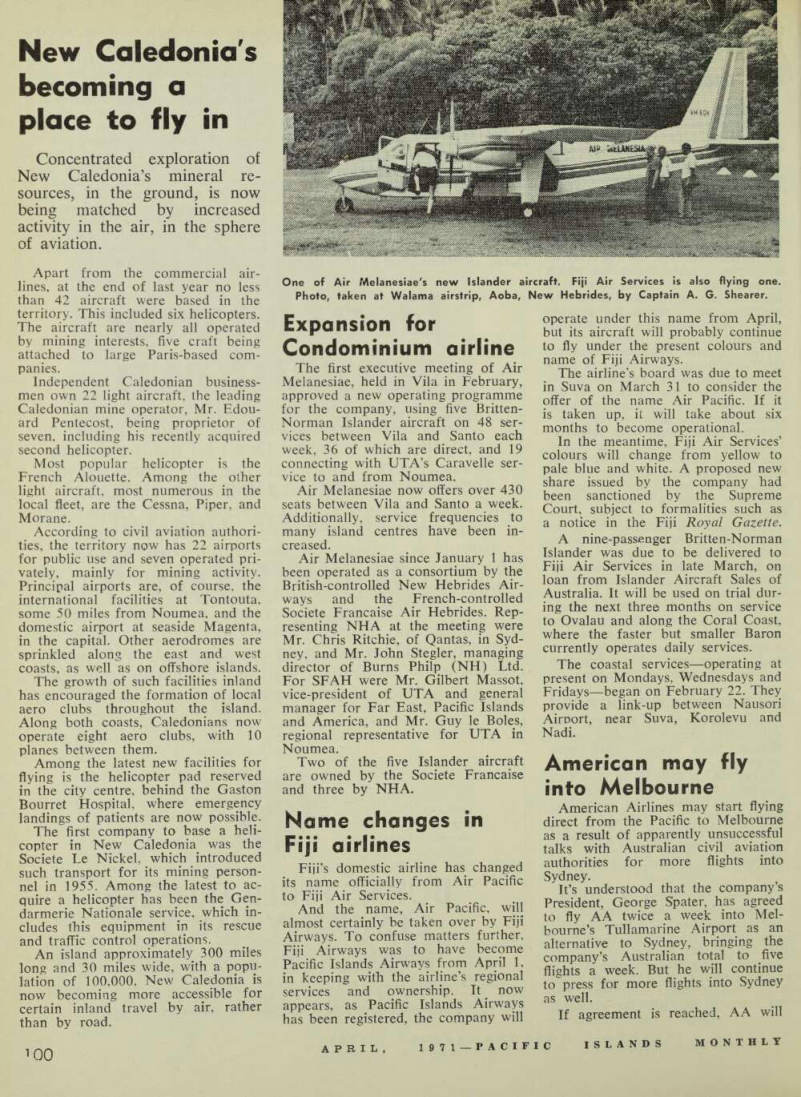
One of Air Melanesiae's new Islander aircraft. Fiji Air Services is also flying one.
Photo, taken at Walama airstrip, Aoba, New Hebrides, by Captain A. G. Shearer.
become the first international carrier to fly direct into Melbourne from the Pacific. At the moment Qantas and PanAm fly into Melbourne from the Pacific via Sydney. AA operates at present three times a week into Syd ney from Honolulu and US, all flights stopping at Nadi.
With rights into Melbourne, AA will start promoting Melbourne in the US (by virtue of its proximity to Alice Springs), and the US and Pacific in Melbourne.
A A reported a net loss for 1970 of $U526,398,000, compared with 1969 net earnings of $U538,468,000.
Reduced traffic growth due to the current slowdown in the American national economy coupled with rising costs, and the inability to raise fares in amounts necessary to offset such costs, were said to be the principal causes of the earnings decline in 1970, Other factors included the introduc tion of the Boeing 747, and the start-up costs of American’s new services in the Pacific.
AA also announced in March it will be flying the new DC 10 on Pacific routes. The company has 25 on order and the last 10 have been flitted with long-range fuel tanks for the Pacific.
Norfolk fores go up
A sudden Qantas announcement that fares from Sydney to Norfolk Island will go up for the second time in 12 months, has caused alarm and resentment on the island, ac cording to the local Norfolk Islander.
A March editorial says the island received a “terse” memorandum from Qantas that, effective from April 1, fares would go up from $65 ($123.50 return) to $71.20 ($142.40 return).
“The resentment has been caused not so much by the fact that there is an increase,” said the editorial, “but mainly in the manner in which these increases are announced—no beg pardons—just ‘you will pay more’.”
The Norfolk Council had written to the Aviation Minister complaining about the fares, but Qantas main tained that the Norfolk Island service ran at a loss, although no figures had been given to support his.
The editorial adds: “Whether the extra $140,000 that will be collected over the next 12 months (going on a figure of 7,000 tourists) will be sufficient for them to show a profit, is anybody’s guess. If the residents were given more facts, there would not be the present hard feeling about the sudden inflationary spiral on air fares to Norfolk Island.”
Over to you Qantas.
'Too many ties'
to NZ-Cooks aid
The Cook Islands Minister of Fin ance, Mr. A. R. Henry, has expressed strong resentment at the level of New Zealand aid to the Cooks.
In his February budget speech in Rarotonga he said the aid took no notice of all large increases in costs in NZ, which were passed on to the Cook Islands whether the Cooks liked it or not. There were strings tied to most of the money granted. Of the $NZ650,000 made available for capi tal works in 1971-72, only $lOO,OOO could be spent on projects chosen by the government, he said. The rest had to be used for particular purposes only.
This present situation, he said, was not the intention of the constitutional relationship between the Cooks and NZ.
He said the Cooks Government was making every effort to increase inter nal revenue and it had risen approxi mately 80 per cent in the past four years. If NZ had done half as well there would be no cause for com plaint.
The recently announced NZ aid programme totals $6,900,000 over three years to the Cooks, of which administration expenses take $4,950,000; grants for specific capital projects, $1,130,000; loans for specific projects, $400,000; and grants or loans for projects yet to be decided, $420,000. In addition, there are spe cial loans of $225,000 and $75,000 for improving international commu nications and a new electric power generator, respectively.
Fiji committee to
attack inflation
An anti-inflation committee set up by the Fiji Government met for the first time on March 5 to consider possible measures for curbing costs and consumer price increases.
The committee, consisting of union and employers’ representatives, as well as civil servants, was examining the feasibility of a prices and incomes re straint policy—and ways in which the government might push productivity forward.
Chairman of the committee, Fiji’s Minister for Commerce, Industry and Co-operatives, Mr. Vijay R. Singh, appealed to the public for suggestions.
After all, he said, inflation affected everybody (see PIM, March, p. 26).
Mr, Singh said the proposed in crease in Australian shipping freight rates to Fiji was viewed with deep concern, because of Australia’s posi tion as Fiji’s largest individual sup plier. Australia’s imports of food items and transport equipment were vitally important to the economy.
He spoke of the possibility of a regional shipping line, operated by Pacific Islands territories, being able to play a role in keeping down freight costs —but added that the economics of such a venture were still to be examined.
The building industry was another area of concern in Fiji. While the short-term answer might be for gov ernment to rearrange its building programme to minimise pressure on the construction industry, he said, the long-term answer was to train skilled manpower.
Trade briefs
AS forecast in PIM, January, the British finance house Jessel is taking over 49-year-old Papuan rub ber, copra and cocoa grower, British New Guinea Development Company.
Eastern Produce (Holdings), a Jessel associate firm, recently an nounced in London an agreed offer of nearly £Stgl million for the 83 per cent, of BNGDC’s capital it and associates don’t already own.
A share exchange offer values BNG’s 2/- shares at 3/5d. or an alternate cash offer values BNG shares at 3/3d. BNG shareholders are entitled to retain an interim divi dend of 6i per cent, (same) for the year to January 31, in the event of the offer becoming unconditional.
BNG expects profits for the current year to be affected by recent wage rises in Papua. Profit for 1970 was $206,716. • A major Australian trade dis play is to be held at the Tradewinds Hotel, Suva, from November 9 to 11, under the auspices of the Austra lian Trade Department. • Twelve members of a 31-strong Japanese Government survey mission to Australia will visit Papua-New Guinea in early April. They will visit Port Moresby and Kieta and meet senior Administration officials and local businessmen. • Suva’s controversial “no Sunday trading” regulation has been reversed by Suva City councillors, who voted eight to five in March to allow shop keepers to do four hours Sunday business when cruise ships are in port—about four more times this year. One councillor, N. S. Niranjan, supporting the Sunday trading motion, declared that since only about 45 per cent, of the population was Christian, he did not see why non-Christians should be made to conform with Christian ideas. • Work began on placing the con crete runway at Rarotonga’s new airport in early March. • Papua-New Guinea’s Depart ment of Education is to conduct a one-year course for young Papuans and New Guineans to be trained in the tourist industry as hosts, tourist guides, receptionists and travel agent representatives. The course, first of its kind, will be held at the Koki Vocational Institute, Port Moresby.
Similar courses may later be con ducted elsewhere in the territory. • A new oil palm factory in West New Britain, constructed jointly by the P-NG Admin istration and the English firm, Har rison and Crossfield, is expected to
begin operating about July. The $7 million factory at Mosa, 20 miles west of Cape Hoskins, will extract oil from fresh fruit bunches grown on oil palm plantings belonging to the company, European and New Guinean settlers and village-owned plantations. The oil will be transport ed by road to storage tanks at Kimbe before being shipped overseas. • A three-man team was to leave Australia in March to finalise negotiations in the US for a $2l mil lion loan from the World Bank to finance stage one of the Upper Ramu Hydro-electric scheme. The team is Mr. J. A. Rutter, Electricity Com missioner, a representative from the
Commonwealth Treasury and one from the Department of External Affairs. • Fiji Industries Ltd., Suva cement manufacturer, increased consolidated sales by 3 per cent, in the latest December half-year compared with the six months to December 31, 1969.
The consolidated net profit for the latest term was 10 per cent, higher. • W. R. Carpenter Holdings Ltd. continues to lift profits. In the six months to December 31, 1970, profit was 14.5 per cent, higher than in the previous corresponding six months.
The group turnover rose by 13.5 per cent, in the same period. The interim dividend is unchanged at 10 per cent.