Pacific Shipping
pp. 89-96 · Read in the full issue
Fiji thinks twice about regional shipping
With other territories—notably Western Samoa—talking about the possibility of setting up a regional shipping line, Fiji’s Prime Minister, Ratu Sir Kamisese Mara, appears to be lukewarm as far as his territory is concerned.
Asked at a March news conference if he intended raising the matter of regional shipping when he met Islands leaders at the forthcoming annual general meeting of the Pacific Islands Producers’ Association in Nukualofa, tie said the idea was not new. It went back to the South Pacific Conference if 1956. He had been chairman of me committee and the present King if Tonga had been chairman of an other, and both committees recom mended common shipping services for he Islands.
Nothing more had been done about ;he recommendations. This had been me of the things that had cooled the cing’s enthusiasm. The Prime Mini ster added, it had also “put my back ip”.
And Fiji Minister of Communica ;ions, Mr. Stinson, announced in late February that Fiji was definitely con sidering setting up its own line, on he same lines as Nauru.
He told the House of Representa ives: “These are not decisions that ;an be reached overnight, because here are many problems to face. This s a highly competitive field and we must make sure we would have :argoes to bring back in the ships in vhich we would take out our ex lorts”.
A sudden desire to start Islands iwned shipping services seems to have iwept the South Pacific, because the slands are dissatisfied with services md freight charges from overseas :ompanies.
Norfolk Island plans a line which would also service Lord Howe (see PIM, March, p. 97); the Cook Islands have been chartering vessels such as Thallo and Slidre Timur, Tonga for some years has operated the Niu vakai abroad; Nauru has a burgeon ing line of its own; Tamasese Lealofi, Prime Minister of Western Samoa, is all in favour of a regional line (PIM, March, p. 96).
"Samos" Goes Out, And
"Tenos" Comes In
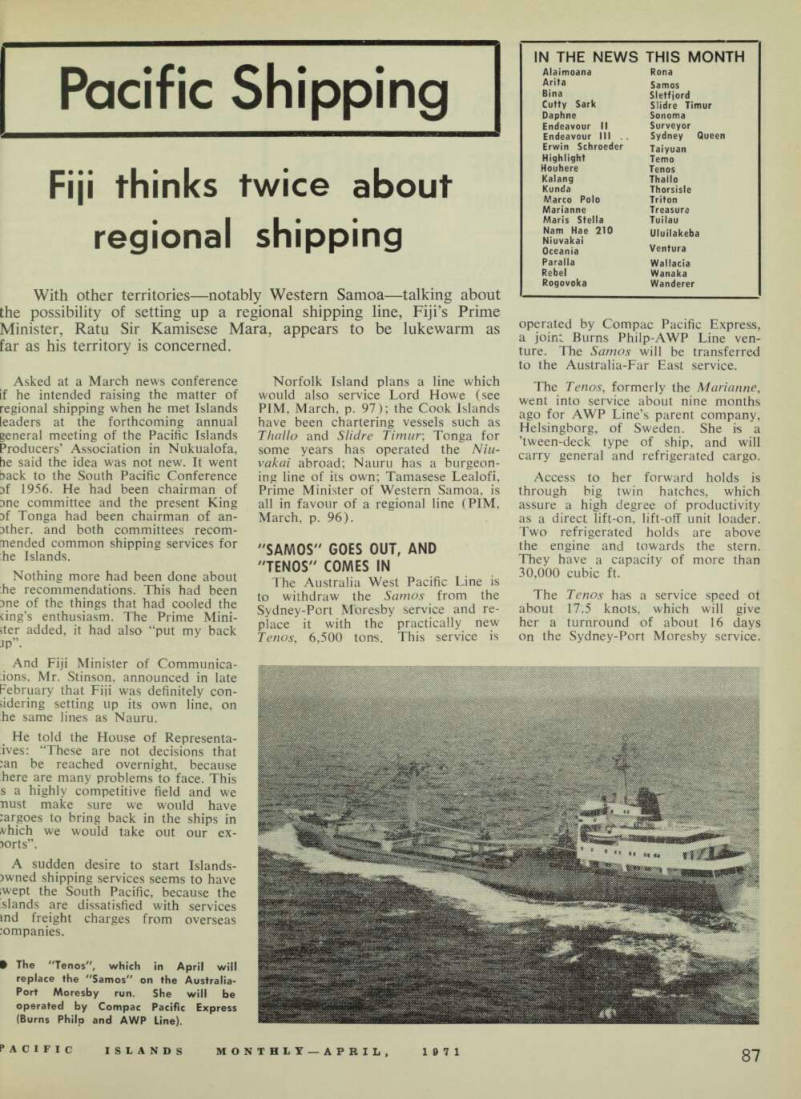
The Australia West Pacific Line is to withdraw the Samos from the Sydney-Port Moresby service and re place it with the practically new Tenos, 6,500 tons. This service is
operated by Compac Pacific Express, a joint Burns Philp-AWP Line ven ture. The Samos will be transferred to the Australia-Far East service.
The Tenos, formerly the Marianne, went into service about nine months ago for AWP Line’s parent company, Helsingborg, of Sweden. She is a ’tween-deck type of ship, and will carry general and refrigerated cargo.
Access to her forward holds is through big twin hatches, which assure a high degree of productivity as a direct lift-on, lift-off unit loader.
Two refrigerated holds are above the engine and towards the stern.
They have a capacity of more than 30,000 cubic ft.
The Tenos has a service speed of about 17.5 knots, which will give her a turnround of about 16 days on the Sydney-Port Moresby service.
The "Tenos", which in April will replace the "Samos" on the Austraiia- Port Moresby run. She will be operated by Compac Pacific Express (Burns Philp and AWP Line).
Growing Costs
Force Up Rates
There will be a 15 per cent, rise in freight rates between Australia and Fiji in May. Three companies which service the group have definitely de cided on the raise, while two others have it “under review”.
The companies which are definite that rates will rise are Karlander, Fiji- Australia Line (China Navigation) and the Tonga Copra Board, which operates the Niuvakai on a round service taking in Tonga, Western Samoa, Fiji and Australia. The CSR Co. Ltd, which operates the Rona, has the question under review, while Messageries Maritimes (Erwin Schroeder ) is considering it.
All the companies have the same story—steeply rising costs, which the companies say they can no longer absorb. But if it is any consolation to Fiji shippers and importers, the new rates will still be proportionately lower than those elsewhere, particularly be tween Australia and New Guinea.
The Fiji-Australia Line also takes in Noumea as part of the regular service with the Taiyuan.
The rates between Australia and Nauru will rise by 20 per cent, on May 1.
Exhaust Pipe Caused
"Rogovoka" Blaze
A wooden batten in the engine room came into contact with a hot exhaust pipe, caught fire, and the flames exploded diesel gas, causing a flash fire. That’s the finding of a Marine Department inquiry into the cause of a fire on the government ship, Rogovoka, carrying Pressmen to meet the Duke of Edinburgh on March 5.
The Rogovoka had been on its way to Lau with 12 passengers when smoke was seen pouring from the engine room. The passengers were ordered to abandon ship, but were allowed to return after 20 minutes when the fire had been put out. First reports indicated the fire had been started by an exhaust pipe igniting a section of masonite ceiling in the engine room.
The 70 ft steel vessel was towed into the government shipyard at Walu Bay the next day and work men began repairs. The Rogovoka appears to carry some sort of jinx for newsmen. Earlier, the voyage had been held up an hour while a radio fault was fixed. Last October she got lost in a maze of reefs in darkness near Bau Island, while carrying Pressmen. The journalists during the fire, however, had nothing but praise for the manner in which the crew tackled the emergency.
Tourism Hopes Lost
With 'Endeavour Ll'
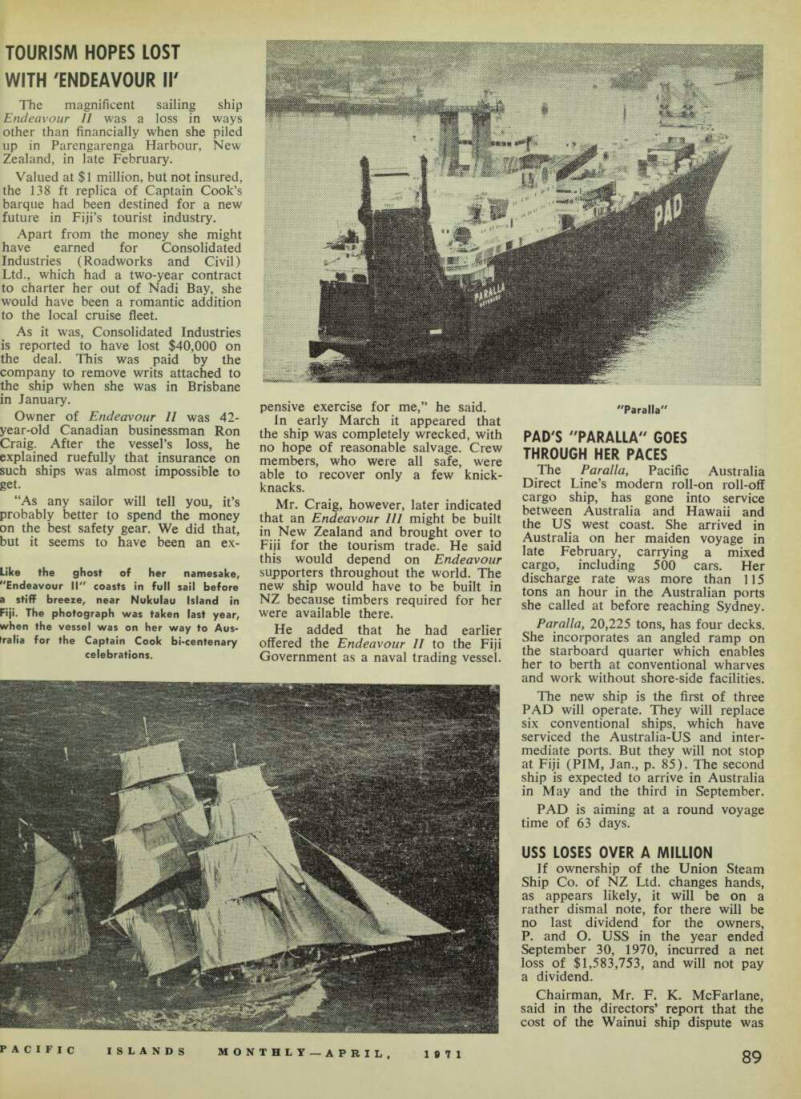
The magnificent sailing ship Endeavour 11 was a loss in ways other than financially when she piled up in Parengarenga Harbour, New Zealand, in late February.
Valued at $1 million, but not insured, the 138 ft replica of Captain Cook’s barque had been destined for a new future in Fiji’s tourist industry.
Apart from the money she might have earned for Consolidated Industries (Roadworks and Civil) Ltd., which had a two-year contract to charter her out of Nadi Bay, she would have been a romantic addition to the local cruise fleet.
As it was, Consolidated Industries is reported to have lost $40,000 on the deal. This was paid by the company to remove writs attached to the ship when she was in Brisbane in January.
Owner of Endeavour II was 42year-old Canadian businessman Ron Craig. After the vessel’s loss, he explained ruefully that insurance on such ships was almost impossible to get.
“As any sailor will tell you, it’s probably better to spend the money on the best safety gear. We did that, but it seems to have been an ex-
pensive exercise for me,” he said.
In early March it appeared that the ship was completely wrecked, with no hope of reasonable salvage. Crew members, who were all safe, were able to recover only a few knick knacks.
Mr. Craig, however, later indicated that an Endeavour 111 might be built in New Zealand and brought over to Fiji for the tourism trade. He said this would depend on Endeavour supporters throughout the world. The new ship would have to be built in NZ because timbers required for her were available there.
He added that he had earlier offered the Endeavour II to the Fiji Government as a naval trading vessel.
Pad's "Paralla" Goes
Through Her Paces
The Paralla, Pacific Australia Direct Line’s modern roll-on roll-off cargo ship, has gone into service between Australia and Hawaii and the US west coast. She arrived in Australia on her maiden voyage in late February, carrying a mixed cargo, including 500 cars. Her discharge rate was more than 115 tons an hour in the Australian ports she called at before reaching Sydney.
Paralla, 20,225 tons, has four decks.
She incorporates an angled ramp on the starboard quarter which enables her to berth at conventional wharves and work without shore-side facilities.
The new ship is the first of three PAD will operate. They will replace six conventional ships, which have serviced the Australia-US and inter mediate ports. But they will not stop at Fiji (PIM, Jan., p. 85). The second ship is expected to arrive in Australia in May and the third in September.
PAD is aiming at a round voyage time of 63 days.
Uss Loses Over A Million
If ownership of the Union Steam Ship Co. of NZ Ltd. changes hands, as appears likely, it will be on a rather dismal note, for there will be no last dividend for the owners, P. and O. USS in the year ended September 30, 1970, incurred a net loss of $1,583,753, and will not pay a dividend.
Chairman, Mr. F. K. McFarlane, said in the directors’ report that the cost of the Wainui ship dispute was
Like the ghost of her namesake, "Endeavour II" coasts in full sail before a stiff breeze, near Nukulau Island in Fiji. The photograph was taken last year, when the vessel was on her way to Aus tralia for the Captain Cook bi-centenary celebrations.
"Paralla"
$1,400,000. The dispute, at its height, immobilised 17 ships.
On a brighter note, the roll-on roll off services between Australia and NZ were well established, and the service had been extended with the intro duction of the Wanaka.
In mid-March, Thomas Nationwide Transport withdrew notice of pro posed takeover of USS, preparatory to submitting a new notice to comply with NZ Government requirements.
The original offer was withdrawn be cause the time limit expired March 18.
Pacific Far East Plans Ahead
The Pacific Far East Line, which recently took over Matson Line, plans to extend services in the western Paci fic area covering Japan, Guam and Australia. The company at present operates 15 ships from California to the three areas.
Mr. L. C. Ross, president of PEEL, in Australia early March on an inspection visit, said that two freighters, Sonoma and Ventura would be replaced by the end of 1971 with ships half as big again and five knots faster.
Mr. Ross did not spell out plans for further expansion in the northern Pacific, but talked generally of what the line hoped to do. A recent move was to order six barge carrying LASH (lighter aboard ship) ships at a cost of $l4O million.
• Nauru Parliament in February passed the Nauru Local Government Council Guarantee Act, which gives the Nauru Government power to guarantee the purchase by the council of a bulk phosphate carrier to be built for the council in Japan. She will be 30,000 tons. • The recently appointed Coastal Shipping Commission in Papua-New Guinea was to begin hearings in Port Moresby on March 29 and continue in various centres until May 28. The commission (PIM, Feb., p. 89) will make recommendations enabling coastal shipping to keep pace with the growing demands of the territory. • Vessels other than US vessels can now be fined up to $lOO,OOO for poaching in US and American Samoan waters. Before this US Gov ernment amendment, the fine was up to $lO,OOO. Fines for pumping bilges or oil dumping within 12 miles of American Samoa have also gone up to $lO,OOO. Coast Guard Lieutenant Richard Simpson has also reported to Governor John Hay don that his unit made 17 oil pollution patrols in Pago Pago Harbour during February and reported nine violations of pollution laws. Harbour police report ed another four. • Lau Provincial Council, Fiji, is pressing for a ship to replace the Tui Lau which sank in 1968, when she was operated by the Maritime Shipping Co-operative, a Lauan org anisation. The present ship, Uluila keba can’t cope with the numbers of passengers and size of freight, they say. • Twelve Chinese seamen who re fused to leave their ship, the Kar lander New Guinea Line, Sletfjord, recently, eventually went ashore at Point Cruz after consulting a lawyer.
Earlier they had locked themselves in their cabins. The men were being laid off at Honiara for a Solomon Island crew to take their place. They said they were unlawfully dismissed and wanted three months’ wages for being laid off—not the five weeks’ pay offered. Eventually the Sletfjord left with the Islands crew on board and the 12 Chinese flew to Hong Kong where the Commissioner of Labour will look into their case. • The Quan Hong vessel Maris Stella took a launch in tow recently which was drifting dangerously close to Alite Reef, New Hebrides. The Daphne had been drifting for 24
hours with engine trouble. The crew had no distress flares and caught the attention of Maris Stella by flashing a mirror. • The Sydney Queen, used during World War II as a floating workshop in New Guinea, was to be auctioned in Sydney on March 23, The Queen, 45 years old and 1,200 tons, was built in Scotland as the Kalang, and plied between the north and south sides of Sydney Harbour as a ferry until the bridge was opened in 1932, For the past eight years she has lain idle at Balmain, Sydney. • Cutty Sark, 60 ft steel diving vessel, belonging to Arthur Johnston, has been stolen from her moorings in Moreton Bay, Queensland. • The Nam Hae 210 a 200 ton Korean fishing ship, was pulled off the Gau reef, Fiji, on March 2. She went aground in October, 1970, on her first voyage after repairs to dam age incurred when she grounded on another reef off Levuka. Suva tug, the Wallacia. pulled the Nam Hae 210 off at high tide. Earlier attempts to get her off the reef failed. Had this attempt failed, the salvage com pany, Marine Pacific Ltd., would have abandoned the ship and borne thous ands of dollars in salvage costs.
Under the terms of its agreement with the Salvage Association in London it was an “all or nothing” attempt. • American Samoa’s first hydro graphic survey for 56 years is being carried out by the US National Oceanic and Atmospheric Administra tion. The 292 ft Surveyor will survey the harbour and its approaches and then work from Amouh towards the international airport and the sea. • The Tonga Government’s new fishing vessel, Eki Aki (meaning sea gull) arrived in Nukualofa recently having taken 21 days from Tokyo.
The Japanese longliner, formerly Taiki Maru, has a steaming range of 35 days and freezer capacity for 50 tons. She cost Tonea $120,000. in cluding complete refit, snare parts and six months’ bait supply. • The British Solomons Marine Department will soon have two new vessels in its fleet—the Bina and the Temo. Temo, a “T”-class vessel, was built at Auki, while Bina, whose hull was brought from Britain, is a cement vessel—the second of her kind in the marine fleet. • Following a recent meeting of the Pacific Islands Development Commission in Honolulu, a two year $3.4 million programme for the development of a tuna fishing
industry, involving American Samoa, the Trust Territory, Guam and Hawaii, may be set up. The money, said Governor John Haydon, would come from federal, local and industry allocations. The programme would involve aerial spotting of fish, more research, development of bait sup plies and a small boat fishing industry. The Governor added that a new 28 ft training boat would arrive from Honolulu on March 26.
If it was successful another would be ordered. • The freighter Thorsisle was expected in Pago Pago recently en route from Noumea to the US,
carrying 60,000 board ft of lumber produced by Potlatch Industries on Savai’i, Western Samoa. It was thought to be the first shipment of lumber from Western Samoa to the US. • Three stewards and a sailor from the cruise ship Marco Polo were left behind in Nukualofa in early March. The men were on a sight seeing tour and returned to find the last launch had gone. They hired the Alaimoana to take them to the ship, but had to give up for fear she would smash against its side. The men, all Chinese, later left by air for Suva, where the Marco Polo was heading.
• HIGHLIGHT, 35 ft lodestar design trimaran, has been sold by owners John and David Glennie of New Zealand, in Los Angeles. The brothers then flew to Australia where they plan to build two more tris using pvc foam and fibre glass. The two have been sailing the Pacific for the past 6i years, but now expect to be holed up near Brisbane for the next two, hard at work on the boats. • TRITON, 35 ft trimaran is in Costa Rica, where skipper Tony Spooner in March was to marry Miss Patty Dooley, of California. Patty crewed with Tony, along with Don Marmo and lan Eeles, from Hawaii.
Triton reached Hawaii via Cook Is lands and Tonga. • BRINESTORMER , 30 ft auxili ary sloop, was in Rarotonga from Tahiti recently with three brothers on board; John Skoog, 24, Leonard, 28, and James, 27. Their cruise took them down the west coast of America to Acapulco, the Galapagos and
Marquesas Islands, the Tuamotus, Tahiti and Moorea. They were due in New Zealand in February after a direct run from Rarotonga. • WANDERER IV, 49 ft steel ketch from England, with Eric and Susan Hiscock, was in South Island, NZ, recently, deciding whether to sail for Australia or stay in NZ. Eric and Susan were last heard in Apia in August. • HOUHERE, 39 ft Sydney yacht, was recently in Hawaii on her way to America with owner-skipper B. J. Tyler and crew. She was last heard of in Rarotonga last August. • TREASURE, 46 ft cutter with lohn and Maureen Guzzwell on board, was in Hawaii recently. John then returned to NZ where he and Dick Mcllvriode (former owner of Arita ) bought 60 ft ketch Tyrant.
They plan to sell Tyrant in Hawaii, and John and Maureen may settle there.
Trimarans seem to get more popular all the time. Bottom is "Rebel", 35 ft Lodestar tri, owned and skippered by Ann and Marvin Glenn and last re ported in February heading for Bougain ville. Right is "Kunda", 36 ft Wanderer tri with Jeff and Luci Montague. Photos: Ann Glenn.