Pacific, and what they want to do
pp. 62-133 · Read in the full issue

What the Americans have done in the Pacific, and what they want to do
By John Griffin
Oceania’s 10,000 islands feel the influence of fringing nations in varying degrees. Above the equator, US strategic interests are strong and controversial. Below it, Australia and New Zealand are economically active. Japan is making a commercial comeback. Indonesia uncomfortably holds half of New Guinea. Yet the tropical Pacific Islands themselves remain an entity worth noting in the world arena, if only because they are largely dependent and underdeveloped—the world’s last emerg ing colonial area now coming of age.
By the usual measures, the area is not large. There are only some four million people, about the number in Rio or Peking and not much more than half of New York City. The land area of about 490,000 square miles is far smaller than Alaska or a country like Peru. Most Pacific island groups are so small that Hawaii has big-power proportions; in fact, a vast number of the islands are uninhabited.
Still, Pacific Oceania is an area emotionally, strategically, and literally bigger than the sum of its small parts, for several reasons. Among them: The sheer size gives it strategic value. As one US military planner put it: “You just can’t ignore that much of the world.” For the US even in the missile age there is a negative security aspect; a desire to keep un friendly powers out. Former Secretary of State Dean Rusk was once quoted as saying, “I want every wave in the Pacific to be an American wave.” It won’t happen in quite that jingoistic sounding manner, but the idea of a friendly-neutral buffer zone is a mini mum security interest.
In the US military pullback from Asia it seems there will be a desire for more bases in the central Pacific, notably in parts of Micronesia.
The Pacific has a variety of scien tific and technological test uses. Some are beneficial, such as weather and sea studies. A few are tolerable, if dangerous, such as ABM tests that make Kwajalein a missile shooting gallery. Some are ugly and frighten ing—the nuclear blasts of past years, nerve gas tests on Hawaii and quite possibly elsewhere, and now the stor ing of tons of deadly gas from Oki nawa on Johnston Island, 700 miles south-west of Oahu.
Even in the age of ocean-spanning jets, the Pacific provides a sea and air transport linkage, notably to Austra lia and NZ, nations who are allies and trading partners and who share a common concern about the Islands.
If the world’s oceans provide new underwater economic frontiers for food, mining, oil, etc,, the Pacific is
remarked recently that, “the Ameri cans and the French are the worst imperialists in the Islands”. Some Americans may be surprised to find themselves classed with the French, who bluntly claim that the islands they hold in Polynesia and New Cale donia are “part of France” and will not be set free.
Yet in Micronesia the US rules what is geographically the world’s biggest colony. There are only about 100,000 people and 675 square miles of land in the entire area, but there are more than 2,100 (fewer than 100 inhabited) spread over an area larger than the US mainland.
Legally, Micronesia is governed by the US as a Trust Territory under United Nations mandate. But if the definition of a colony is one people by another in the latter’s self-interest, Micronesia has long qualified.
In fact, there have been four colonial masters in 300 years; Spain came first in search of souls, gold, and national glory. Practical German traders arrived last century and for a time the two contested. That era ended with the Spanish-American War when Guam, which is part of the Marianas group, become a US posses sion and the rest of the area now called Micronesia went to Germany.
Japan seized the German islands when World War I broke out in 1914 and was formally granted rule under a League of Nations mandate in 1920. Until it ended in the bombs and bloodshed of World War 11, the Japanese period was the high point of Micronesia’s economic develop ment. To be sure, it was a Japanese effort largely by Japanese for Japan, but in economic terms it was efficient use of the islands’ limited resources.
Micronesians shared some peri pheral benefits in basic education, an introduction to Westernised progress, and a generalised feeling of satisfac tion.
Americans may regard our wartime battles in this area as something akin to the liberation of the Philippines or Guam. But that is not the perspective of many Micronesians who saw rela
the biggest of them all. New kinds of international co-operation—or compe tition —could emerge.
Aside from any unknown oil poten tial and some very important mine ral deposits in the South-West Paci fic, the Islands are no economic trea sure house. But for Japan, Australia, NZ and for some American business, they do present a market. Tourism is really just emerging as a major fac tor. Behind it is the potential of tour ism’s next phase “commuter colonies”—of part-time residents from affluent nations.
For the US especially, the Pacific is important as a moral challenge.
The immediate and pressing question involves reconciling US strategic self interest with the wishes and best in terests of the Pacific people.
And at this point the name of that problem spells Micronesia.
A prominent South Pacific leader
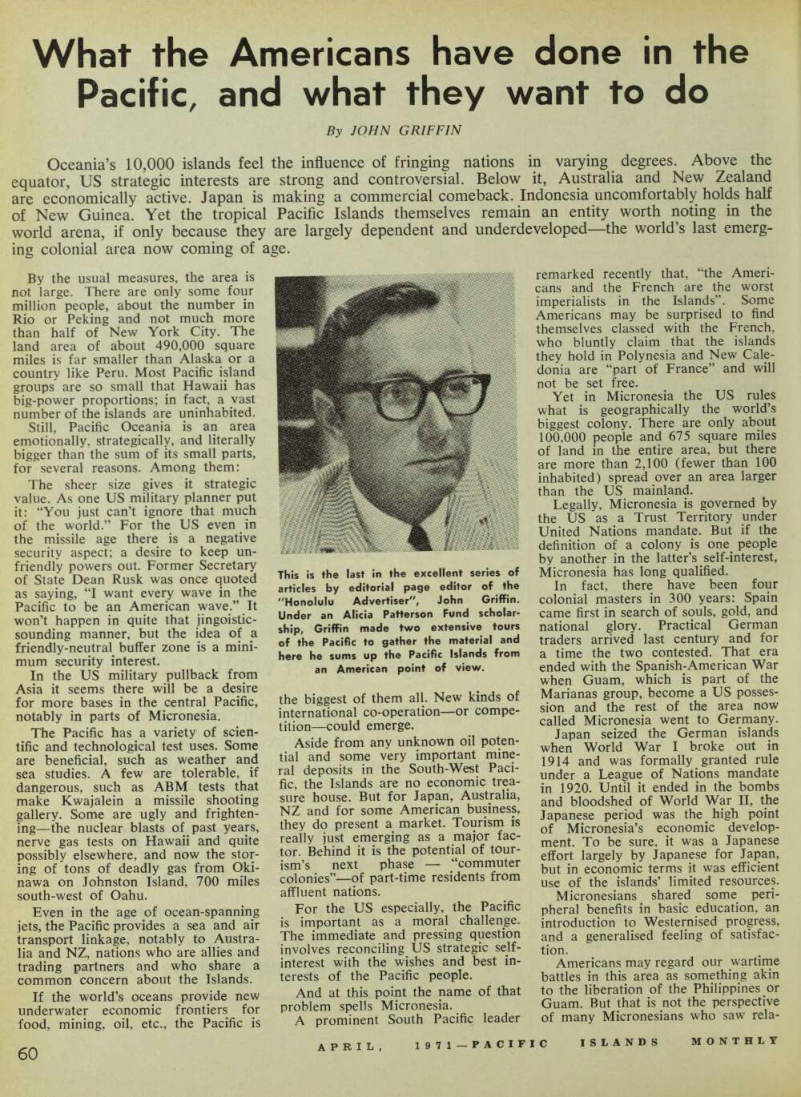
This is the last in the excellent series of articles by editorial page editor of the "Honolulu Advertiser", John Griffin.
Under an Alicia Patterson Fund scholar ship, Griffin made two extensive tours of the Pacific to gather the material and here he sums up the Pacific Islands from an American point of view.
lives die and the economy smashed.
A government worker on Palau put it this way: “Nobody in Micronesia asked for you to come in and bomb in World War 11, not the chiefs here, in Truk, or in the Marshalls.”
The shortcomings of American rule in Micronesia, especially after the In terior Department took over from the navy during the 19505, have been well documented. It literally became “The Rust Territory”, and the kind est explanation is that Washington followed the “zoo theory” of colonial rule. This holds that you “protect” the native culture from expensive public improvements so the people will be able to afford independence if and when it comes.
But since the good Japanese eco nomic structure was smashed by the war, the real result was stagnation at a low level. And there was basic cynicism in having such a policy when the American military security view dictated against independence and we were using the islands for a variety of highly expensive purposes, including nuclear tests, missile shots,
US does some good, too
and CIA training of Chinese Nationalist guerrillas. The improvements of the American effort in Micronesia, begun in the early 19605, also deserve to be noted The annual budget has jumped from $7 million to $5O million. The Nixon Administration has not only continued improvements, but added new programmes and new interest.
Such things are worth stressing, But they also must be judged against three other factors—the basic economic situation, political development, and US policy.
A quarter-century after the US took over a shattered Micronesia in World War 11, economic development re mains a basic need. This does not mean development on some high level a kj n t 0 Hawaii today; often it means j ust rehabilitation to the standards set b the Japanese before World War T 7 x; . ... , • • TTXT Trllo II- Visiting missions of the UN Trus teeship Council have documented this problem over the years. The latest, issued in May, noted some favourable signs. But the report also talked of “economic stagnation”.
And its first economic conclusion reads: “The visiting mission did not see signs of significant progress in the economy of the territory as a whole.
In particular, the basic infrastructure is still in a lamentable state; agri culture is stagnant and seems to be threatened by the movement of popu lation to the towns; the adverse trade balance is increasing, and, apparently, some pressure is beginning to be felt on prices.”
An even more important point is that Micronesia’s political develop ment has moved faster than economic and social improvements brought by new US policies.
Micronesia has some very talented young leaders; men who are friendly, yet able to argue persuasively that the US should live up to its own high principles in its treatment of Pacific peoples. It is to America’s credit that these leaders were offered the educa tion (much of it at the University of Hawaii) and provided a political forum for their aspirations. Despite limited legal power ,the Congress of Micronesia has won the reputation of being both responsible and determined in seeking the best possible future for the area’s people.
As this legislative development was under way in the late 19605, the US was correspondingly weak in develop ing Micronesian administrators. A vir tual crash programme has put Micro nesians in many top jobs in the past 18 months. But such improvements have come in a time of increasing Micronesian concern over future poli tical status. Thus big new US appro priations are sometimes suspiciously interpreted as a move to “buy” Micro nesian dependence and permanent ties with the US.
In this perspective, the JUS has hardly given too much in Micronesia in terms of what’s right. But Washing ington may have been too late in giv ing it in terms of its own policy.
United States policy in Micronesia seems quite clear: Washington wants agreement on a future political status that will end the UN mandate and bring Micronesia into some form of permanent association with the US.
What is not clear is how tough and rigid Washington will be. There is
(Continued on p. 125)
ample evidence that paramount con cerns are American strategic interest in having a friendly buffer, and hav ing territory for bases when we fall back from Asia. In a showdown, these concerns could be strong enough for the US to disregard any United Nations call for a plebiscite that might lead to independence.
Whether it would ever come to such an unpleasant point is now the big question.
After two years of talk and manoeuvring, the situation is at an impasse, but not frozen. Washington has offered “commonwealth” status, seemingly a form of territorial gov ernment perhaps like or better than Puerto Rico has. The Congress of Micronesia rejected this at its sum mer session. The Micronesians have called for a status titled “free asso ciation”, which in effect would give them independent self-government in the islands.
There would be financial help from Washington in return for US control over foreign affairs and defence, with an option for Americans to lease land for bases, missile test sites, etc.
The key question is whether Micro nesia would be some kind of Ameri can area where Micronesians live or a Micronesian area closely related to the US. The end result could be much the same thing. However, the most delicate point in Micronesia’s de mands seems to be one that would allow either side to withdraw from the “free association” arrangement at any time—in effect, for Micro nesia to later choose full independ ence if it wishes. Even there, how ever, it seems possible to bargain a 10-year freeze or other form of com promise.
Somewhere in the fabric of Wash ington thinking about Micronesia has to be consideration of Guam, the US island territory of 108,000 people with its blooming mini-Hawaii type economy of growing tourism, US military bases, and air and sea trans port links. Among other American failures in the area was not joining Guam and the Trust Territory long ago. Now it is too late, although the northern Marianas above Guam are the part of the Trust Territory that most favours US commonwealth status.
But, if it will not happen right away, it seems likely that the future Micro nesia, whatever its new political status, will have growing economic, and possibly later political, relations with Guam.
So what the US faces in its deal-
Dreamland?
jigs with Micronesia is a very real challenge between short—and long— range interests at a changing time :hat calls for new thinking, and per iaps new political arrangements.
What the US does about Micronesia will say something to the peoples of ;he Pacific. More important, perhaps, we will be saying something to our selves.
There are really two parts of the Pa/dfid. Islands for Americans to think about —north and south.
The North Pacific is the US sphere 3f influence. There is Hawaii, the vast Trust Territory, and the island of Guam, all under various forms of American rule.
The significant exception is part of the Gilbert Islands (Tarawa, etc..) Geographically and racially, the Gil berts are part of Micronesia, which means “small islands” and generally means small people of medium colour and often a Malay-like look.
Politically, however, the Gilberts are with the Ellice Islands, a below the-equator Polynesian group, as a British crown colony that is con sidered part of the South Pacific pic ture.
The American view of the North Pacific tropical islands tends to that of a coconut Clausewitz: If we have political problems with the Micro nesian people, the main consideration remains security. Tourism, other busi ness, and transportation links are secondary.
The South Pacific is something else.
When Americans think about this area below the equator it is usually in terms of the “South Seas” image (a mixture of dreams, history, and tourist promotion) or to harsh reali ties of the Pacific war—black natives and bloodshed.
It is that, and more.
The US political presence in the South Pacific is in American Samoa, our only territory below the equator.
The US acquired American Samoa at the turn of the century when the big powers were busy carving out coaling stations and colonies among the little islands. It’s a little place even bv Pacific standards—76 sq. miles— and only enough people (30,000) to fill a medium-sized stadium.
Here, as in Micronesia, the US re cord has improved. But the picture of Pago Pago is still shadowed by the legacy of past neglect, lack of re sources, a tendency for petty feuding, and booming population pressure re lieved only by immigration to Hawaii.
American Samoa, of course, is only
The beauty’s there
one speck of Polynesia (“many islands”), the big triangular area tak ing up most of the eastern Pacific.
Because they were originally popu lated by people from the area near Tahiti, Hawaii and NZ are far points in the triangle. Today, however, both are basically westernised groups where other races predominate.
The heart of Polynesia remains in the South Pacific. There is Tahiti, be ing commercialised, but still the capi tal of the South Sea dream. And there are other magic names and happy places—Bora Bora, Puka Puka, Rarotonga, Nukualofa, Savaii. There may be flies all over and the women are often fatter than the travel posters indicate; but often enough to raise your heart, the beauty of place and people remains by lonely lagoons or beneath towering crags rising from deep blue sea and the white line of wave-crashed reef.
Copra and bananas are no longer enough to meet rising expectations of health and comfort for the younger and more sophisticated among these islanders. Tourism is seen as the big economic hope, and it is picking up momentum. How much happiness it will bring is an open question.
Melanesia is the other half of the South Pacific —starting with Fiji, where the people show touches of Polynesia and stretching across to New Guinea, which at times seems more like an African country than a huge island between the Pacific and South-east Asia.
Melanesia means “dark islands.”
Perhaps that’s a reflection of the more Negroid look of the people. But it is also a comment on the islands: dark, brooding, often big, and sometimes rich with minerals.
These are the islands of Michener’s Tales of the South Pacific, and as in Micronesia, far north, reminders of war remain. Skeleton of a wartime control tower stands on Guadalcanal’s Henderson Field. Japanese guns still guard Rabaul. Rusting landing barges lie half buried as native chil dren play on lovely beaches. Crumb ling quonsets mark what was the big base of Santo.
But the people have changed. True, some still venerate pigs, wear leaves, and have little idea of the world be yond their mountains, but many have been well educated abroad and are preparing to lead new nations. In some places there are black power movements and even touches of Westernised youth culture that pro mise new aspects of change in the future.
In contrast to Micronesia and cen-
Colonial record
ral Polynesia, the islands of Mela lesia often have the size and poten ial resources to support themselves, fhey also have the potential for some explosive political disputes. North s acific politics are simple by contrast; hey relate to the US and its policy, n the South Pacific there are a be vildering array of multi-national in luences.
Most rigid are the French, who •reclaim their territories are part of 7 rance. In Polynesia they have a luclear test ground, dollar-producing ourism, and an emotional attach nent for Tahiti and the other islands, n New Caledonia, where almost half he people are French, they have an sland third only to Russia and Canada in nickel deposits. But in both ireas the French face increasing re entment, not so much from people vho want independence, but from hose who seek more self-government n the centralised French system.
In contrast, the British goal is to eave when possible. They still must ind a viable future for tiny Pitcairn vith its 60-some citizens, the resource ess Gilbert and Ellice colony, and he undeveloped Solomons, where hey are experimenting with a new orm of parliamentary government.
Britain and France jointly rule the •lew Hebrides in the world’s only :ondominium government. The comic >pera aspects (three sets of laws and idministration, two police forces, lual money, etc.) are overshadowed >y sales of American subdivisions, alk of a Bahama-like tax free haven or foreign business, and the develop ng aspirations of 75,000 Melanesians.
NZ, which has a considerable Is ander population, maintains commer :ial and emotional ties in the area.
But it has dispatched most of its colonial responsibilities with imagina ion. It granted Western Samoa inde aendence in 1962 and gave the Cook islands a generous form of self-gov ;rnment that could be a model for he US in Micronesia.
Australia governs the eastern half )f New Guinea and the neighbouring Bismarck Archipelago. However, it 10 longer sees the area as essential o its defence. Its plan for the vast, populous (over two million people) area is self-government as soon as aossible.
Independence or something close X) it is the goal for most Paci ic Islands. If they cannot immedi ately afford it, they assume the :olonial power will feel obligated or remain interested enough to help tide
The new Pacific
them over. In that, they are partly right.
Ihe number of independent states is growing: Western Samoa makes its poor but pleasant way with a British parlia mentary system veneer over a strati fied clan system that produces thous ands of chiefly titles.
The republic of Nauru, just below the equator, has only eight square miles, but its 8,000 people have one of the world’s highest per capita in comes because their island is essen tially one large phosphate deposit.
Tonga, the Pacific’s last real king dom, last year gave up its status as a British protected state to join the Commonwealth.
Fiji, with a size and multi-racial population akin to Hawaii, last Octo ber became the Pacific’s newest nation. It is also the only one to join the United Nations so far—thus giv ing the Islanders their first real voice in the world forum.
It seems likely that Fiji, New Guinea and other major Islands areas will be most preoccupied with their own emergence and development in the early 19705. But some thought is already being given to new forms of co-operation and unity.
There is already a forum of sorts in the South Pacific Commission. It was started in 1947 by the colonial powers to deal with health, educa tion, and economic development mat ters. But in recent years Islanders have gained more power in the SPC and nudged it towards political ques tions. In addition, some see modest Pacific Common Market potential in the Fiji-based Pacific Island Pro ducers’ Association.
Distances, under-development, lin gering colonialism, and various West ern impacts all make for confusion in trying to view how the Pacific Is lands will “emerge” in the 19705.
There is much these people need and deserve in the way of health, educa tion, and economic betterment from the West.
All is not idyllic by any means. But for centuries the Pacific Islands have also given Western man something important—an element of mystery and dreams, caught in the vision of barrier reefs, trade winds in palms, quiet lagoons, thatch villages, and smiling, friendly people.
Again, it is not that idyllic. But the charm survives, and that is im portant in a world with far too few happy dreams. The hope is that the best of the Pacific way of life will not die from a disease called pro gress.