Kava May Cure
p. 57 · Read in the full issue
New Hebridean
Drunkenness
Every Saturday night in Vila
and Santo a crowd of brawling, swaying New Hebrideans collect in the street around the numerous bars. Drunkenness— whether it be the drooling or the belligerent kind—is on the in crease in the New Hebrides, and it’s estimated that alcohol is asso ciated with 75 per cent, of the crimes committed by the New Hebridean.
That’s why I support the latest idea to combat drunkenness—bringing back the comparatively harmless occupation of kava drinking.
The Administration has been con cerned about drunkenness for some time. Up to the present it has been regarded as a police matter, but in the condominium, as elsewhere, the use of police and punishment has met little success in combating what is mainly a social ill.
In 1964 an Advisory Committee on the Campaign Against Alcoholism had a few meetings. The good inten tions were lost in the general feeling current in the New Hebrides that next year is the best time for start ing a project. The good intentions petered out.
The most recent attempt to find a solution is a report by Dr. Karl Schmidt, mental health specialist of the South Pacific Commission, in which he recommends certain measures to curb drunkenness.
He identifies the problem drinker as a young New Hebridean man who is either unmarried or has left his wife at home in the islands.
He recommends increased sport and better amenities for New Hebri deans in their leisure time. More interesting, he recommends the use of kava as an alternative to alcohol.
Unfortunately this would be no easy matter.
For the past hundred years Presby tarian missionaries have outlawed the use of kava. They have not succeeded in eliminating its use
altogether, but people now grow it in the high hills where the missionaries do not go. It is drunk in secret.
It is not sold in the market or in stores because many New Hebrideans believe that the government has re inforced missionary disapproval and made it illegal.
When the small ships arrive in Vila from Tongoa or Tongariki with a load of kava, the whole supply is usually sold within an hour of the boat’s arrival, and at exorbitant prices. Kava is fairly plentiful on Tanna but the distance is too great for any but European-owned ships.
The role of the Administration. it it decided to implement Dr.
Schmidt’s suggestion, could be bringing buyer and producer together.
Perhaps the cooperative societies could start marketing it in small kava shops and bars.
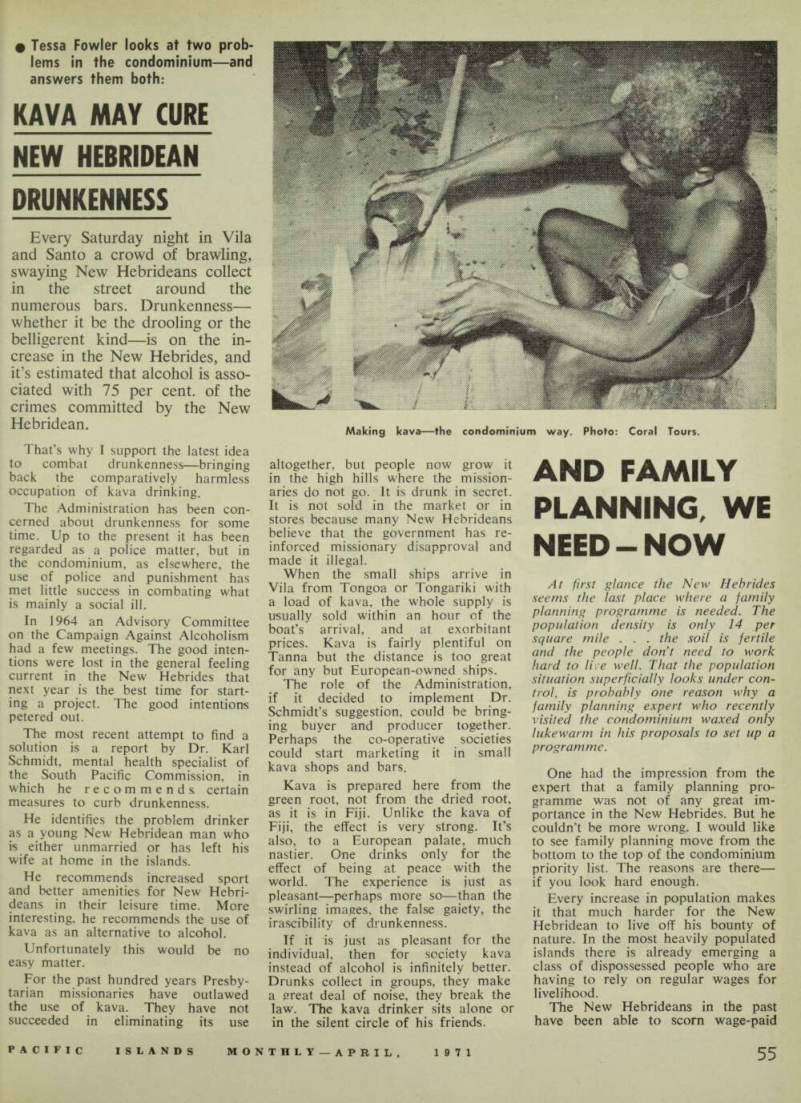
Kava is prepared here from the green root, not from the dried root, as it is in Fiji. Unlike the kava of Fiji, the effect is very strong. It’s also, to a European palate, much nastier. One drinks only for the effect of being at peace with the world. The experience is just as pleasant—perhaps more so—than the swirling images, the false gaiety, the irascibility of drunkenness.
If it is just as pleasant for the individual, then for society kava instead of alcohol is infinitely better.
Drunks collect in groups, they make a great deal of noise, they break the law. The kava drinker sits alone or in the silent circle of his friends.
Tessa Fowler looks at two prob lems in the condominium—and answers them both:
Making kava —the condominium way. Photo: Coral Tours.