story of New Guinea exploration
pp. 43-52 · Read in the full issue
Akmana: A new name in the continuing story of New Guinea exploration
Special to PIM, by ERNIE SHEPHERD [Copyright]
On September 3, 1929, I was 32-years-old and ready for anything—so it was a great adventure when on that day I arrived at Madang from Sydney on the Bums Philp steamer Montoro, ready to search for gold in the New Guinea hinterland.
With me were Sam Freeman and H. V. (“Pontey”) Seale (a mining engineer, with the initials AMIMM) and at Madang we joined up with Reg Beazley and Bill MacGregor. We had all seen overseas service in the AIF and had had previous New Guinea experience. We now comprised the field party of the Akmana Gold Prospecting Co.
This had been formed in Sydney as a result of some prospecting that Reg Beazley had done in the mountains of the Arrabundio, a tributary of the Sepik, the previous year, 1928.
He had had two mates, Engle and Moseley, and had left them at the base in the mountains because of sickness and accident, and with a party of six—carriers and gun boys—made his way to the Upper Yuat and prospected about the Jimmi junction with that stream.
He collected a small bottle of gold,
which led to the formation of the prospecting company in Sydney through the instigation of Sam Freeman. Freeman was party leader, Seale was mining engineer and Beazley and MacGregor prospectors, who also supplied gun boys and carriers. I was responsible for transport and supplies and also handled recruiting. We all had bonus shares in the company, and Beazley a number of allotted shares.
At Madang we took over a fine 38 ft cruiser, which we had shipped from Sydney, the Banyandah, fitted with sails and powered by a 25 hp Kermath marine engine. It was a good outfit and my responsibility.
As it turned out, we were able to make two trips into the mountains— both expeditions taking us into what is now the Western Highlands of New Guinea. We went further into those Central Ranges than anybody had at that time.
From Madang that September we set off up the coast and into the mouth of the mighty Sepik and headed for Marienberg, first post of note on the Sepik at that time, We had a full complement aboard, including a good line of carriers, canoe men and gun boys—experi enced in grass country, mountain and swamp.
We reached Marienberg on Septem ber 19, 1929, where we loaded five canoes with petrol drums three quarters filled with perishables so they would float in case of capsize of the canoes. Cargo went on the pinnace and we set off up-river towing the canoes. Floating islands of soil and grass, timber, submerged trees and whirl pools due to the fast current and many turns in the stream were our hazards, made more difficult to nego tiate towing the canoes. At night only
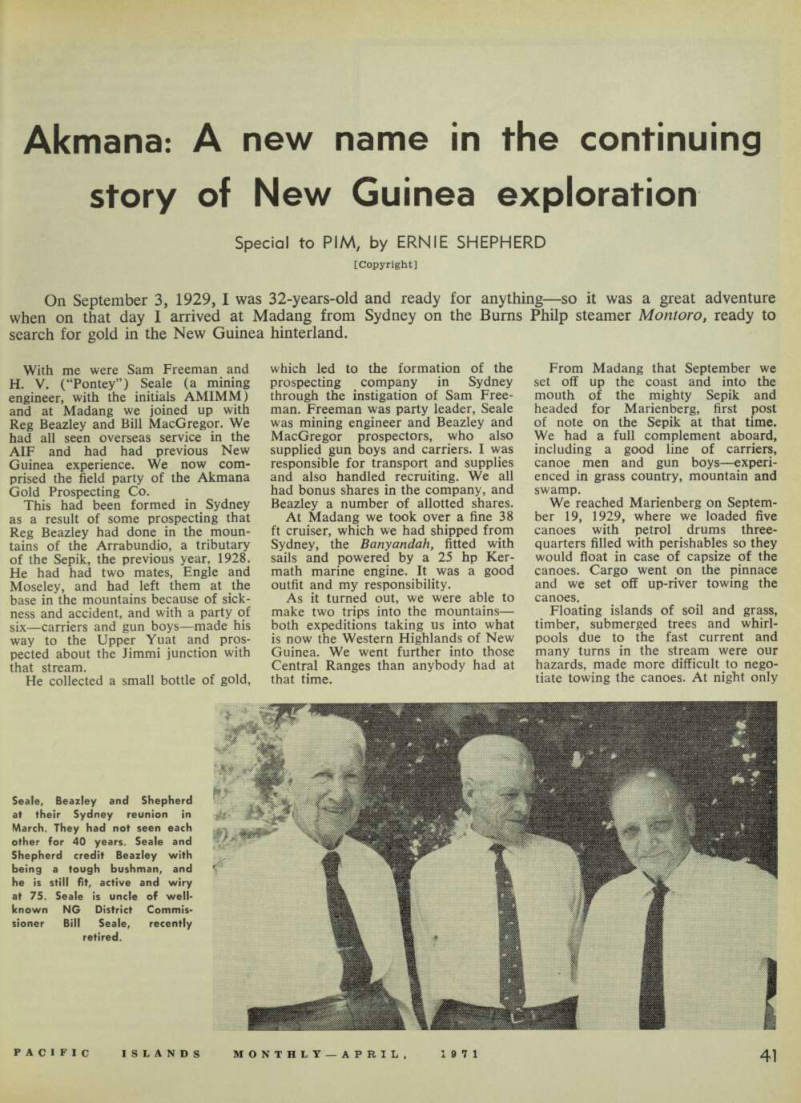
Seale, Beazley and Shepherd at their Sydney reunion in March. They had not seen each other for 40 years. Seale and Shepherd credit Beazley with being a tough bushman, and he is still fit, active and wiry at 75. Seale is uncle of well known NG District Commis sioner Bill Seale, recently retired.
well erected nets made sleep possible with the dense hordes of mosquitoes for which the country is famous.
By October 10 we were at Yimas, furthest controlled village in that huge area of swamps and waterways. This place is on the Arrabundio, a tribu tary of the Karrawaddi (now called the Karawari).
We could take the pinnace no fur ther, so transported by canoes after this, running relays to the mountains.
We prospected the Arrabundio and tributaries, then trekked overland to the Upper Karawari—all with inter esting results, yet with nothing of importance.
It was a huge area of conglomerate formation, shedding colours of gold in every dish. We crossed the range at 4,500 ft to the Upper Yuat, meet ing that stream just north of the Jimmi junction.
It was slate country on the eastern fall, and severe on the carriers’ feet.
There was a lot of moss and roots on the so-called track, and it was a moss forest at 4,500 ft. Here on one occasion the boys bled from the nose and mouth, but soon recovered at lower levels.
We prospected in this precipitous country, clambering down spurs to prospect the streams, and then up again because the streams were too rough to travel along. The medicine box was in great demand for cuts and abrasions.
But when we later came to better country, the stream racing through channels it had cut into the slate, Sam Freeman decided he could not go on. He was a veteran of the Boer War and of World War I, with ser vice at Gallipoli, and he had stuck it out well. We were all to go back.
Before we set off on the return journey the party made first contact with the wigmen. At this time I was relaying cargo and it was Beazley, who had gone ahead of the main party, with only a half dozen gun boys, who found himself suddenly the centre of interest for about 150 High lands warriors, with bows and arrows.
Apparently they had been watching the movements of the party for some days and now chose to make them selves visible. The party had been
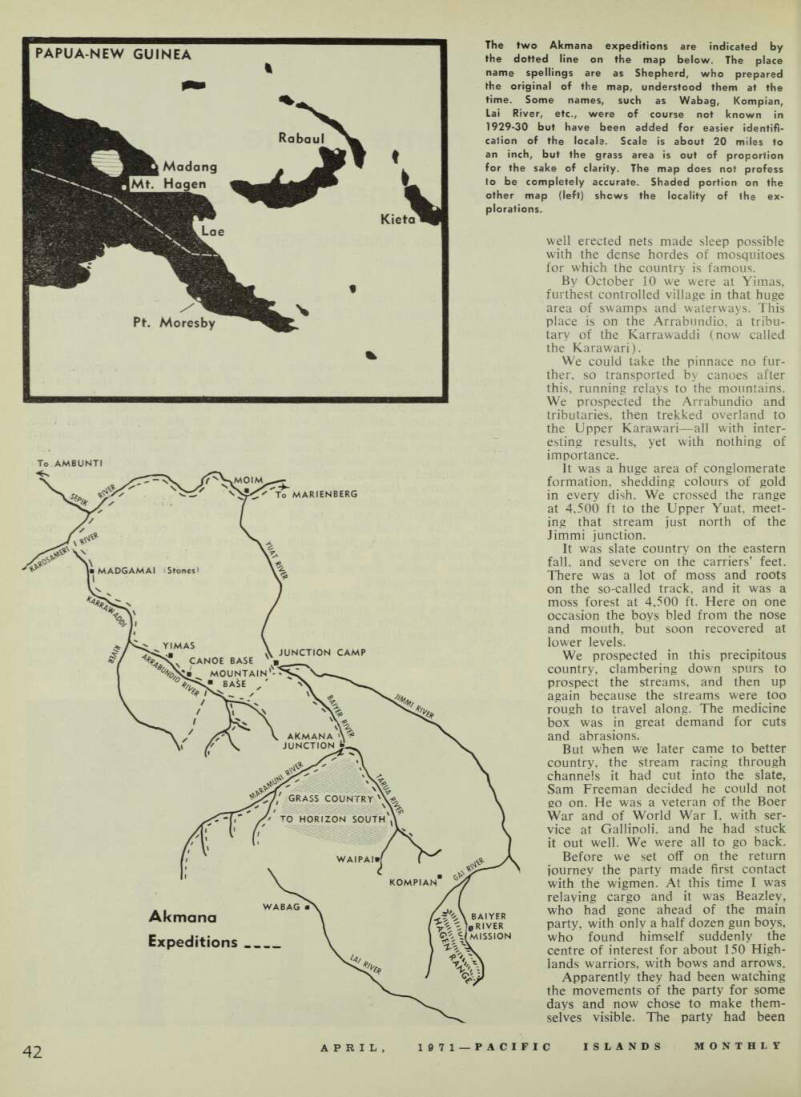
The two Akmana expeditions are indicated by the dotted line on the map below. The place name spellings are as Shepherd, who prepared the original of the map, understood them at the time. Some names, such as Wabag, Kompian, Lai River, etc., were of course not known in 1929-30 but have been added for easier identifi cation of the locale. Scale is about 20 miles to an inch, but the grass area is out of proportion for the sake of clarity. The map does not profess to be completely accurate. Shaded portion on the other map (left) shews the locality of the ex plorations.
noting signs of entering a greater population area.
The warriors were curious and friendly, but Beazley had completed his job and wisely retraced his steps to his previous night’s camp. There he was met by another 200 warriors, and since the first group had fol lowed him downstream he now found himself the centre of interest of 400 odd Highlanders who had never be fore seen a white man.
After some demonstrations of fire power with his rifle and the magic of matches he returned to the main camp without incident.
Our party left that area on Decem ber 14. 1929, and with light packs and a knowledge of the route, we were back in our base camp less than a fortnight later, and at Marienberg on the last day of 1929.
Freeman, Seale and Beazley left Madang for Sydney on January 6, 1930. to report to the company, which would decide whether to con tinue further.
I held the fort in Madang with the Banyandah, running it under charter to the Administration. I made excit ing and interesting runs to places up and down the coast I had not visited before, to drop patrols of police boys.
I liked Madang. A grand harbour, a beautiful area and “Tosh” Schilling and his wife to welcome you at the old German Club. [His obituary, p. 112.] T enjoyed the company of “Spess”
Wharton and Jimmy Simpson on one trin to Marienberg. They had left a claim on Edie Creek to be worked on tribute, and bought some hundreds of cattle on the plantations about Madang, which they drove to Wau via the Ramu Valley and the Markham.
That was one of the grandest droving feats I know of, and I know a few.
Spess Wharton is gone now, but I last heard of Jimmy Simpson with a stud of exotic cattle he had estab lished on the Queensland coast. I hope he is still running it.
But it seemed that the prospecting party had hardly gone when Seale and Beazley were back again in Madang—on February 19. Beazley was now leader. We picked up Mac- Gregor and on February 22 we left again for the Sepik and the moun tains of the unknown hinterland.
Within a matter of weeks we had travelled quickly through the country we had prospected to the end of 1929, and concentrated on the Mara muni area.
As we went further south we came upon greater numbers of wigmen. for we were now past the area where Beazley had made contacts with the big numbers of the Highlanders.
Some of the men had been in the party which contacted Beazley, and
they showed their delight in seeing old friends again. This indicated to US that the people who had contacted Beazley were a representative gathering from the entire area, curious and excited about the visitors.
Two-inch plane blades were in great favour for trade. These fitted readily into the haft of the people’s Stone axes after the stone heads were removed, and made an axe light and sharp. Large knives, axes and toma hawks were revered by the people.
Small knives, beads, shells, etc., bought us sweet potato in good quality and quantity. ...
From the Jimmi junction south they called the river the Baiyer. There is another Baiyer; it rises on the eastern side of the Hagen Range and is part of the headwaters of the Jimmi. I know that from today s maps —but all this country we were now going through was unexplored at this time, and we used names that the natives used. The Baiyer we knew as the Baiyer ended where the Maramuni flows in from the south-west and the Tarua from the south-east, and to that spot we gave our own name—Akmana Junction.
When the natives were referring to rivers they used the prefix “eba”.
Thus they spoke of Eba Maramuni, and Eba Tarua (“Tooyer” is how they pronounced it, according to my note at the time). We presumed that eba meant river or tributary, but when they talked of the Baiyer they did not use the prefix, so I can only imagine that perhaps Baiyer meant main stream.
j n t^e wee k s ahead, Akmana June tion became an important place to us, because we built a substantial palli saded base camp there, with the tim ber uprights close enough together to be good protection against arrows, anc j some security for our stores. We bad, up to that time, no big trouble w j t b the friendly wigmen—although we were soon to have some—but we not take any chances. All mem bers, masters and boys, were on the a j ert a t a \\ times, u , , , , . rson , a l boys would see that their master did not move far without % ™in" case mis occurred, inere was no point ‘9 tempting the wigmen with our rlches o£ steel and shell - was around the Akmana Junc tion area that we first saw wigmen in really great numbers. Most of the adults wore wigs and they were most impressive. They were made of human hair somewhat like a cossack hat, but wider on top and usually decorated with a strip of silver leaf in front and some with cassowary
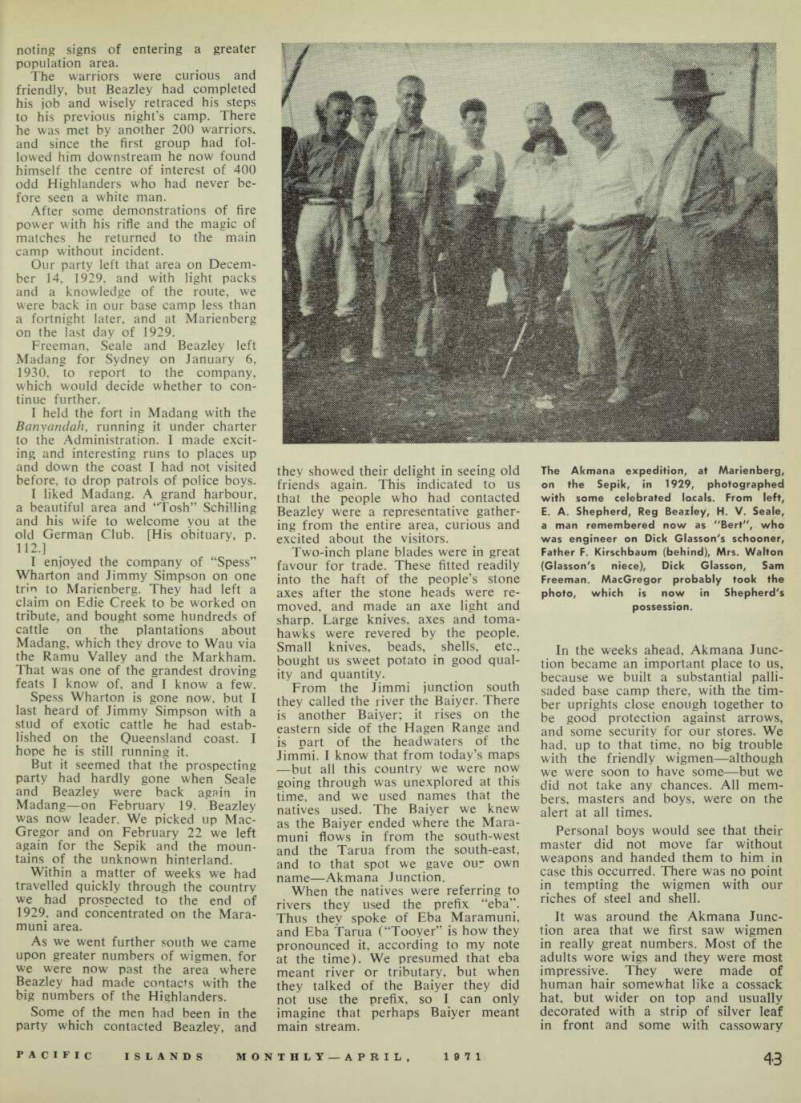
The Akmana expedition, at Marienberg, on the Sepik, in 1929, photographed with some celebrated locals. From left, E. A. Shepherd, Reg Beazley, H. V. Seale, a man remembered now as "Bert", who was engineer on Dick Glasson's schooner, Father F. Kirschbaum (behind), Mrs. Walton (Glasson's niece), Dick Glasson, Sam Freeman. MacGregor probably took the photo, which is now in Shepherd's possession.
plumes on top. They were more than wigs and could truly be described as hats. They were hats.
Their attire was a lengthy front garment of fibre netting in many folds, some coming down almost to their ankles, and strips of cane around their middles in which the stone axe was carried and which held the leaves covering them behind.
There were spearmen with spears about 10 ft long, shod with the horn of the cassowary toe, making a most effective sharp point. The bow and arrow men had huge bows higher than themselves and they carried the arrows, which were not feathered, in hand. They had broad bamboo fire hardened points, sharpened to needle sharp, most effective. Their stone axes were works of art and effective.
Their cigarette papers were leaves plucked from the stern of their neigh bour when squatting near the fire and fixed upright in a hole on top of a section of bamboo used as a holder, or pipe.
The women were adorned with necklaces of many-coloured and bamboo in small to fine sections, variously coloured to deepest amber
by fire. They wore them in many folds around the neck and they were more attractive than the glass beads which we traded them. Furthermore, they estimated the value correctly and were not overly-impressed when we paid them for sweet potatoes.
They were friendly coquettes, the women, and did their own gold digging, soon acquiring all the objects of decoration which our boys could give them. They were good, tough traders in disposing of their food stuffs.
Fire-making equipment was most efficient and the locals often made fire quicker than our boys with their matches, much to the delight of the locals. A length of bamboo with sec tions cut out over half the length held tinder of dried moss, bark, etc.
The solid end was held under foot, and strip of cane which was passed around a groove in the end holding the tinder, made smoke and fire with
very few pulls of the cane. A small stone inserted at the slotted end pre vented the bamboo crushing the tin der. I would recommend the method for the survival kit of any tropical army.
These people did not know betel nut or salt. They had no garamuts, or drums, for signalling, and hailed their messages. Their deep voices fairly filled the valleys and echoed their way across the mountains.
Villages were not large. Houses were in groups scattered about the mountains, some pallisaded.
Their houses were both circular and oblong. The former were, say, three feet off the ground and under neath they were fenced with stakes, probably to shelter pigs.
The oblong houses were built on the ground, in two rows, forming a small village or hamlet. Some of these houses we entered through a small entrance in the wall, with the aid of ladders on some higher houses.
They could pull the ladders up, pre sumably for defence reasons.
Each house had a large slab of flat stone in the middle of the floor on which they built their fires. In one house visited, a sick pig was placed on one of these hot stones to cure it of some illness. Pigs were of great importance and sometimes were suckled by the women.
We were then about 6,000 ft, so it was cold. Gardens were extensive, sometimes terraced and fenced partly with split timber, to withstand the wet conditions.
The Highlanders used a piece of bamboo cut in this fashion to make fire. Tinder was placed in the open end and a pliable cane strap used to create friction; see text.
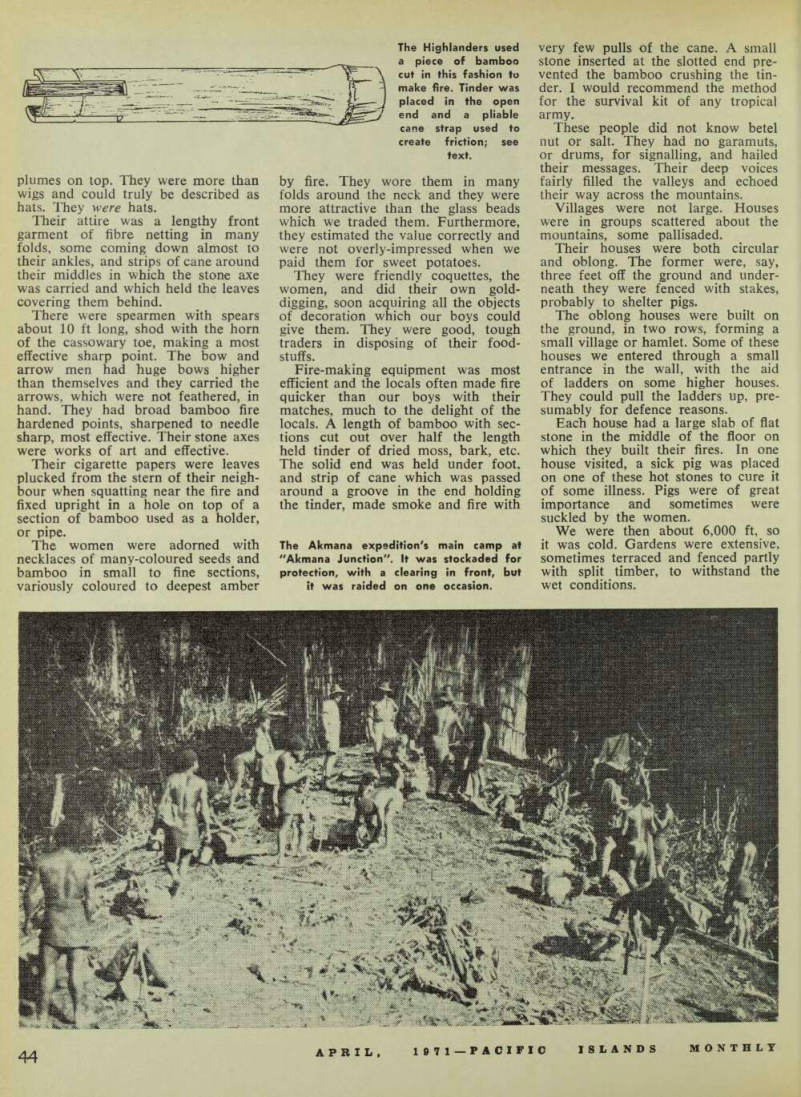
The Akmana expedition's main camp at "Akmana Junction". It was stockaded for protection, with a clearing in front, but it was raided on one occasion.
One small village on the Maramuni had a fine plantation of bamboo and casuarinas and many pigs. It was in this vicinity we saw the first cere monial ground, set out like a small showground with hedges of planted colourful plants and trees with a clearing and substantial buildings of timber and native materials, obvi ously well cared for and the grass under control. Many skulls and bones of pigs were in evidence.
Using Akmana Junction as our base, we prospected the Maramuni to its main source at 7,000 ft, and its tributaries to where the colours ran out. I suppose at the Maramuni’s source we must have been within 30 miles north-west of where Wabag is now. Ahead of us were more rugged broken mountains and more moun tains of the Central Range. 1 know now that if we had con tinued further in a westerly direction and crossed the range the country would have drained to the west to the Lagaip headwaters and on to the Strickland.
And if we had travelled south from the Upper Maramuni it would not have been distant to the Upper Lai River. But we were not interested in exploring further south. The head waters of the rivers that drained to the north coast of New Guinea via the Sepik were the ones we were pros pecting.
It was in this high and poorer coun try (although at 6,000 ft we saw a
good crop of sugar cane) that we made first contact with some “little people.” The little ones were con siderably under normal native height.
They had natives of normal native height with them. They were a friendly, happy people.
It turned out that back at Akmana Junction while we were on this Upner Maramuni job something was hap pening.
We found on our return that the Akmana camp had been raided and most of our steel and trade goods stolen. As no natives came to the camp with food for trade as usual, we decided to take the offensive.
We had very friendly relations with a wigman called Dribau, who had attached himself to the camp as friend and guide. He first joined us on the Baiyer and was a man of influence and obviously highly re spected over a wide area. Dribau was now on hand and we asked him to spread the word by hailing across the valleys that we were very angry (we described with actions that our bellies were boiling with anger).
He was to tell them that the stolen goods were to be left on a flat rock on the river below the camp, other wise we would have to raid their gar dens for food —and there would be no payment this time!
The messages were passed, but by the next day there were no results, so we helped ourselves in the gar dens, and put on a display with our
Right: These nomads were photographed on the Arrabundio. They are a different kind of people from the wig men. The party also met some "little people" of pygmy size.
Below: The wigman Dribau, who befriended the party and assisted them on several occa sions.
.303 rifles, firing them at long range in the general direction of any stray native we saw on watch, sometimes in rapid fire to make the show more impressive. The shots were meant to demonstrate that we were serious, but we were not trying to hit anyone.
This got better results. The next morning there were some stolen goods on the flat rock.
About midday we decided we would have to speed things up a bit, so Dribau passed on the news that we would “make thunder without a cloud in the sky” and that they had better watch out!
We detonated a big supply of gelig nite and made those old mountains echo and re-echo, much to the horror of those visitors who happened to be in the vicinity (who, unfortunately, didn’t include any of the miscreants).
Those near the camp clung to each other for comfort in their fear (the locals often did this also when they were perplexed and surprised, but not to such a degree of frenzy). They were also much given to holding hands, and we met one tribe where you would see warriors walking about hand in hand.
The booming of the dynamite did the iob. Next morning most of our goods were on the flat rock and it was not long before we were a friendly community again, with busi
ness as usual, and quite a few grins.
Both sides took the exercise in good humour, and the Poomani people were blamed for the raid. They were the stronger tribe who raided the locals, who tried hard to provoke trouble between them and us.
In this, and in other instances, we went to some trouble to keep on good terms with the people, for we knew that in that community, like all others, there were trouble makers and young warriors anxious to show their prowess, and the atmosphere could change in quick time. And steel and trade goods are always a temptation.
The recovery of our goods com pleted to everybody’s satisfaction, we set off next to prospect the Tarua.
This, too, was mountainous country, not steep and harsh, but on the south ern side, after a week of prospecting during which we continued to follow the river and to move further south east, we came to a big area of open downs-type grass country.
The grasses were somewhat similar to the Mitchell and Millet type grasses that grow on the north-west plains of New South Wales. This, I thought at the time, was grand cattle country, for it had strong feed (not big and coarse), and running streams. This grass country rose to a not-far-distant horizon to the south, but we did not go further south because we were working towards the south-east, where the river took us.
Looking at the maps today I would say we were then about 30 miles north-east of where Wabag is today, and that probably only a range sepa rated us from the Lai River Valley, and it could only have been a low range as there was no background of mountains to the south. We did not cross the grass country in that direc tion.
Soon we came to a timbered range where a landslide revealed the forma tion, and we were able to study the rocks and formation, which were not of interest.
It was in this grass country that we came across a sunken road. It was most impressive. We were following the well-made path across slightly undulating grass country when we came to a cutting about 30 paces long, dug through one of the undula
Right: The Akmana party on the Baiyer River, with great boulders in the background. Below: A High land house, on the upper Mara muni. Pigs are kept underneath.
lions, so that its side rose to 10 ft at the deepest part. You could drive a cart through this cutting, which was obviously built as a defensive measure to give protection to those who were following this route and who found themselves in the open grass country without any natural protection. A few warriors with bows and arrows could keep off any attackers from this effec tive defensive position.
We saw only one warrior in this area—a fine type of man standing near a grand old pine tree, one of the hoop pine variety. We said nothing and neither did he.
At this time, on the able advice of “Pontey” Seale, it was decided there was nothing to justify further explora tion. We had broken into much new country and discovered new peoples, but gold was our interest, and we had traced the rivers and tributaries as far as practicable where conditions and results justified the effort and found nothing worthwhile. In the many years since, there have been quite a few reports of prospecting parties in the area. But nothing of note has been reported: So we did not leave much behind, it seems.
We made a peaceful entry into this new country, establishing a reputation for fair trade and decent behaviour, but to stay and search further just on the off chance could not have been justified.
On our travels, despite the friendli ness of the people, we saw plenty of evidence of local wars. Houses were burned out at times, and numbers of
men showed battle scars. A number of minor adventures we had could have provoked fighting, perhaps a war, if not properly handled.
I want to pay tribute to all mem bers of that expedition of 40 years ago—friendly and enjoyable com panions all—and where every mem ber pulled his weight, including the loyal gun boys and carriers, whom I will always remember. We returned to Madang, and very shortly after to Sydney on the Montoro, leaving Madang July 3, 1930. We had been four months on our final ex pedition to the Central Ranges.
Seale is today retired in Sydney, like myself. Beazley is retired in Bris bane. MacGregor and Freeman have passed on. Seale later visited New Guinea again, following his profes sion, in 1937. MacGregor remained there and took part in the develop ment that came later. Freeman never went back and neither Beazley nor myself has returned.
After I got back from the expedi tion in 1930, I became travelling manager of a pastoral company in NSW and Queensland. Having later acquired my own interests I have had no reason to follow the many changes that have occurred in New Guinea since I saw it in those pioneering days on the Sepik and the Western High
lands. And when it comes to the Highlands, those were pioneering days.. , , . A 1 FOOTNOTE : Members of the Ak mana party donated wigs they had brought J> ac k to various museums, T. wo °* wen * t 0 the Australian Museum, Sydney (from Beazley and Shepherd). Current records at the Australian Museum show that Beaz ley s wig, described as “a cap com posed of human hair from the head aters . of ™ e , U-at River, Central Mountains, Mandlated Territory of * was lodged on January 31, 1930, presumably on his quick visit to a * ter I* l6 , h rst expedition, Shepherd presented another wig to Father Kirschbaum, who wanted to senc ll ■ to Germany. The wigs in the Australian Museum were later con £V. se ,4 5° me brought out tj l6 Highlands 10 years afterwards by Jim Taylor during his Hagen-Sepik patrol, and wrongly attributed to him when put on display,
A wigman and a young boy, taken on the Upper Maramuni.
Ernie Shepherd still has the Miner's Right issued to him for the Akmana expedition.
He had held an earlier one, in 1926, when he did some work in the Sepik for an oil exploration company.
WiKiam Hawari