The Censor Moves In
p. 34 · Read in the full issue
The Duke
Rubs Noses
With The
Dancing
Girls
The Censor Moves In
Off the beaten track: That was in Pitcairn, Rarotonga, Western Samoa, Fiji, New Hebrides, BSIP and Papua-New Guinea, and a few stray islands between. From the start the Duke let it be known he wanted to see new faces and places, as informally as possible. He travelled in the royal yacht or by air.
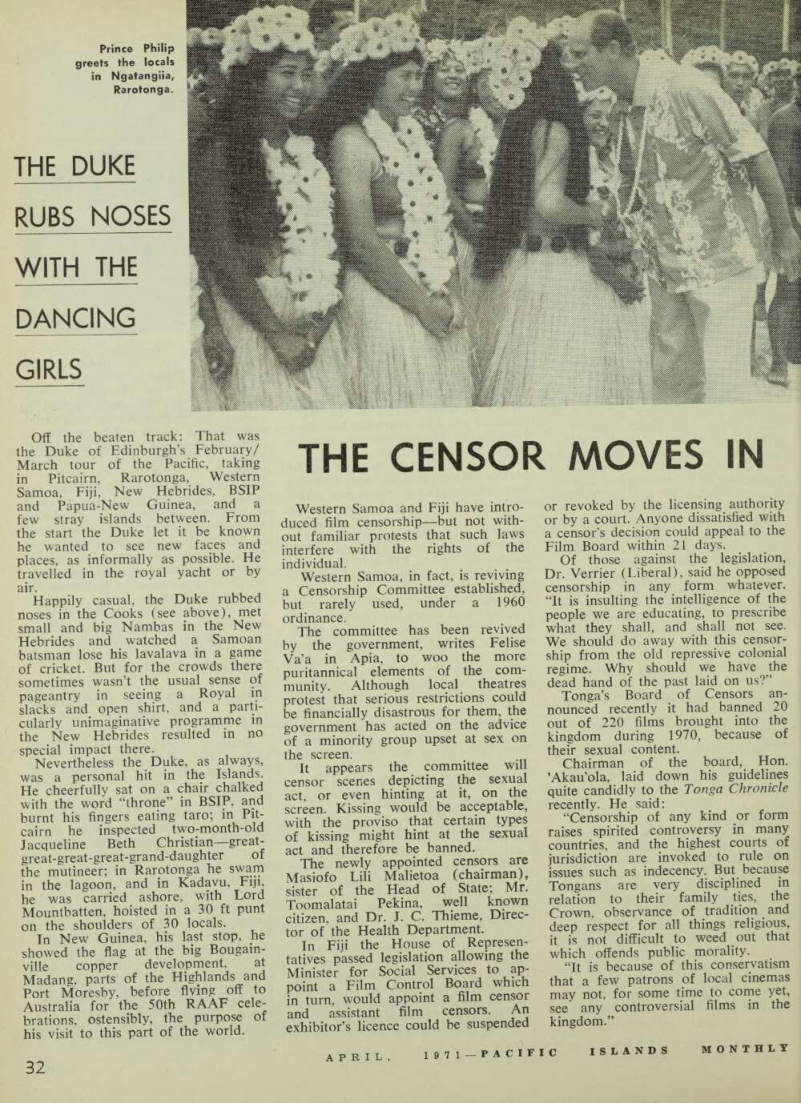
Happily casual, the Duke rubbed noses in the Cooks (see above), met small and big Nambas in the New Hebrides and watched a Samoan batsman lose his lavalava in a game of cricket. But for the crowds there sometimes wasn’t the usual sense ot pageantry in seeing a Royal m slacks and open shirt, and a particularly unimaginative programme in the New Hebrides resulted m no special impact there.
Nevertheless the Duke, as always, was a personal hit m the Islands He cheerfully sat on a chair chalked with the word “throne” in BSIP, and burnt his fingers eating taro; in Pitcairn he inspected two-month-old Jacqueline Beth Christian great-
great-great-great-grand-daughter of
the mutineer; m Rarotonga he swam m the lagoon, and in Kadavu, Fiji, he was carried ashore, with Lord Mountbatten, hoisted in a 30 ft punt on the shoulders of 30 locals.
In New Guinea, his last stop, he showed the flag at the big Bougamville copper development, at Madang, parts of the Highlands and Port Moresby, before / Australia for the 50th RAAF celehis'vkit’to o 'tirtt of the > 'wo°U.
Western Samoa and Fiji have introd uced film censorship—but not without f am iii ar protests that such laws interfere with the rights of the individual.
Western Samoa, in fact, is reviving a Censorship Committee established, but rare i y used, under a 1960 ordinance ’
ThQ committee has been revived . the government, writes Felise y^ a in Apia to ’ woo the more itannical elements of the com- Although local theatres protest that serious restrictions could be financia d y disastrous for them, the SOV ernment has acted on the advice & minority groU p upset at sex on tb een appears the committee will censor scenes depicting the sexual hinting at it, on the nmtmg * iso that certain types kissing might hint at the sexual therefore be banned. new i y appo i nte d censors are Masiofo u ( (chairman), of the Head G f state; Mr.
T’nnmalatai Pekina well known j c ’ rj|jj eme Di rec -
fnr nf’the Health Department.
tor of the health V es passed legislation allowing the tauves passed icgib u & Minister fa Board which f n mm would appoint a film censor w.turn, would appoint a_n An exhibitor’s licence could be suspended
or revoked by the licensing authority or by a court. Anyone dissatisfied with a censor’s decision could appeal to the Film Board within 21 days, Of those against the legislation, Dr. Verrier (Liberal), said he opposed censorship in any form whatever.
“It is insulting the intelligence of the people we are educating, to prescribe what they shall, and shall not see.
We should do away with this censor ship from the old repressive colonial regime. Why should we have the dead hand of the past laid on us?
Tonga’s Board of Censors an nounced recently it had banned 20 out of 220 films brought into the kingdom during 1970, because of their sexual content.
Chairman of the board, Hon. ’Akau’ola, laid down his guidelines quite candidly to the Tonga Chronicle recently . H e said: “Censorship of any kind or form raises spirited controversy in many countries, and the highest courts of jurisdiction are invoked to rule on issues such as indecency. But because Tongans are very disciplined m relation to their family ties, the Crown, observance of tradition and deep respect for all things religious, ;t n J difficult to wee d out that which offends public morality, « It j s because of this conservatism that a few patrons of local cinemas may not, for some time to come yet, any controversial films m the kingdom.”
Prince Philip greets the locals in Ngatangiia, Rarotonga.