Footnotes
pp. 30-31 · Read in the full issue
In Defence
Of An Ancient
Trade Language
COB A LELE is a 12-year-old Koiari boy from Efogi, a village on the Kokoda Trail.
The Koiari are a mountain tribe with a reputa tion for ferocity and sorcery which has made them greatly feared by the people of the coast, and they are only now emerging from the primitive condi tions in which they were found to be living when first visited by missionaries and administrators in the 1880 s.
No longer ago than 1942, a group of carriers from the Yule Island area, deserting from the rigours of the Kokoda Trail and trying to make their way home across country, were merci lessly massacred by a party of Koiara hunters who came upon them as they were trying to cross a river. I suppose that the Koiari felt that as the Australians were slaughtering their enemies there was no reason why they should not be allowed to do so too.
Soba Lele emerged into fame when a policeman arrived in his village after a three-day walk from Sogeri, to serve a summons for non-payment of income tax.
Soba has never enjoyed a cash income, but when the policeman asked him if his name was Soba, he said “Yes”, and accepted the summons which the policeman handed him.
As Soba can’t read he was unable to observe that the name
on the summons was that of one Soba Gemena.
Soba’s family rallied to his aid, as Papuan families are wont to do. They scraped together enough money to provide Soba and his uncle with air fares to the big smoke, with a bit over for their sustenance while there.
When Soba presented himself on the appointed day at the Port Moresby District Court, it was obvious to one and all that a mistake had been made. Why at this point Soba and his uncle were not put aboard a plane and sent back to their village is not clear. But they weren’t. The magistrate adjourned the case for a month. Soba spent the month enjoying the bright lights, and at its expiry appeared again in court, where, with the assistance of a lawyer from the Public Solici tor’s Office, he obtained $l5O in costs.
Rich beyond the dreams of avarice, and leaving behind him, no doubt, some red faces in the Departments of Taxation and Police, Soba
and his uncle boarded a plane for Efogi, where, one hopes, he will live happily ever after.
It was an odd case, and there were some odd Press and radio comments on it. The Papua- New Guinea Post-Courier said of Soba, “He can not speak English or Pidgin, communicating through Police Motu”.
Why anyone should have expected Soba to be able to speak Pidgin is hard to understand. He is a native of the Central District of Papua. His mother tongue is Koiari. In so far as he can be
With Percy Chatterton
in Port Moresby
said to have a national language, it is the ancient trade language of Papua, which was in use for centuries before the arrival of the white man, but which, due to its adoption as a lingua franca by Sir William MacGregor’s embryo police force and later by the Royal Papuan Armed Constabu lary, came to be known as “Police Motu”.
Following the post-war amal gamation of the Papuan and New
Guinea police forces and the resulting in creased use of Pidgin in the force, the designation “Police Motu” has become increas ingly incongruous, and House of Assembly Speaker Dr. John Guise’s suggestion that this still widely used Papuan lingua franca should be called “Basic Motu” is worthy of adoption.
It is, of course, true that Papuans who are exposed to Pidgin easily pick it up and use it in talking to New Guineans. But Soba Lele has never been exposed to it, and it is therefore not surprising that he has no knowledge of it.
In its broadcast report of the case the ABC added, rather unkindly, that Soba is illiterate. I do not think he need be ashamed of this short coming. According to the 1966 census figures he is one of Papua-New Guinea’s 1,126,955 illiter ates —approximately half of the total population.
As far as Papua is concerned, the level of illiteracy is probably greater now than it was
before the war when the missions were concen trating on vernacular literacy. It must be admitted that when Papuans became literate in their own language or in Motu, there wasn’t much for them to read. On the other hand, this form of literacy did provide our dusky damsels with a medium in which they could write more evocative love letters to their boy friends than their daughters and grand-daughters are able to compose nowa days in primary school English. Today’s teenage love notes are poor wishy-washy stuff compared with those I used to confiscate away back in the 19205.
Recently some missionaries in New Guinea have been advocating a return to Pidgin in New Guinea’s primary schools. I feel much sympathy with them, but doubt if the proposal is really prac ticable. I am afraid that we are stuck with English as the language of formal education. However, the idea that a vernacular or Pidgin or Basic Motu, as the case may be, should have some place in primary education, if only for the benefit of those whose education will not go any further, is gaining ground, and there are indications that it may receive more sympathetic consider ation from the newly established Territory Edu cation Board than it has in the past from the Department of Education.
But apart from this, there is tremendous scope for the promotion of literacy in the vernacu lars, and in Pidgin and Basic Motu, among adults and among those of Papua-New Guinea’s children (six out of every 10), who are unable to secure any formal education at all.
The more successful such a literacy cam
paign, the more practicable will become the pro duction of reading material, at least in Pidgin and Basic Motu, and probably in some of the major vernaculars as well.
However, for such a venture to succeed, the material published must be material composed in these languages, not stuff translated from English.
A great deal of the translation from English into Basic Motu is appallingly bad, and the worst of it is completely unintelligible. This is due some times to the translator’s inadequate understanding of the English before him, but more often to over literal translation.
I am not competent to speak about Pidgin, but I have been told by people who are that the situation is much the same in relation to transla tions into Pidgin.
Whatever is produced must be written in, not translated into, the language, whether it be a vernacular or a lingua franca.
By and large I am not an enthusiast for Pidgin. I have suffered too much during long hours spent in listening to Pidgin speeches in the House of Assembly. I am convinced that Pidgin is not a suitable medium for the discussion of political or economic problems.
But I think that it has a great future not only as a medium of social intercourse, but also in the fields of poetry, drama and short story writing.
Plays produced in Pidgin have been most effec tive, and the two small collections of Pidgin poems I have read are quite fascinating.
A literacy programme should be orientated not only towards reading in the language chosen but also towards original writing in it.
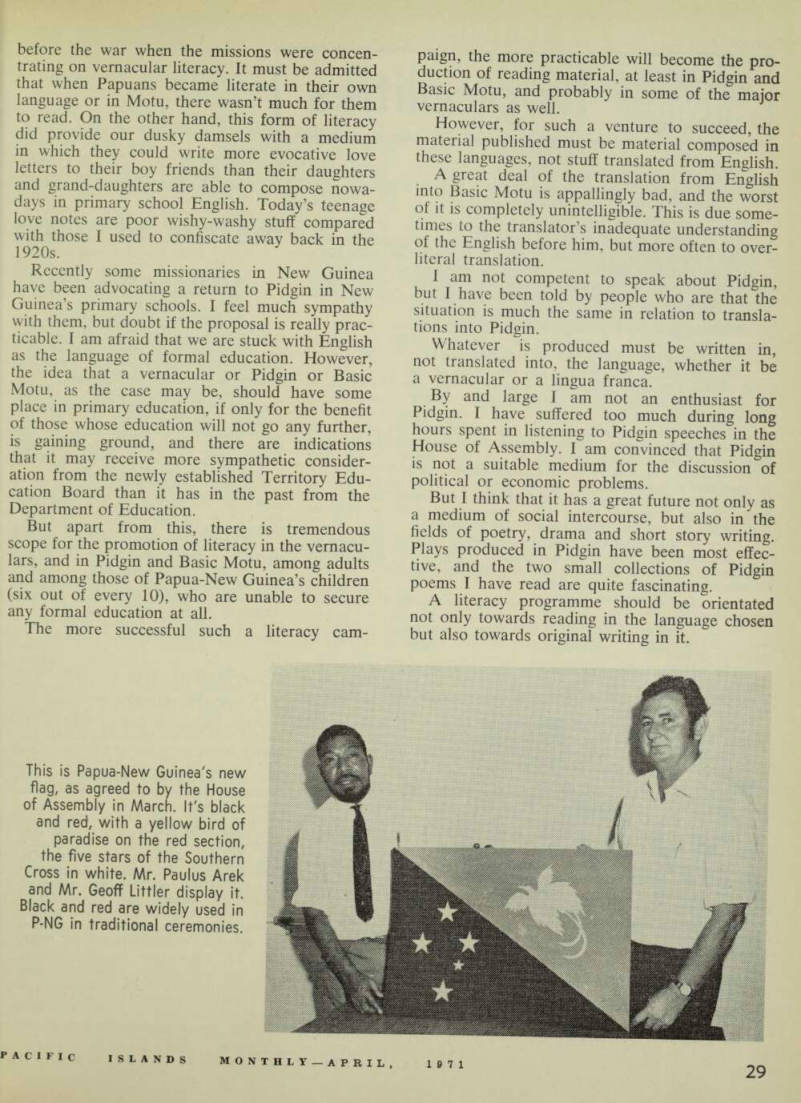
This is Papua-New Guinea's new flag, as agreed to by the House of Assembly in March. It's black and red, with a yellow bird of paradise on the red section, the five stars of the Southern Cross in white. Mr. Paulus Arek and Mr. Geoff Littler display it.
Black and red are widely used in P-NG in traditional ceremonies.