Business and Development
pp. 111-114 · Read in the full issue
Noumea Gets Its First
Caledonia-Based Bank
New Caledonia’s rich nickel ore deposits are responsible for a scramble among France’s top banks to get in on the ground floor.
But until only a few years ago, the Paris-based Banque de I’lndochine had the monopoly on banking throughout the territory and even had the privilege of issuing its own bank notes.
About two years ago, the BIC lost the right to issue such notes and at the beginning of 1969 the government - controlled B a n q u e National de Paris opened an office in Noumea.
Towards the end of 1970, several other French banks applied for the right to operate in the territory. The Banque de Paris et des Pays Bas (Paribas), the “Societe Generale” and the “Credit Lyonais” were the most active.
Finally, on January 16, 1971, the Banque de Paris et des Pays Bas be came the talk of the town when it announced the formation of the first Caledonian-based bank. A French holding company called “Caldev” holds 70 per cent, of the capital and the Bank of America the remaining 30 per cent.
The sudden introduction of the Bank of America in partnership with Paribas lent support to the whisper that French financiers were short of cash for the big mining development planned by Paris for New Caledonia.
Significantly, Paribas is a shareholder in the Cofimpac nickel refining pro ject with Inco of Canada.
Caledonian mining circles were quick to contrast the ease with which the Bank of America was allowed in, while the Paris-based Societe Le Nickel request to Japanese financiers for a SUSI9O million loan to build a nickel ore smelter at Poum (the Someca project, with Patino) was a “little slow” in being granted.
The French bank Paribas used a novel technique for setting up its new operation. First it took 67 per cent, in a holding company called Caldev (Societe Neo-Caledonienne de Developement et de Participa tion) and distributed the remaining 33 per cent, to Caledonian investors.
The main Caledonian shareholder is Mr. Edouard Pentecost, a leading nickel ore miner and exporter. Mr.
Pentecost is also second vice-president of the Territorial Assembly and was until recently an active member of the Gaullist mino r it y in the Assembly. (Mr. Pentecost stopped paying his SUS3OO monthly party dues in May, 1970, after the Paris government introduced a limitation on nickel ore exports to Japan.) Caldev then took 70 per cent, and the Bank of America 30 per cent, in a bank set up in Noumea under the name “Banque de Paris et des Pays de Nouvelle Caledonie”. The pro moters were quick to point out that as the new bank was registered and had its head office in Noumea, it was the first “real” Caledonian bank.
To sign the company agreement in Noumea, Paribas Bank was repre sented by Mr. Pierre Decker, assis tant managing director of the Paris head office.
The Bank of America sent Mr.
Scudder Mersman, senior vice president, Europe and Middle East, and Mr. James Drumwright, vice president, Asia Division. At the Press conference held in Noumea on January 15, a newsman was heard to say of Mr. Mersman, “But he speaks French with a Tahitian accent . . .”
Which was true, as Mr, Mersman spent some of his childhood in Tahiti, when his father was posted at the US Consulate there.
Meanwhile, the site of the new bank was still under discussion when its creation was announced. However it is expected that it could open in the middle of this year.
Asian Development
Bank aid for Fiji
The Asian Development Bank will give Fiji technical assistance worth $90,000, to assist with the re organisation of the Fiji Development Bank.
An agreement on the terms of the assistance was signed in Suva in February by the Prime Minister,
Visiting president of the Asian Develop ment Bank, Mr.
Takeshi Watanabe, and Fiji's Minister of Finance, Mr. Wesley Barrett, look happy at the start of Mr.
Watanabe's four-day visit to Fiji in February. Fiji is now a member of the bank.
Ratu Sir Kamisese Mara, and the president of the Asian Development Bank, Mr. Takeshi Watanabe.
Three officials of the Asian De velopment Bank will spend a year working with the Fiji bank, although the actual date has not yet been de cided.
Their terms of reference will be to assist the Fiji bank in forming a policy statement and deciding op erational guidelines; to advise on and help with the bank’s reorgani sation, to set up an industrial loans division of the bank and to train its staff.
The Asian bank’s experts will ad vise on how the bank can assist in diversifying industry in Fiji and on the expansion of its work in ac cordance with sound financial principles.
Canadians interested
in Fanning
Burns Philp and Co. Ltd. has been asked by a syndicate of Canadian businessmen if its Central Pacific atoll plantations on Washington and Fanning Islands are for sale.
An initial enquiry by a titled Eng lishman to the company’s old Crutched Friars London headquarters, on behalf of the syndicate, was re ceived late last year. It’s been fol lowed up by an approach to BP’s Sydney office.
Run by a BP subsidiary, Fanning Islands Plantations Ltd., the two atolls are part of the GEIC group.
In good years, the plantations pro duce over 2,000 tons of some of the best copra available in the South Pacific.
Twelve months on
the London markets
The London market, which deter mines much of the world’s prices for commodities, was a mixed bag for the Islands during 1970. And potential is equally mixed.
Most metals (including nickel, cop per, bauxite and manganese), rubber and cocoa all declined, while sugar, coffee and coconut oil rose. Copper fell £Stg.26B a metric ton to £431/15/- a ton, which will hasten some re-estimates of potential Boug ainville copper profits. Rubber fell with the general malaise of the world economy; spot closed at 18 9-16 d lb, a drop of 5 7-16 d over the year.
Hopes are an upturn in the US car industry will soon help prices.
Sugar did best of all, increasing over 50 per cent, and in early Janu ary it hit a 6k-year peak of £46 per ton. Producing countries, including Fiji, start 1971 with export quotas at 100 per cent., against 90 per cent, a year ago, so prospects are excellent.
Cocoa had a record year in Lon don, with a five million-ton turnover.
Prices opened at £335 a long ton and gyrated widely throughout the year because of unpredictable statements from the major producers in Africa.
Closing price was £285/5/- and the market estimated that if the Ghanian crop totalled 360,000 tons, it would drop to £250.
Coffee future under the Robusta contract rose £53 a long ton over the year, closing at £390/10/-. Eyes are now turned on Brazil to see if recent diseases have been overcome.
Coconut oil terminal activity disap pointed, with UK consumption drop ping, and the big buys being for the Continent and the US. Price rose £ll/10/- to £155/5/-.
New Hebrides copra
plan delayed
Ballandes, the diversified French trader and shipper in New Caledonia and the New Hebrides, is the party with which Burns Philp (New Hebrides) Ltd. has made a joint pro posal to build a copra crushing mill in the New Hebrides.
The Hebrides Government has not yet given a go-ahead on the project, but the two firms are not pressing a decision until it is known if coconut oil will be allowed into Britain should she enter the European Common Market.
Light industry moves
into Nausori
The small town of Nausori, out side Suva, is being turned into an important centre for light industry.
Companies with plans to manufac ture products ranging from yoghurt and clothing to nails and parquet flooring have already bought land on a new industrial estate being established near the town.
One of the biggest factories on the 12-acre first stage of the estate, will be occupied by Union Woods (Fiji) Ltd., a new public company which will manufacture parquet flooring.
The Hines Construction Corpora tion intends to invest about SFBO,OOO in establishing a new head quarters at Nausori. The company at present operates from Suva^ A new company, Gang Nail Fiji Ltd., has plans to build a factory to manufacture special nails for construction work. It will manufac ture roof trusses and bridge com ponents also.
Oceania Foods (Fiji) Ltd., will operate a yoghurt factory on the estate and another company.
Cotnit Products Ltd., will manufac ture clothing.
There are plans too for a bakery, rice mill and factory to produce con crete blocks.
Coconut boards
to meet
Fiji and Tonga have called a meeting of renresentatives of the nine South Pacific copra boards, to be held in Nukualofa on April 15-16.
The meeting is to decide whether
the boards should take regional membership of the Asian Coconut Community.
The agenda will also include dis cussion of a proposal to establish a regional coconut research centre, copra marketing, coconut pest con trol and the setting-up of more coco nut-processing industries in producer territories.
Apia cannery to
keep going
Marketing Management (Western Samoa) Ltd, an almost wholly New Zealand-owned pineapple canning firm, would be out of receivership by March, a director said in Auckland in February.
The firm, which has operated out of Western Samoa for about a year exporting to NZ, was recently placed in receivership. Its plant is now being operated by a local concern, Para dise Canneries Ltd.
A director of Marketing, Mr. J.
R. Pulham, said positive steps were being taken to get the firm back in operation. Earlier there had been some concern in Samoa that the failure of the cannery would have a bad effect on overseas investment. A senior official in Apia said high over heads and lack of guaranteed pine apple production contributed to diffi culties in marketing management.
Apparently canned papaw juice failed to interest the NZ market.
Rotary aid for Sepik
swamp dwellers
Rotary clubs in Massachusetts and Western Australia nearly 10.000 miles apart are working together so that villagers in the lower reaches of New Guinea’s Sepik River can snap-freeze their fish for market.
An American girl on a Rotary exchange with New Guinea, worked during 1969 in the Pagwi area of the Sepik River, and was quick to see that if the fishermen could freeze their fish long enough, then there’d be a good market at Wewak.
Back home in Massachusetts, the American girl talked about the idea.
Soon, all of the Rotary clubs in Massachusetts began working on a 5A5.600 project to give Pagwi a snap-freezer capable of handling 1.000 lb of fish at a time.
International Service Director of the Carnarvon Rotary Club in West ern Australia, Mr. Ted Cockram, got involved ... to the extent of visiting the Senik.
Roman Catholic missionary.
Father Joseph Egan, is in charge of the Pagwi proiect covering the Pagwi-Bimi area in the Sepik. He says the villagers are building a large
two-hull canoe to carry the freezer, and it will start working late March or early April.
Father Egan says that if the market at Wewak is as good as the fishermen hope, then the Massachusetts- Western Australia Rotary clubs’ freezer could be the first step in a co-operative leading to a fish-canning industry.
The Sepik swamp people certainly could do with a few luxuries out of life for a change.
D* L.
Kicn manganese
finslc in Fiii TinaS in njl The Australian-backed mining concern. Investment Corporation of Fiji Ltd., has reported rich deposits
of manganese ore at Sigatoka and Nayavu.
The company, which holds six month options on four prospecting licences for sites at Sigatoka, Ba and Nayavu, has been prospecting for several months in Fiji, The corporation’s resident secre tary in Fiji, Mr. M. D. Richmond, describes the deposits at Sigatoka as very big. “We are hoping to exercise our option on this site with in the next two or three months and begin mining operations,” he said in February.
Assay results of the Sigatoka and Nayavu deposits showed a high per centage of manganese ore about 57 per cent., he said. The deposits at Balevuto, Ba, had not yet been fully investigated.
Japanese cars most
popular in Fiji
Japan has cornered the car mar ket in Fiji and Britain has slipped to third place.
Most recent figures released by the government in February, show that in November last year Japan sold 157 cars in Fiji, Australia sold 90 and Britain sold only 85.
Britain formerly held the mono poly on the Fiji motor market, but industrial disputes and strike delays appear to have affected its export production during the past few years.
Five years ago, Britain sold 1,060 cars in Fiji during a 12-month per iod in which Australia sold 613 cars and Japan only 374.
In 1969 Japan took the lead with 881 sales, compared with 843 Brit ish sales and 672 Australian sales.
During the first 10 months of last year, Japan sold 1,018 vehicles, Brit ain sold 826 and Australia sold 632.
There were also 21 sales from other European countries, six from the US and Canada and three from New Zealand.
And tuna fishing
for Fiji?
Fiji Islanders may soon be using barbless hooks to haul in tuna around the Fiji coast. A UNDP/FAO and Fiji Government two year, $450,000 project to start a local tuna industry began in January with the arrival in Suva of Hawaiian tuna expert, Mr.
Robert Lee.
Mr. Lee said the project’s first three months would be spent searching for live tuna bait in an 80 ft tuna boat chartered from Japan and crewed by Fijians under a Japanese skipper. He hopes Fiji Islanders will take to the technique of catching tuna by hook ing them with barbless hooks when they swim round the ship attracted by the live bait. It’s a technique used widely round Australia’s coast, and it could lead to a big reduction in Fiji’s canned fish import bill. (Twenty years ago the late Mr, Harold Gatty tried to start a tuna industry using the same catching methods, but the project was not a commercial success).
Kege has an
ear for business
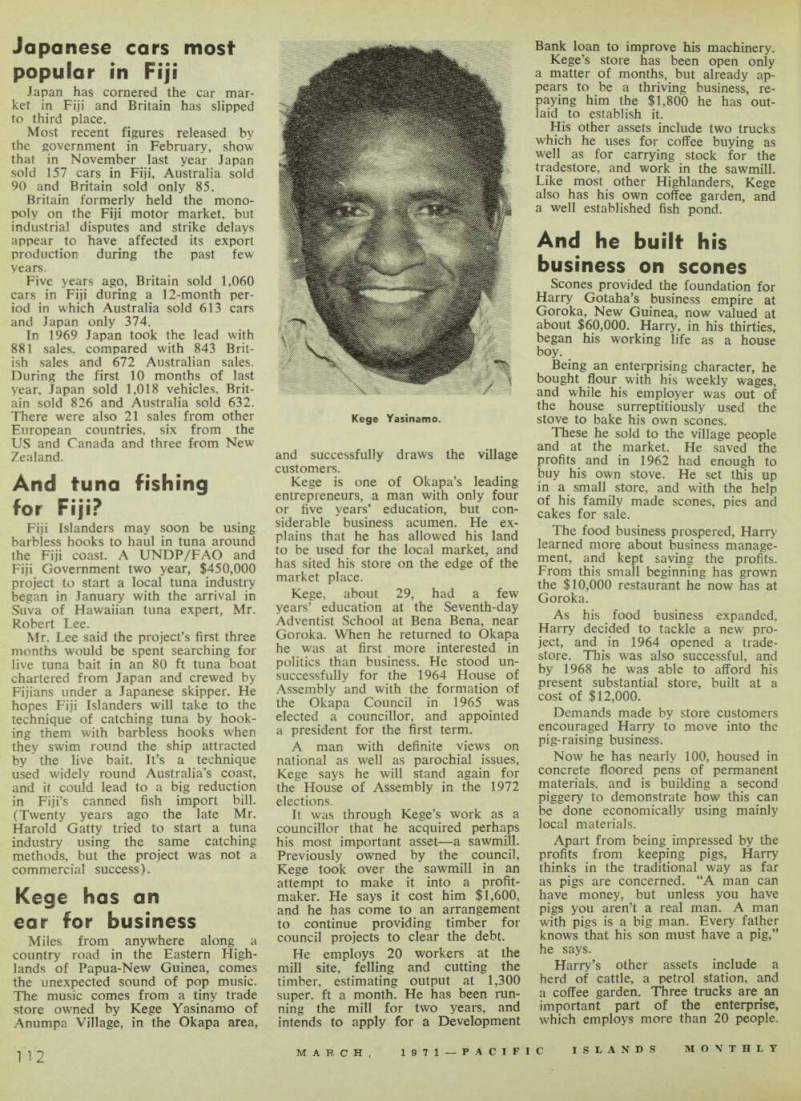
Miles from anywhere along a country road in the Eastern High lands of Papua-New Guinea, comes the unexpected sound of pop music.
The music comes from a tiny trade store owned by Kege Yasinamo of Anumpa Village, in the Okapa area,
and successfully draws the village customers.
Kege is one of Okapa’s leading entrepreneurs, a man with only four or five years’ education, but con siderable business acumen. He ex plains that he has allowed his land to be used for the local market, and has sited his store on the edge of the market place.
Kege, about 29, had a few years’ education at the Seventh-day Adventist School at Bena Bena, near Goroka. When he returned to Okapa he was at first more interested in politics than business. He stood un successfully for the 1964 House of Assembly and with the formation of the Okapa Council in 1965 was elected a councillor, and appointed a president for the first term.
A man with definite views on national as well as parochial issues, Kege says he will stand again for the House of Assembly in the 1972 elections.
It was through Kege’s work as a councillor that he acquired perhaps his most important asset —a sawmill.
Previously owned by the council, Kege took over the sawmill in an attempt to make it into a profit maker. He says it cost him $1,600, and he has come to an arrangement to continue providing timber for council projects to clear the debt.
He employs 20 workers at the mill site, felling and cutting the timber, estimating output at 1,300 super, ft a month. He has been run ning the mill for two years, and intends to apply for a Development
Bank loan to improve his machinery.
Kege’s store has been open only a matter of months, but already ap pears to be a thriving business, re paying him the $l,BOO he has out laid to establish it.
His other assets include two trucks which he uses for coffee buying as well as for carrying stock for the tradestore. and work in the sawmill.
Like most other Highlanders, Kege also has his own coffee garden, and a well established fish pond.
And he built his
business on scones Scones provided the foundation for Harry Gotaha’s business empire at Goroka, New Guinea, now valued at about $60,000. Harry, in his thirties, began his working life as a house boy.
Being an enterprising character, he bought flour with his weekly wages, and while his employer was out of the house surreptitiously used the stove to bake his own scones.
These he sold to the village people and at the market. He saved the profits and in 1962 had enough to buy his own stove. He set this up in a small store, and with the help of his family made scones, pies and cakes for sale.
The food business prospered, Harry learned more about business manage ment, and kept saving the profits.
From this small beginning has grown the $lO,OOO restaurant he now has at Goroka.
As his food business expanded, Harry decided to tackle a new pro ject, and in 1964 opened a trade store, This was also successful, and by 1968 he was able to afford his present substantial store, built at a cost of $12,000.
Demands made by store customers encouraged Harry to move into the pig-raising business.
Now he has nearly 100, housed in concrete floored pens of permanent materials, and is building a second piggery to demonstrate how this can be done economically using mainly local materials.
Apart from being impressed by the profits from keeping pigs, Harry thinks in the traditional way as far as pigs are concerned. “A man can have money, but unless you have pigs you aren’t a real man. A man with pigs is a big man. Every father knows that his son must have a pig,” he says.
Harry’s other assets include a herd of cattle, a petrol station, and a coffee garden. TTiree trucks are an important part of the enterprise, which employs more than 20 people.
Kege Yasinamo.