Book Reviews
pp. 89-91 · Read in the full issue
Behind the lines in the wartime Solomons
It’s surprising that so long after the end of World War II an important source book on a Pacific campaign can still appear, and virtually unheralded at that, but such a work is D. C. Horton’s Fire Over The Islands.
It’s a first-hand account of the work of the Coastwatchers in the Solomons, of whom Dick Horton was one. Like M. Murray’s Hunted, which dealt with some exploits in New Ireland, and Malcolm Wright’s If 1 Die (New Britain), it just has to go on the shelf alongside that first, best and overall reference work, Eric Feldt’s The Coast Watchers.
For depth and interest, Fire Over The Islands is the next best thing to The Coast Watchers.
Although Horton bases his book on his personal story, he branches off frequently to give detailed reports on the exploits of his companions-in arms, using their own accounts as much as possible. Thus he gets the whole Solomons campaign in focus for us, with stress on the part played by the Coastwatchers and the native scouts.
As a pre-war District Officer on Guadalcanal, in the time when Tulagi, not Honiara, was adminis trative headquarters, Horton is eminently qualified to report on the affects of the war on the Mela nesians, and especially those of Guadalcanal, and his book is as much an account of, and tribute to, their work as that of the Coast watchers.
He stresses frequently their valu able ability at scouting—of their in telligent approach to the task, without fuss.
Horton says, “By nature the Solomon Islander is very observant and capable of very shrewd judgment of character but, until he knows someone well, he appears shy and undemonstrative. Yet it would be a great mistake to underrate his courage and intelligence, which are allied to a nature which is at once practical and interested in things spiritual, whether it be the worship
of his ancestors, or his clan totems, or the comparatively newly estab lished Christian sects.
“Therefore the blossoming of the varied talents lying dormant in the islanders until the war called them forth was more easily understood by the Coastwatchers and others who had been in the islands for some time than by the Americans, who were in clined to equate them as somewhat intellectually below the Negroes of the United States.”
As one of many cases in point Horton refers to Aliki, an Ysabel man who was attached to the Coast watching unit in position behind the Japanese base in Rekata Bay, on the north coast of Ysabel.
“Aliki looked a complete fool, but he had a very shrewd brain and any amount of courage,” writes Horton.
“When the Japanese first estab lished themselves in Rekata Bay he
walked into their camp with fish and vegetables for sale. He was im mediately seized and taken before the naval commandant, closely in terrogated, then lined up as though he was to be shot. The commanding officer asked him if he was not afraid of being shot, to which Aliki replied: ‘Shoot me if you like, but I am a friend of Japan’s’.
“Eventually the commanding officer was satisfied of his innocence and made him a personal friend, telling him such things as when and how he was going on leave by sub marine, allowing Aliki to move all over the camp and see the gun positions, the barracks and other ar rangements. All this information
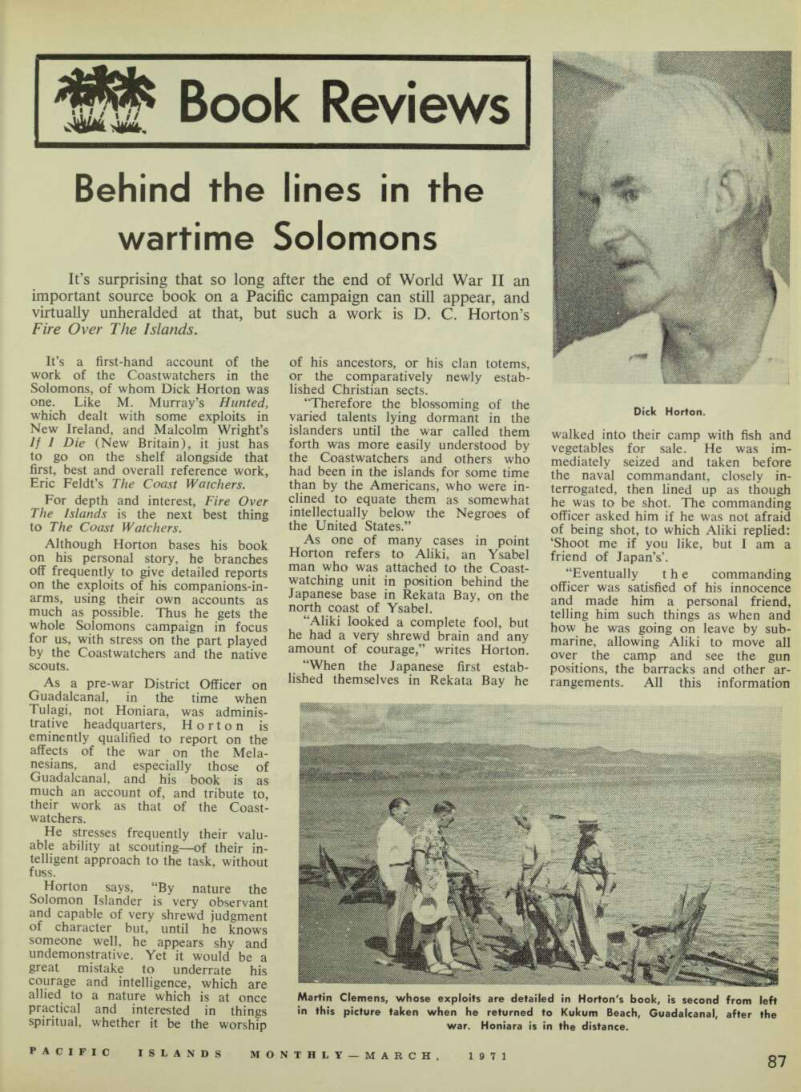
Martin Clemens, whose exploits are detailed in Horton's book, is second from left in this picture taken when he returned to Kukum Beach, Guadalcanal, after the war. Honiara is in the distance.
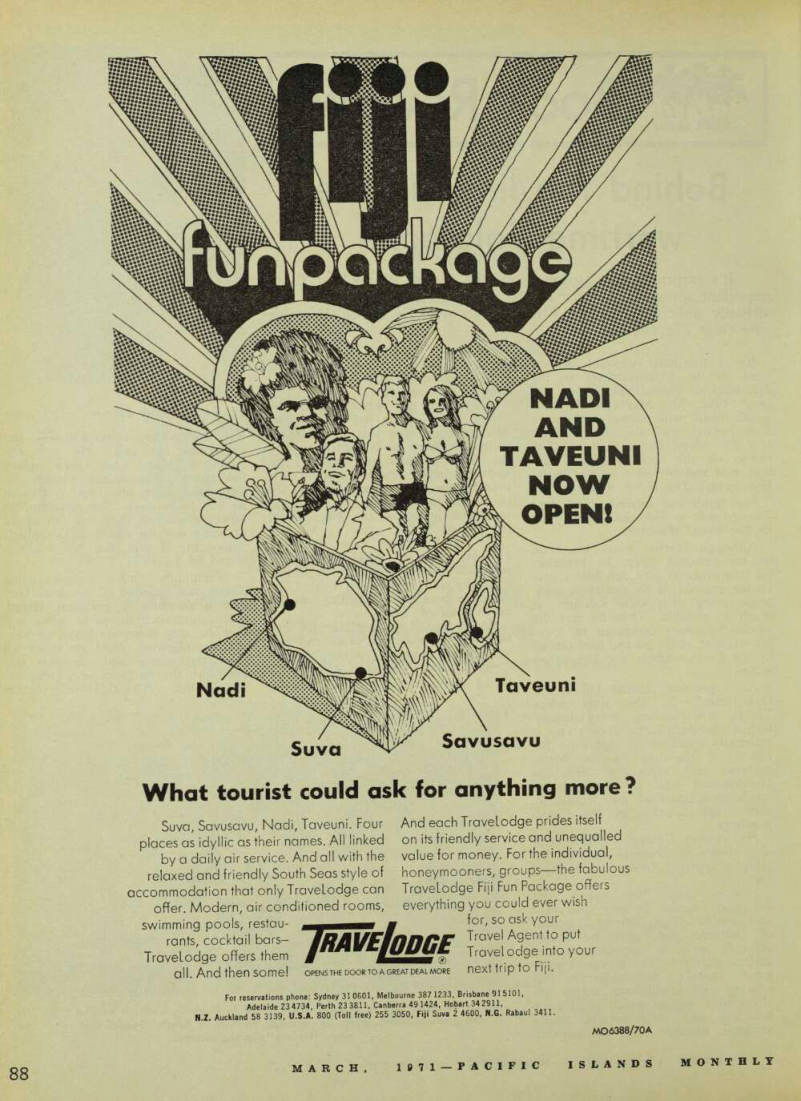
Dick Horton.
Aliki took back to the Coastwatcher in charge of the station (originally Geoffrey Kuper, then Snowy Rhoades and then Fit. Lt. Corrigan, followed by Andy Andresen).
“After one particularly successful raid engineered on information sup plied to Corrigan, Aliki went back into the camp, commiserated with the commander, counted the dead and wounded, assessed the damage done and the guns knocked out, and returned and reported to Corrigan, who was then able to signal a report to the base on Lunga of the actual damage done for comparison with the accounts of the pilots taking part in the raid.”
There are detailed stories here of the work of some famous Coast watching names—Martin Clemens, D. G. Kennedy, Ken Dalrymple- Hay, Carden Seton, among many others—and this book enhances the reputations of all of them. And not the least it enhances the reputation of the self-effacing Dick Horton him self, the District Officer and Coast watcher who after the war became a schoolteacher in England until he was called back to the Solomons in 1968 to conduct the first full census of the protectorate.
His recent two-year stint on his old stamping grounds (he is back in England again now), no doubt helped him put this narrative into focus, and to fill in many of the little details that make the account so use ful and interesting.
The account of the daily life of the little team of Coastwatchers led by Lt. Cdr. Hugh Mackenzie from a foxhole on Guadalcanal just after the
American landing is in itself a gripping story, made all the more hairraising by the matter-of-fact approach that Horton has in telling it.
“The Coastwatching headquarters was probably the least impressive headquarters I have ever seen,” he recalls. “It was in a Japanese dugout just to the north-west of the runway —a site selected because it was free from electrical interference. This dugout was four feet deep and about three feet wide, covered with logs and sandbags, and when it rained— as it frequently did—the flood rushed past our feet. The precious teleradio sets were housed above the floor but apart from them and a few spares, everything else had been begged, borrowed or scrounged.
“A shrapnel-blasted Japanese tent nearby served for coding and decoding messages and as a primitive mess hut. Another dilapidated affair served as a sleeping tent but was empty more often than not as we tumbled into the slit trenches which
were the first things dug on the site.”
Some of Dick Horton’s early chapters on how the war came to the Solomons, and how the civilians were evacuated in the nick of time, are reminiscent of experiences in parts of nearby New Guinea, notably Rabaul, where the civilians were not so lucky. In Rabaul, the hide-bound administration in Canberra let the residents down, being incapable of grasping the urgency of the situation, Dick Horton is critical of the attitude to the Solomons war in Suva, and makes it clear that many people besides himself were relieved when Sir Philip Mitchell took over from Sir Harry Luke as High Corn missioner for the Western Pacific, D. C. Horton’s valuable, fascinat ing record is well illustrated with photographs and maps, if you ignore the dustjacket, which is a cheap abomination unworthy of the con
tents.-
SI.
ISLANDS ' A ' H ' and
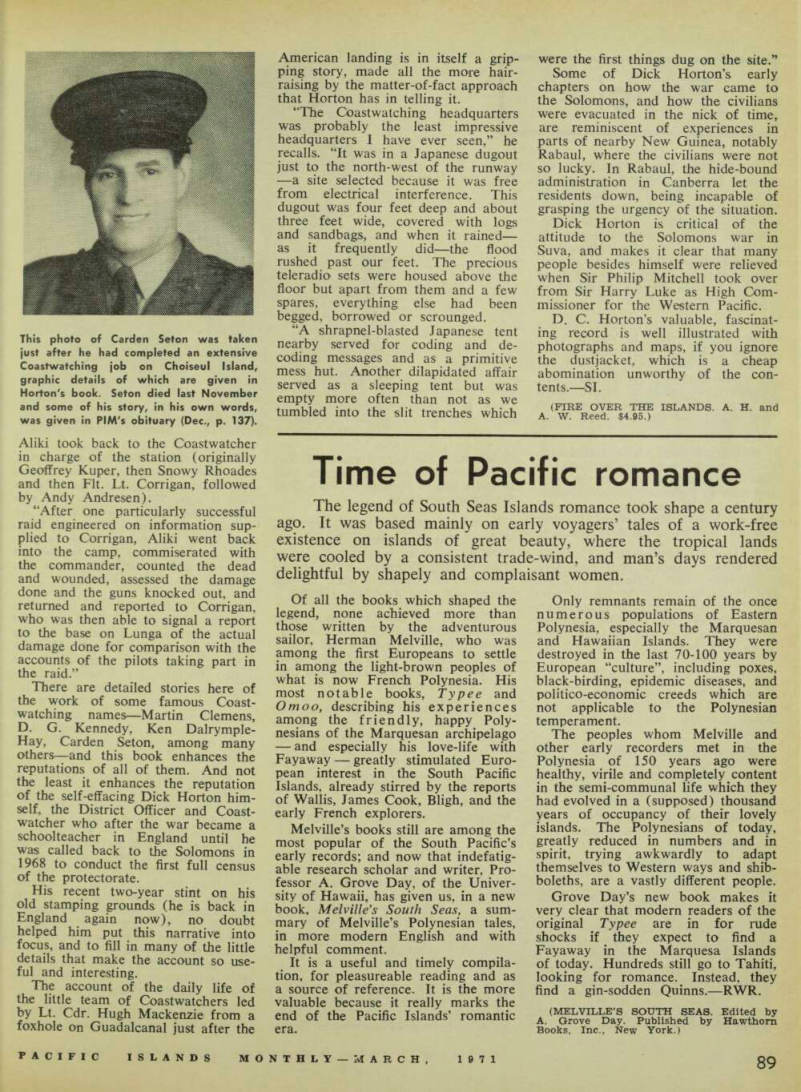
This photo of Carden Seton was taken just after he had completed an extensive Coastwatching job on Choiseul Island, graphic details of which are given in Horton's book. Seton died last November and some of his story, in his own words, was given in PIM's obituary (Dec., p. 137).