They're dusting
pp. 63-69 · Read in the full issue
off Samoa's colourful past
By Judy Tudor
Like all places with a colourful past, Western Samoa has a number of ancient monuments largely ignored by the local people although being dusted off now by tour operators as tourist sights.
It also has some monuments that aren’t so visible and a great deal of old history of the 1850-1920 period that is now almost forgotten and in which few take any interest.
One of the few residents who have taken an interest in the country’s European period is Mr. P. W. H.
Kelly, who has just retired as general manager of Western Samoa Trust Estates Corporation, the successor in 1957 to New Zealand Reparation Estates, the instrumentality formed after World War I to administer expropriated German estates.
But unless Mr. Kelly spends part of his retirement putting the result of his researches into permanent form, that link, too, will probably be lost, WSTEC operates from what is probably the most ancient of all European relics in Western Samoa— Trust Estates Corporation headquarters, over the road from the Apia waterfront in the Sogi area.
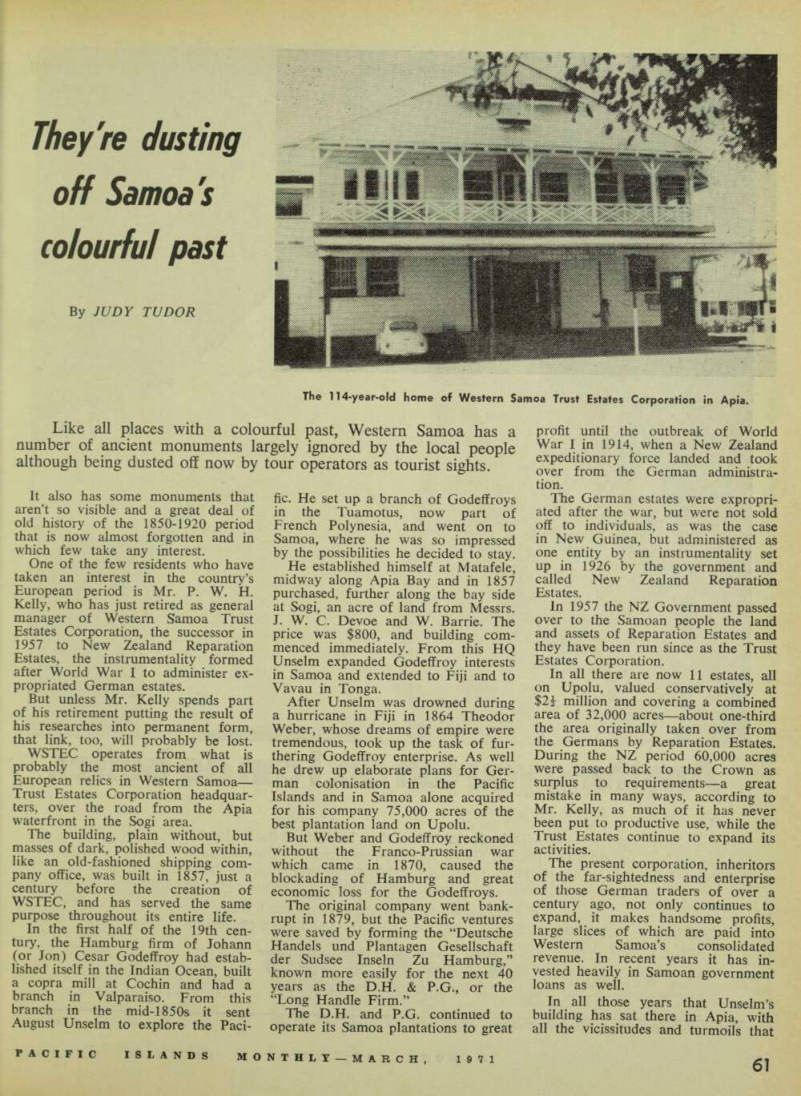
The building, plain without, but masses of dark, polished wood within, like an old-fashioned shipping company office, was built in 1857, just a century before the creation of WSTEC, and has served the same purpose throughout its entire life.
In the first half of the 19th century, the Hamburg firm of Johann (or Jon) Cesar Godeffroy had estabhshed itself in the Indian Ocean, built a copra mill at Cochin and had a - m Y al P ar ?i s °- From this branch m the mid-1850s it sent August Unselm to explore the Pad-
fic. He set up a branch of Godeffroys in the Tuamotus, now part of French Polynesia, and went on to Samoa, where he was so impressed by the possibilities he decided to stay.
He established himself at Matafele, midway along Apia Bay and in 1857 purchased, further along the bay side at Sogi, an acre of land from Messrs.
J. W. C. Devoe and W. Barrie. The price was $BOO, and building com menced immediately. From this HQ Unselm expanded Godeffroy interests in Samoa and extended to Fiji and to Vavau in Tonga.
After Unselm was drowned during a hurricane in Fiji in 1864 Theodor Weber, whose dreams of empire were tremendous, took up the task of fur thering Godeffroy enterprise. As well he drew up elaborate plans for Ger man colonisation in the Pacific Islands and in Samoa alone acquired for his company 75,000 acres of the best plantation land on Upolu.
But Weber and Godeffroy reckoned without the Franco-Prussian war which came in 1870, caused the blockading of Hamburg and great economic loss for the Godeffroys.
The original company went bank rupt in 1879, but the Pacific ventures were saved by forming the “Deutsche Handels und Plantagen Gesellschaft der Sudsee Inseln Zu Hamburg,” known more easily for the next 40 years as the D.H. & P.G., or the “ Long Handle Firm.”
The D.H. and P.G. continued to operate its Samoa plantations to great
profit until the outbreak of World War 1 in 1914 ’ when a New Zealand
“ad^ua
tion.
The German estates were expropri ated after the war, but were not sold off to individuals, as was the case in New Guinea, but administered as one entity by an instrumentality set up in 1926 by the government and called New Zealand Reparation Estates.
In 1957 the NZ Government passed over to the Samoan people the land and assets of Reparation Estates and they have been run since as the Trust Estates Corporation, In all there are now 11 estates, all on Upolu, valued conservatively at S2J- million and covering a combined area of 32,000 acres—about one-third the area originally taken over from the Germans by Reparation Estates.
During the NZ period 60,000 acres were passed back to the Crown as surplus to requirements—a great mistake in many ways, according to Mr. Kelly, as much of it has never been put to productive use, while the Trust Estates continue to expand its activities.
The present corporation, inheritors °f the far-sightedness and enterprise of those German traders of over a century ago, not only continues to expand, it makes handsome profits, large slices of which are paid into Western Samoa’s consolidated revenue. In recent years it has in vested heavily in Samoan government loans as well.
In all those years that Unselm’s building has sat there in Apia with all the vicissitudes and turmoils that
The 114-year-old home of Western Samoa Trust Estates Corporation in Apia.
Withstood it all
the country has passed through Samoan wars, pushing traders, colon ising Great Powers, two foreign ad ministrations, economic depressions, two World Wars—there has none theless been remarkable continuity in the business of tending Samoa’s biggest business.
From 1857 only 11 men have sat in the front office: Unselm, Poppe, Weber, August Godeffroy, Weber again for a period, Riedel, Hansen, and, for New Zealand, Cowley, Gotz, Eden and Kelly, and now, of course, we have the first Samoan. It is likely that Mr. Kelly will be the last Euro pean in Trust Estates general mana gership. All the more reason then why he should get busy and record something of the romantic story that began with Unselm and looks like going on for a long time yet. % sk Half a dozen years ago, R. W.
Robson and I were invited to a UN happening in the garden of the old Casino Hotel in Apia. During the speeches we became far more in terested in what was hidden in the middle of a large piece of shrubbery —a black stone cairn with dis coloured plaques upon it of J. C.
Godeffroy, 1813-1885, commemorat ing the fact that “here was founded” the Samoan branch of his firm.
In November, 1970, I was back again in Apia and revisited the Casino, now more delapidated than ever. I noticed that the bush around the old cairn had doubled in size, but I finally beat my way into the middle of it, only to find that some one had removed the plaques from the stone work.
I mentally cursed whoever had done it, but was cheered next day when I went to call on Mr. Kelly to get some Trust Estates production statistics. There, halfway up the stairs, were what I took to be better preserved duplicates of the plaques and a typewritten note underneath which said, in part: Plaques presented on the 100th anniversary of the birth of J. Cesar Godeffroy in 1913 to the D.H. & P.G. This building has been in continuous use since 1857 — J. C.
Godeffroy & Sohn, 1857-1882; D.H. & P.G., 1882-1920; Crown Estates, 1920-26; New Zealand Reparation Estates, 1926-57; Western Samoa Trust Estates, 1957.
My business with Mr. Kelly was finished in about 10 minutes, but we spent the next half-hour metaphoric ally back in the stirring days at the end of last century. The plaques on
the stairway were the originals from the Casino monument, he said. He’d rescued them from the bulldozers in the previous year or so, during one of the periods when it was planned to raze the Casino and build there a modern hotel—plans which have so far come to nothing.
He’d spent much time cleaning the grime of 50 years’ neglect from them and in his opinion they are now where they should always have been.
It was there, not in the Casino grounds, that the first Godeffroy branch was established. The Casino was built only in 1910 at a cost of 100,000 marks (about £Stg.soo-600) as a D.H. and P.G. boarding house.
The reason for placing the memorial plaques there in 1913, and not at the company headquarters, is not now known.
When our talk ended, I went back along the road to Mulinuu to photo graph more relics of this period. Not far from Sogi, on the left-hand side of the road, is the German monu ment to their 92 men who were lost when the warships Adler, Eber and Olga were caught inside the reef and sank during the disastrous hurricane of March 16, 1889.
The eagle on the monument is in need of repainting, but the column stands in a fenced area that is kept clear of encroaching grass and scrub, possibly for the benefit of tour parties who are taken out to Mulinuu to see Western Samoa’s Parliament House and a number of Samoan tombs.
But the stone cairn on the edge of the bay further along towards Mulinuu stands neglected in tall grass, It marks the spot where the German flag was first raised in Samoa.
The Americans lost three warshins
anH <A ™itZ iffSl
and 54 men in me 1889 hurricane ttq or. • (one US and one German warship were later though nn A • . i’, .J? r .
American monument marks this fact.
But just before you enter the Mulinuu reserve, there is a British-American granite monument to another tragedy—stuck out on its own beside the road like an orphan in a storm, with some sort of commercial or domestic activity now going on all round it.
It is a memorial to the six men of USN Philadelphia and the six men of HMS Royalist who were “killed in action” in 1899 in what Mr. Kelly calls the “four-day war.” For once Germany was a bystander during the action, but these US and British war , • un ships shelled Apia, sending one shell through the German consulate. Most Europeans left the town in a hurry . ~Jc „ • , . * * "£'' e **„ S ?“°* nsremamed t 0 loot at 1 e V c u • Later that year the three Great Powers ended the skirmishing over the Samoan islands that had occupied them ever since Weber had made his plans of empire. By treaties Germany was permittted to annex Western
Not far from Sogi is this German memorial to 92 men lost from three war ships sunk in the famous hurricane of 1889 in Apia.
" Calliope" relic
Samoa; the United States was per mitted to exercise sovereignty over Eastern Samoa as a territory under Navy control; and Britain gave up ail claims to Samoa in return for Ger many renouncing her rights in Tonga, Niue and all the Solomons east and south-east of Bougainville.
Most of these ancient relics can be seen during a car ride around Apia Bay, but there remains another that cannot. It is the giant steering wheel of HMS Calliope, the seventh warship caught by the 1889 hurricane and the only one which battled out through the reef passage to the safety of the open sea. Calliope lived to fight an other day, but was finally broken up in England. Some time in the 1950 s the wheel was sent to Samoa as a memento and failing some better place to put it was erected in, of all unlikely places, the dimness at the back of the main court room. It was shown to me there recently by Mr.
Fritz Thomsen (Samoan title, Su’a Leituposa II), Secretary for Justice, although normally it is seen by few except litigants, prisoners and court officials.
The wheel is, in fact, two wheels, fixed six inches apart on a spindle and decorated with brass letters that spell out FEAR GOD, HONOUR THE KING. It is five or six feet across, wooden and of many spokes ending in handles. It must weigh a ton and looks as though it needed four seamen to manage it.
It nonetheless is a beautiful piece of work as well as being of historical interest. It should have a more access ible home than the back of a court room.
It seems that, failing a continuing effort on the part of Mr. Kelly, what Apia really wants is an enthusiastic historical society. • Western Samoans may be in terested to learn that in the United States Potlatch Forests Inc. was recently singled out for mention dur ing US Federal hearings on air and
water pollution.
Potlatch’s huge paper and pulp plant, at Lewiston, Idaho, gurgled out 40 tons of organic waste into a nearby river every day, the hearings revealed. As well, Potlatch admitted, Lewiston’s atmosphere was dense, with an annual supply of million tons of sulphur gases and nearly two million tons of particulates.
In Samoa, Potlatch is progressing with a multi-million dollar timber development on Savaii.