Poor
pp. 55-59 · Read in the full issue
The
People Of
Paradise
From SUE WENDT, in Suva
Poverty in Fiji? Land of happy, smiling people and booming investment? Where islands sell for a fortune—and tourists treat dollars like water?
Ridiculous! Nobody starves in the Islands, you know—even if there’s no money, there’s fish in the sea and dalo in the ground. Fijians can always go back to the village, can’t they?
And didn’t one of our elected rep resentatives, a Fijian himself, declare in the House the other day that there were no poor Fijians? He was sick and tired of hearing it, he said—and who’d ever seen anyone dying in the streets from hunger in Fiji?
Perhaps nobody—but that particu lar politician’s remarks seemed extra ordinarily out of touch in the light of recent publicity given to the efforts of an organisation called HART (Housing Assistance and Relief Trust).
Sponsored by the Fiji National Council of Churches, HART is a charitable trust aimed at providing low-cost housing for Indian and Fijian families living in desperate circum
stances, with incomes of less than $lO a week.
These include thousands struggling to survive on government destitute allowances of $5 per month per adult, $8 per couple and $1.50 for each de pendent child.
Nobody knows just how many exist at poverty level in Fiji. A small in dication perhaps is the fact that dur
ing a single month recently, 4,420 pe 2l? le destitute allowances.
There may be many more who are either unaware that such help exists or who are unable to qualify because there is an able-bodied though job less—potential breadwinner in the family.
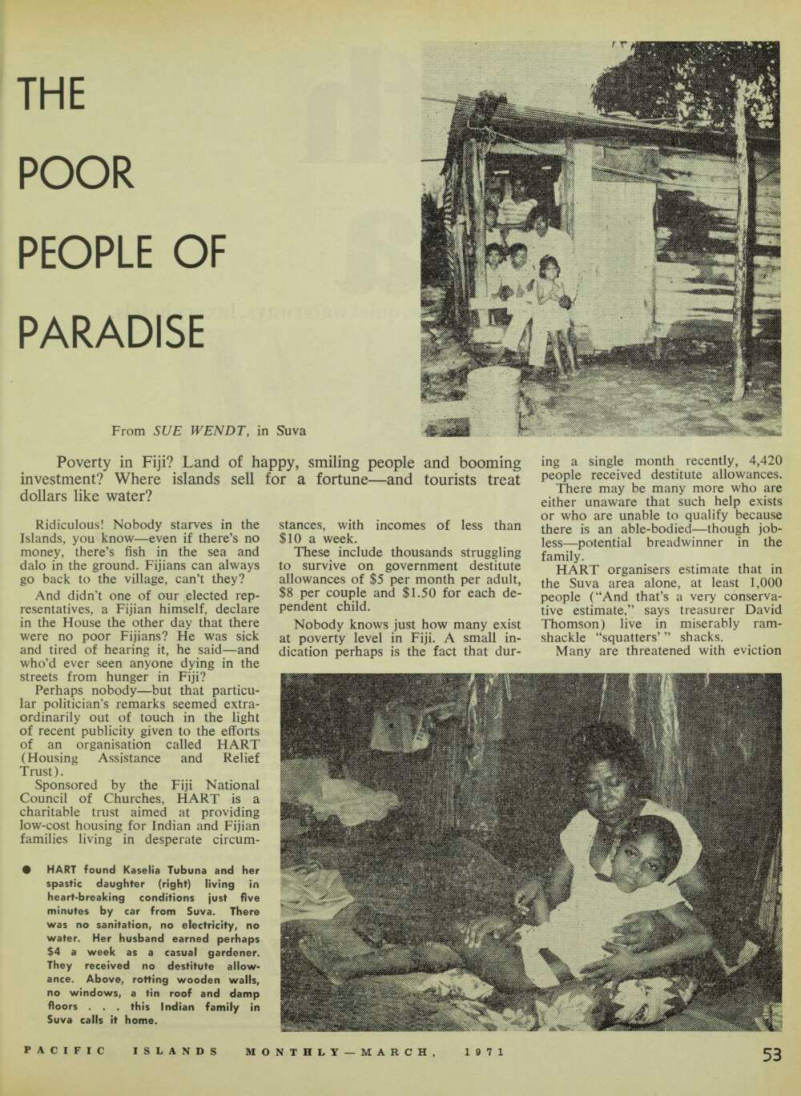
HART organisers estimate that in t^e Suva area alone at least 1 000 people (“And that’s a very conserva tive estimate,” says treasurer David Thomson) live in miserably ram shackle “squatters’ ” shacks, Many are threatened with eviction
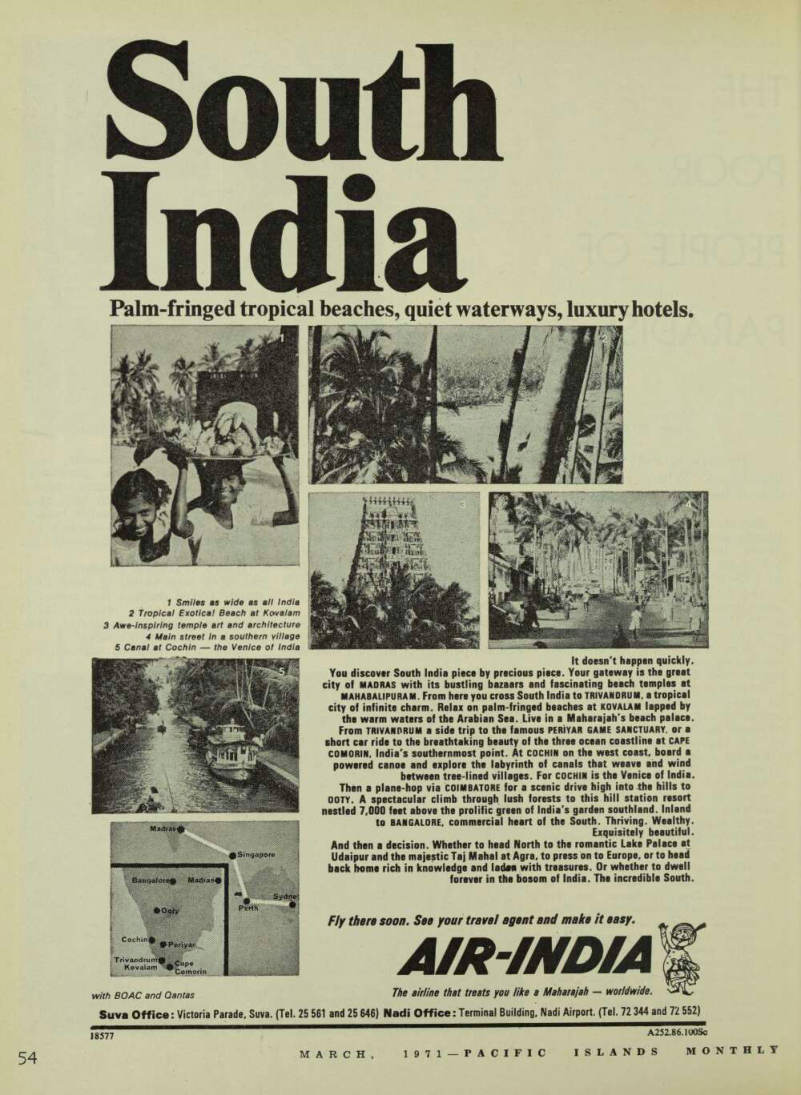
HART found Kaselia Tubuna and her spastic daughter (right) living in heart-breaking conditions just five minutes by car from Suva. There was no sanitation, no electricity, no water. Her husband earned perhaps $4 a week as a casual gardener.
They received no destitute allow ance. Above, rotting wooden walls, no windows, a tin roof and damp floors . . . this Indian family in Suva calls it home.
Sickness and squalor
because of new redevelopment and subdivision schemes. Unless they have incomes of more than $lO a week they can’t qualify for help from the Housing Authority—which faces its own problems of spiralling building costs.
But figures mean nothing to a com placent public. To get the message across, HART launched a public ap peal for funds in November-Decem ber and The Fiji Times presented a series of stories and photographs about destitute families living right on Suva’s doorstep.
HART’S helpers found scores of Indians and Fijians ekeing out miser able existences in lean-to dwellings and shacks, slung together from scraps of rusting tin, grass and even paper.
They discovered sickness and squalor in Toorak tenement build ings, where many families crowd to gether, paying exorbitant rents for no facilities whatsoever, A mother and three children were found to be living in a cow shed. The husband was in prison—so the only income was the meagre monthly destitute allowance. There was no water, no electricity, no sanitation.
In a rusting iron shack on a wet, muddy patch at Samabula, HART found a man, his wife and six sons living on $lO a month. The father’s health was ruined through tubercu losis, so he couldn’t work. The eldest son, aged 15, had just got a job sell ing peanuts for $2 a week.
There were many similar cases, each seeming more pitiful than the last. Most of the stories were about Indians, for whom housing and land ownership have always been a prob lem in Fiji.
But there were Fijians, too—proof that the drift from villages to urban areas is becoming a one-way move ment.
In the old days a Fijian could always go back to the koro if the bright lights palled. Now, perhaps through pride or because they feel they have no roots, many city-born Fijians remain in the only surround ings they know.
Some, too, feel that they’ve sunk so low that they can’t face the vil lage. Like the sweet-faced woman from Kadavu, whom HART found sitting listlessly in a rusted lean-to, nursing her nine-year-old spastic daughter and clutching a worn Bible.
She couldn’t walk, because she was swollen with filariasis and had a crippled foot. Each morning her hus band prepared the day’s food,
walked a quarter of a mile for a bucket of fresh water —and went out to look for a gardening job.
If it rained there was no work.
If it was fine and he was lucky, he’d earn a few dollars.
The woman felt that she’s had so much misfortune, including the death of her other daughter two months before, that surely she was being punished for something? How could she face the village?
The appeal for funds was highly successful. Firms and individuals gave a total of $lB,OOO and four complete houses were donated by big companies.
HART has already built four homes at Wainibuku. It now hopes to acquire another 24 suitable sites early this year and has applied for lots in Crown Land and Housing Authority subdivisions.
Initially, it will build houses made of iron, 22ft by 16ft, containing one main room, kitchen with water to sink and a shower recess/laundry.
This type of dwelling costs $5OO.
Rehabilitation of families is a vital part of HART’s programme. Partly to remove any stigma of charity, families with incomes of more than $6 a week will be asked to pay one sixth of this in rent.
“Self-help is important,” explains Mr. David Thomson. “But we’re mindful of the fact that many people need a leg along first, before they can gather together their shattered dig nity.”
HART’s programme is to be a con tinuing one. When the present funds are spent, a further appeal may be
launched and assistance sought from overseas aid agencies.
Ideally, it will work in co-operation with the longer-established Nasinu Housing Trust, an organisation with similar aims which began with a substantial private donation in 1964.
The Nasinu Trust has already built 60 low-cost homes and it has 32 more sites in a new subdivision. Two of these sites have been offered to
Hart.
For low-income workers earning more than $lO a week, the Government Housing Authority—which operates on loan money—is doing its best. It has already built more than 2,500 low-cost homes, which the occupants can pay off over a 20-year period. By 1975, the authority hopes to have completed more than 7,000 such units, centred mainly around Suva and Lautoka.
For those with regular jobs, future expansion of the authority’s building
programme offers some hope for the future.
But what of those who cannot find work, and the money to pay off even the lowest priced home?
Government policy is to encourage as much as possible the establishment of new industries and job opportuni ties, but even for the most optimistic it must seem like a losing battle.
As the Minister for Labour, Ratu Sir Edward Cakobau, put it recently: Fiji is like the old woman in the shoe who had so many children she didn’t know what to do.
He described the addition of 6,000 school-leavers a year to Fiji’s man power resources as a “terrifying” figure. Like many others, he doubted whether Fiji would ever be able to make new jobs fast enough to absorb the growing number of job-seekers.
“It is a pity we did not adopt family planning 20 years ago,” he added.
This low-cost house was built by HART at Wainibuku, eight miles from Suva.
The $5OO dwellings are a vast improve ment on the un
healthy "squatters"
shacks clustered on the outskirts of Suva and Lautoka.