brief moment of glory
p. 51 · Read in the full issue
Pago's new cannon recalls a brief moment of glory
By ED ENGLEDOW, in Pago
Eighty-four years ago, the Kingdom of Hawaii dis patched its entire fleet to the South Seas in a “display of power” against Germany, England and France in a struggle for control of vital Pacific islands.
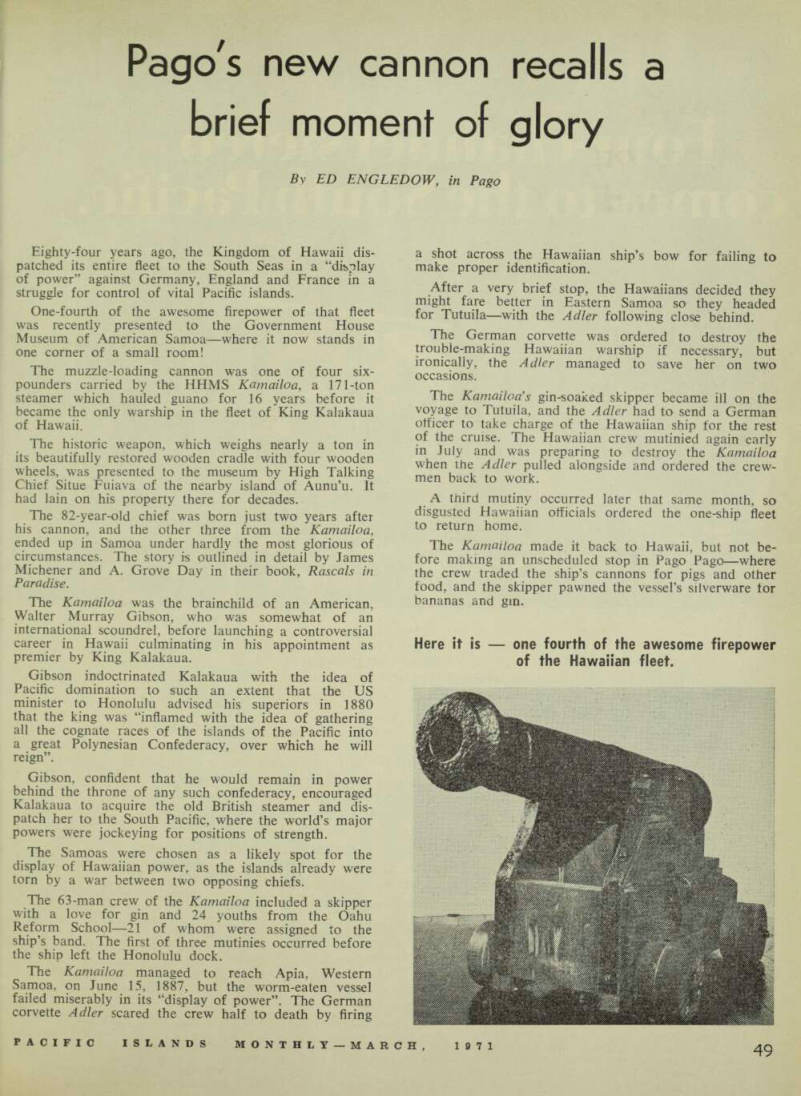
One-fourth of the awesome firepower of that fleet was recently presented to the Government House Museum of American Samoa—where it now stands in one corner of a small room!
The muzzle-loading cannon was one of four six pounders carried by the HHMS Kamailoa, a 171-ton steamer which hauled guano for 16 years before it became the only warship in the fleet of King Kalakaua of Hawaii.
The historic weapon, which weighs nearly a ton in its beautifully restored wooden cradle with four wooden wheels, was presented to the museum by High Talking Chief Situe Fuiava of the nearby island of Aunu’u. It had lain on his property there for decades.
The 82-year-old chief was born just two years after his cannon, and the other three from the Kamailoa, ended up in Samoa under hardly the most glorious of circumstances. The story is outlined in detail by James Michener and A. Grove Day in their book, Rascals in Paradise.
The Kamailoa was the brainchild of an American, Walter Murray Gibson, who was somewhat of an international scoundrel, before launching a controversial career in Hawaii culminating in his appointment as premier by King Kalakaua.
Gibson indoctrinated Kalakaua with the idea of Pacific domination to such an extent that the US minister to Honolulu advised his superiors in 1880 that the king was “inflamed with the idea of gathering all the cognate races of the islands of the Pacific into a great Polynesian Confederacy, over which he will reign”.
Gibson, confident that he would remain in power behind the throne of any such confederacy, encouraged Kalakaua to acquire the old British steamer and dis patch her to the South Pacific, where the world’s major powers were jockeying for positions of strength.
The Samoas were chosen as a likely spot for the display of Hawaiian power, as the islands already were torn by a war between two opposing chiefs.
The 63-man crew of the Kamailoa included a skipper with a love for gin and 24 youths from the Oahu Reform School—2l of whom were assigned to the ship’s band. The first of three mutinies occurred before the ship left the Honolulu dock.
The Kamailoa managed to reach Apia, Western Samoa, on June 15, 1887, but the worm-eaten vessel failed miserably in its “display of power”. The German corvette Adler scared the crew half to death by firing
a shot across the Hawaiian ship’s bow for failing to make proper identification.
After a very brief stop, the Hawaiians decided they might fare better in Eastern Samoa so they headed for Tutuila—with the Adler following close behind.
The German corvette was ordered to destroy the trouble-making Hawaiian warship if necessary, but ironically, the Adler managed to save her on two occasions.
The Kamailoa’s gin-soaked skipper became ill on the voyage to Tutuila, and the Adler had to send a German officer to take charge of the Hawaiian ship for the rest of the cruise. The Hawaiian crew mutinied again early in July and was preparing to destroy the Kamailoa when the Adler pulled alongside and ordered the crew men back to work.
A third mutiny occurred later that same month, so disgusted Hawaiian officials ordered the one-ship fleet to return home.
The Kamailoa made it back to Hawaii, but not be fore making an unscheduled stop in Pago Pago—where the crew traded the ship’s cannons for pigs and other food, and the skipper pawned the vessel’s silverware tor bananas and gin.
Here it is one fourth of the awesome firepower of the Hawaiian fleet.