Younger Nauruans
pp. 47-49 · Read in the full issue

on the way up
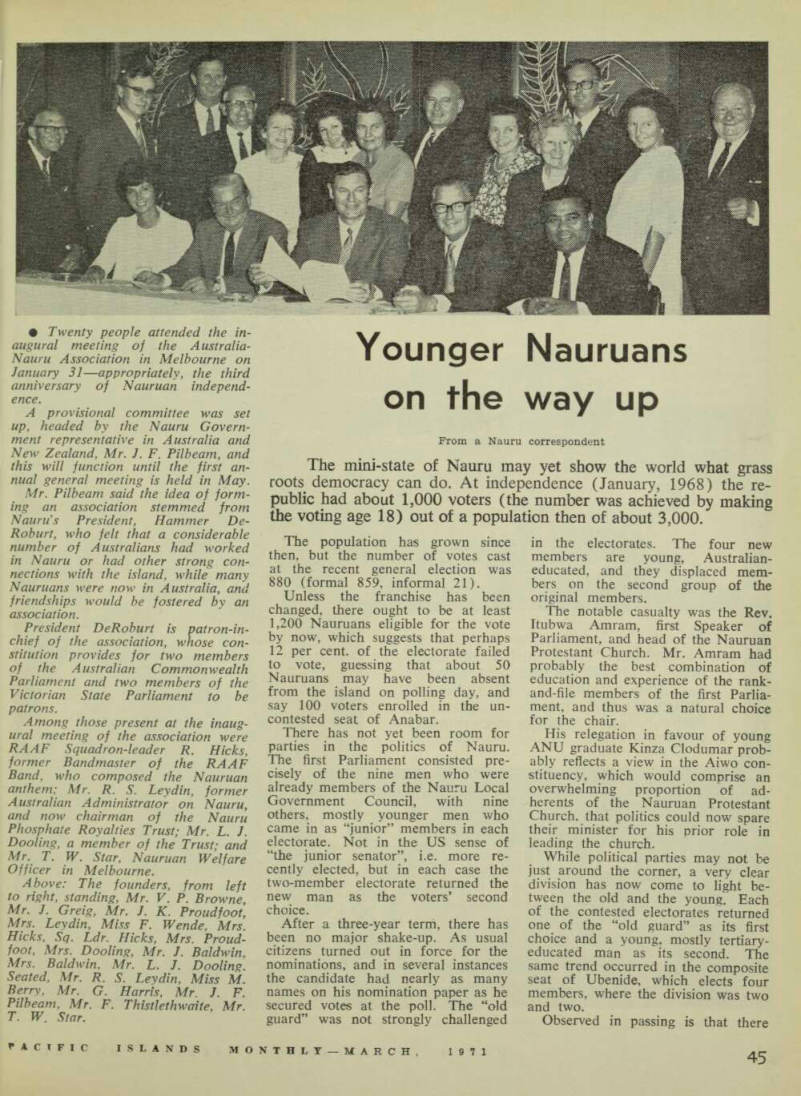
• Twenty people attended the in augural meeting of the Australia- Nauru Association in Melbourne on January 31 — appropriately, the third anniversary of Nauruan independ ence.
A provisional committee was set up, headed by the Nauru Govern ment representative in Australia and New Zealand, Mr. J. F. Pilbeam, and this will function until the first an nual general meeting is held in May.
Mr. Pilbeam said the idea of form ing an association stemmed from Nauru’s President, Hammer De- Roburt, who felt that a considerable number of Australians had worked in Nauru or had other strong con nections with the island, while many Nauruans were now in Australia, and friendships would be fostered by an association.
President DeRoburt is patron-in chief of the association, whose con stitution provides for two members of the Australian Commonwealth Parliament and two members of the Victorian State Parliament to be patrons.
Among those present at the inaug ural meeting of the association were RAAF Squadron-leader R. Hicks, former Bandmaster of the RAAF Band, who composed the Nauruan anthem; Mr. R. S. Leydin, former Australian Administrator on Nauru, and now chairman of the Nauru Phosphate Royalties Trust; Mr. L. J.
Dooling, a member of the Trust; and Mr. T. W. Star, Nauruan Welfare Officer in Melbourne.
Above: The founders, from left to right, standing, Mr. V. P. Browne, Mr. J. Greig, Mr. J. K. Proudfoot, Mrs. Leydin, Miss F. Wende, Mrs.
Hicks, Sq. Ldr. Hicks, Mrs. Proud foot, Mrs. Dooling, Mr. J. Baldwin, Mrs. Baldwin, Mr. L. J. Dooling.
Seated, Mr. R. S. Leydin, Miss M.
Berry, Mr. G. Harris, Mr. J. F.
Pilbeam, Mr. F. Thistlethwaite, Mr.
T. W. Star.
From a Nauru correspondent The mini-state of Nauru may yet show the world what grass roots democracy can do. At independence (January, 1968) the re public had about 1,000 voters (the number was achieved by making the voting age 18) out of a population then of about 3,000.
The population has grown since then, but the number of votes cast at the recent general election was 880 (formal 859, informal 21).
Unless the franchise has been changed, there ought to be at least 1,200 Nauruans eligible for the vote by now, which suggests that perhaps 12 per cent, of the electorate failed to vote, guessing that about 50 Nauruans may have been absent from the island on polling day, and say 100 voters enrolled in the un contested seat of Anabar.
There has not yet been room for parties in the politics of Nauru.
The first Parliament consisted pre cisely of the nine men who were already members of the Nauru Local Government Council, with nine others, mostly younger men who came in as “junior” members in each electorate. Not in the US sense of “the junior senator”, i.e. more re cently elected, but in each case the two-member electorate returned the new man as the voters’ second choice.
After a three-year term, there has been no major shake-up. As usual citizens turned out in force for the nominations, and in several instances the candidate had nearly as many names on his nomination paper as he secured votes at the poll. The “old guard” was not strongly challenged
in the electorates. The four new members are young. Australian educated, and they displaced mem bers on the second group of the original members.
The notable casualty was the Rev.
Itubwa Amram, first Speaker of Parliament, and head of the Nauruan Protestant Church. Mr. Amram had probably the best combination of education and experience of the rank and-file members of the first Parlia ment, and thus was a natural choice for the chair.
His relegation in favour of young ANU graduate Kinza Clodumar prob ably reflects a view in the Aiwo con stituency, which would comprise an overwhelming proportion of ad herents of the Nauruan Protestant Church, that politics could now spare their minister for his prior role in leading the church.
While political parties may not be just around the corner, a very clear division has now come to light be tween the old and the young. Each of the contested electorates returned one of the “old guard” as its first choice and a young, mostly tertiary educated man as its second. The same trend occurred in the composite seat of Übenide, which elects four members, where the division was two and two.
Observed in passing is that there
was not a woman among the 48 candidates and two unopposed mem bers. There has been an attempt made by the girls to gain a share of power at earlier elections, but this appears to have been dropped.
The election of Kenas Aroi as Speaker makes an interesting point to watch in Nauru. Mr. Aroi is a most astute young original parliamen tarian, and whether his new office will silence him, win him for the Establishment, or provide him with a power base to become effective leader of the “youth group”, remains a question to be answered.
The office of Speaker in Nauru is quite different from that in most parliamentary democracies. He is chairman of the House, but since the President of Nauru is simul taneously head-of-state and govern ment leader in the legislature, it is given to the Speaker to sign into law the bills passed by the Parliament.
He thus exercises a function more like a figurehead president, while the President is effectively more like a prime minister.
President Hammer Deßoburt is clearly confirmed in power for another term. He secured the highest percentage in the primary election, and was unopposed in the parlia mentary ballot for the Presidency.
A curious fact, in passing, is that Speaker Aroi is the “junior” member in the same constituency as the President.
In the Cabinet, which is the same as before, Vice-President Austin Bernicke is a staunch contemporary of President Deßoburt.
Heir-apparent for many years, Buraro Detudamo, remains in minis terial office. He is the youngest Cabinet Minister, but despite his grooming and lineage (his father was a former and illustrious Head Chief) he will need to look to his laurels when the time comes for the presi dential shoes to be filled; the new young men are breathing down his neck. • Crown of thorns starfish are not just a problem in the Pacific. An outbreak has been reported off Port Sudan in the Red Sea. British re search worker Mr. James Ward is to record their location and size and bring back samples for laboratory tests on their life cycles. Recent ob servations on the coral eater have found that the Cheilinus Undulatus may also be a predator on the starfish.
It will join the Giant Triton as a possible cure for the starfish plague —but this creature, a member of the wrasse family—grows up to 7 ft long.