How To Grow And
pp. 137-143 · Read in the full issue


The Practical Planter
Market Pepper
■ This is the first of a series of articles on spices—on how to grow them, where to grow them and how to market them. Other spices to be covered in the series include chilli, cinnamon, casia, vanilla, ginger and cardamon.
?y E. Brown, B.Sc., and Miss D. E. Reader, Colonial Products Advisory Bureau (Plant and Animal), London.
Pepper is produced from the its of the perennial climbing e Piper nigrum L. This vine indigenous to the moist low d forests of Ceylon and South lia, but it is now widely grown many tropical regions, the ef sources of supply being In
lesia, Thailand, Sarawak and
ia.
Tie pepper vine requires a hot, lid climate with an average rain of at least 70-100 inches per um, fairly evenly distributed, e the plant cannot withstand ods of prolonged drought. The it can be grown successfully at :udes up to 3,500 ft but it is irted to do best at elevations not ceding 1,700 ft, although some lorities are of the opinion that
knowledgement is made to the British nment's Tropical Products Institute which led PIM with this article.
land below 300 ft gives the best results.
Level ground is most suitable, particularly along river banks, pro vided such land is not susceptible to flooding. Hill slopes may be used if precautions are taken to prevent erosion. Good drainage, however, is essential, especially in regions of very heavy rainfall, where the soils tend to become sodden and water logged, unless deep and well-laid drainage channels are provided.
Under cultivation, pepper will grow on a variety of soils although a loam is preferable, but where humus is absent, heavy manuring is essential. In Malaya, the plant has been grown successfully on stiff yellow clay soils, poor in potash, but the fertility has been maintained in the past by the heavy use of burnt earth and wood ash. In Indonesia, a sandy clay is favoured, and on the island of Bangka the Chinese planters are reported to choose light yellow soils that are not too sandy. In West Borneo, a humus-rich top soil is con sidered necessary with a yellow sub soil, hard red clay sub-soils being regarded as unsatisfactory. Heavy
clay soils, or soils of a peaty or boggy nature, are quite unsuitable as the pepper roots are very sus ceptible to rot where soil drainage is poor.
Pepper may be grown from seed, although cuttings are usually used.
From Seed. Propagation from seed is simple, and vigorous plants are usually produced. Unfortunately, plants raised from seed do not usually begin fruiting until at least the sixth or seventh year. Moreover, owing to cross fertilisation, the re sulting plants are very variable and there is also a danger of the vines reverting to the unproductive uni sexual male type. However, the pepper growers in Malabar are re ported to have favoured propagation from seed. This method has also been used for establishing pepper in new areas remote from existing gardens when it has not been pos sible to transport cuttings easily and quickly.
When seed is used for propaga tion, the following points should be observed: • Choose healthy, ripe fruit.
Remove the pulp before drying the seeds.
Store in a cool dry place im mediately after drying.
Soak the seeds in water for at least 24 hours before sowing.
Some authorities recommend a period of at least three days. lie seed should be sown in well pared seed beds with adequate ie. Reports indicate that under Durable conditions about a 90 per t germination is obtained in from to six weeks. When two or three iths old, the seedlings may be isplanted into nursery beds, 1 ft rt. lenerally speaking the seedlings not ready for planting out in the [ until about 18 months after ing, although seedlings raised at Malayan Experimental Plantation SCuala Lumpur were successfully ted out when only three months having then attained a height of rom Cuttings. When propagated tatively, selection of the parent from which to take the cuttings great importance, since the pepper ts take about four years to come bearing, and it is only after period that any clear indication tie quality of the new plants can ibtained. Pepper is dioecio-poly □us which means that male ers and female flowers can be e on different plants and yet r plants can be hermaphrodite carry both pistils and stamens he same spike). Obviously, from up-bearing point of view, herma dite plants are the most desir and every effort should be made ike a cutting from these, rong cuttings from 1 to 2 ft are usually selected, although Mysore, India, longer cuttings ar to be favoured. There they usually taken from the branches ing from the base of the vine.
Ceylon, cuttings with lateral :hes taken from the upper part ie vine are said to be used, but cuttings require greater care basal cuttings, although plants lished from them are reported ■uit earlier.
Bangka, only cuttings from the :hes of young plants that still signs of vegetative growth are The upper part of a branch :en, and the tip, all side branches all the leaves, except the top are cut off.
The most satisfactory method for raising the cuttings is in the nursery beds. Tliese should be on good, well drained soil in a sheltered position.
In Malaya, the nursery beds are sometimes placed under fruit trees, and, after planting out, the cuttings are kept shaded with palm trees until they are well established.
Frequent watering
In dry weather frequent watering is often necessary. If basal cuttings are used they have the advantage of already possessing roots and so take more easily. It was found at Serdang, Malaya, that nursery beds of fine sand give the best results, provided they were kept well watered and shaded.
The use of cuttings having at least five nodes, with three nodes placed below the soil surface, has also been recommended.
Nevertheles, it seems that pepper cuttings are somewhat difficult to establish—one Ceylonese expert even put the percentage that take as low as 5 per cent. In the nursery, growth usually commences after three or four months, after which the plants are ready to be transplanted into the field.
Under favourable soil conditions, cuttings can be planted direct in the field at the beginning of the rainy season. It appears that this is widely done by growers in Mysore, where pepper is often grown in conjunction with betel nuts. As would be ex pected, the percentage of cuttings that fail to root is very high indeed, and this method is considered very wasteful.
As pepper is a climbing vine, pro vision must be made for supports.
These may be either living trees, or
concrete or hardwood posts. The use of living trees is more economical provided care is taken not to over shade the vines too much or exhaust the soil. Trees selected should be quick-growing, able to withstand heavy pruning, and preferably leguminous.
The jak tree (Artocarpus integer ), the betel nut, the mango, kapok, dadaps ( Erythrina indica and E. lithosperma) and Morinda tinctoria have been widely used in India and Ceylon. In Malaya and Indonesia hardwood or concrete posts have been more favoured, although their provision entails a heavy initial ex pense when establishing a pepper garden.
Trials carried out in Malaya with a view to comparing the yield of pepper vines grown on living sup ports with those of hardwood posts indicated that when grown on living supports, the vines were slower in establishing themselves and took longer to commence fruiting. The yield per vine was also reduced, no doubt owing to the competition between the pepper plant and its living support.
Trees, however, have the advantage of giving shade to the vines, especially during the first two or three years. The question of shade depends very much on local con ditions. Although pepper is naturally a shade plant, too much shade can reduce the yield considerably.
Some authorities, however, have recommended the provision of moderate shade by planting Leucaena glauca and Deguelia microphylla, but according to one authority, the Chinese in Indonesia have planta tions with no shade at all, at very low altitudes. In Sarawak, shade is
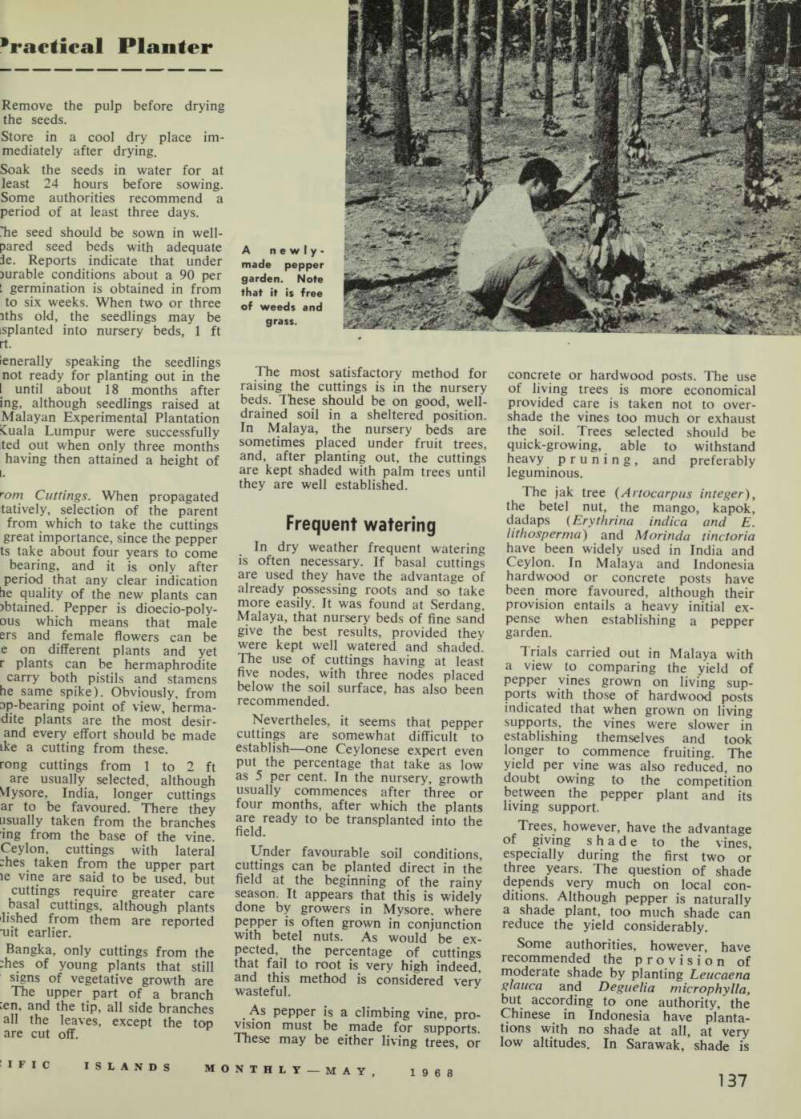
A newly
made pepper garden. Note that it is free of weeds and grass.
ften dispensed with the high jmidity tends to make it unneces iry.
Spacing
Cuttings or seedlings are trans anted to the field during the wet ason. Malayan planters recommend at three or four rooted cuttings be anted a few inches from each post, e posts being 6 to 7 ft apart each ay. The Chinese are reported to ic a closer spacing of 4 ft x 4 ft.
Tien living supports are used for e vines, planting distances appear vary according to the tree used. ;tel nut or dadap planted 8 ft x ft usually carry only one vine per ;e. Kapok planted 18 ft x 18 ft n carry two vines, and in the case mango or jak trees planted 25 to I ft apart, each tree may carry ree or four vines.
Once established in the field, the ties should receive applications of inure frequently. Most growers re mmend keeping the surrounding il well cultivated and free from ;eds, at least for the first year. r ter this initial period, clean weed g is often recommended, although :ent work in Sarawak indicates at it is unnecessary and may be desirable. In some areas, irriga •n may be necessary during the V m season, especially when estab hing a pepper garden. Chinese :>wers often protect the roots of ; vines with cut grass or leaves, d in Sarawak mulching with mbier refuse used to be widely ictised with beneficial results, in helping to maintain iwth during a dry spell.
Adequate manuring is essential for j successful cultivation of pepper. the past, burnt earth was con ered essential, particularly in rawak where is was estimated that Tie five or six acres of land were juired to maintain one acre of pper.
However, since the war, the pepper -dens there have had to be re ablished, and the work of the partment of Agriculture has shown it bean meal, fish and prawn use, and, whenever obtainable, ano and artificial fertilisers, are most satisfactory. Although burnt ‘th is still employed by many the Chinese in Sarawak, its use belived to be on a much reduced le compared with before the war. [n Sarawak, it has also been found it digging in cover crops of Cro atia and Calopagonium and thick ilching with lalang have been
beneficial, together with the use of potassium muriate and rock phosphate in addition to guano.
In Thailand, however, it has been reported that the use of commercial fertilisers has been harmful in many instances, and growers there now recommend their judicious use in combination with burnt earth and such organic manures as dung.
In Malabar, fish manure is re ported to be applied at the rate of about i lb per vine at regular inter vals. In addition, cattle manure is often used.
Manurial experiments carried out by the Madras Department of Agri culture over a nine-year period have been recorded. The following infor mation has been compiled from the experiments:
In Bangka, the vines are usually manured twice a year. For a long time the chief fertiliser was burnt earth, next came groundnut cake, fish waste and dung. In recent years,
however, manuring with artificial fertilisers has largely replaced burnt earth, though, it appears, not always with very good results.
Periodic pruning is necessary as the plant grows to prevent its be coming bushy at the top. In Malaya, the vine is heavily pruned when a year old to induce lateral branching, the object being to cover the post with a mass of growth from the ground to the top. In Sarawak, it used to be customary for the plants first to be trained round the base of the support to form a ring, thus ensuring a strong vigorous rooting system.
Nowadays, two cuttings are planted on either side of the stakes and allowed to climb. This system, known as “two fighting bulls”, makes it possible to obtain the first crop of pepper after three years instead of possibly six to 12 months later, as with the older system. The more experienced growers, however, at tribute the decline in vigour of the pepper plant that has occurred in recent years to the adoption of this system.
Pests and diseases
Pepper is subject to a number of diseases and pests, and reports on research on this subject date back to about 1880. One of the most im portant diseases, which at one time almost wiped out the pepper industry of Sarawak, is the “black berry”, caused by a brown alga, Cephaleuros
Pepper berries nearly ready for harvesting.
Treatment Yield in Madras Measures* of green Leaf mould pepper, per vine 4.91 Leaf mould plus lime 4.32 Oil cake 5.22 Cattle manure .. 6.06 Ashes 4.57 Fish manure 6.38 Leaf mulch 8.76 * A Madras measure — 100 cu. in.
ycoidea. This attacks the skin of rries, which become spotted, and riously attacked berries turn black d drop prematurely. It is generally nsidered that “black berry” disease ily attacks vines already on the dine and that efficient cultivation ethods, with adequate fertilising, Duld do much to prevent this.
Most growers recommend the moval of all flower spikes to pre nt the vines bearing a crop before e third year. The plants may bear commercial crop in their third or urth year, and are considered to in full bearing from about seven 10 years. After this their pro ictivity begins to decline. The life the vine varies according to the il condition and the attention they ceive as regards manuring, etc., it most authors consider it to be om 12 to 20 years. However, ac rding to one authority, vines have en economically productive for as ng as 25 to 30 years.
In Malaya and India there are ually two crops per annum, though fruiting often continues to limited extent throughout the lole year. In Malaya the two crops e usually in August/September id March/April. In India the prin pal crop is in December.
According to Dutch literature, in donesia there is one principal irvest in the year, the time of tiich varies according to weather •nditions. This harvest is followed few months later by a much laller crop yielding smaller fruits : lower quality.
The pepper fruits are borne on spikes and are at first green; they then become yellowish and finally, when ripe, bright red. Many growers pick the berries as they begin to turn red, gathering the whole spike off the vines. The Chinese, however, recommend that fruit for black pepper should be picked when the green berries begin to turn yellow, and for white pepper the berries should not be picked until they are completely ripe (i.e. bright red), otherwise the husk is very difficult to remove and the grains shrivel on drying. If picking is delayed, the ripe berries fall off and are lost, and the Chinese have found it necessary for white pepper production to harvest the berries at three-weekly intervals.
The yield from pepper vines is generally stated as being in the region of 1 lb of dry pepper for the first year of cropping, rising to 3 or 4 lb per vine by about the seventh year. Heavier yields have been re ported in Indonesia, where yields as high as 20 lb of dry pepper per vine have been known.
Black pepper consists of the whole dried berries, and white pepper con sists of fully ripe decorticated fruit.
In the past, white pepper was mainlv prepared by the Chinese, although some planters produced both kinds according to circumstances, chiefly price and local conditions.
For instance, in Indonesia, Sumatra specialised in the production of black pepper and Bangka in white. The
yield from 100 lb of berries of black pepper is of the order of 36 lb, while that of white pepper only 24 lb.
Black pepper is produced simply by drying the clusters of berries.
Usually, after picking, the clusters are piled into heaps and left in the sun for several days, when fermenta tion sets in and the berries burn black. Sometimes the berries are first plunged into boiling water for 10 minutes before drying. Boiling results in the skin turning black rapidly and accelerates the drying process.
It is also reported to improve the quality of the pepper. After either process the bunches of berries are separated and left to dry thoroughly in the sun. Artificial drying appears to be rather the exception unless weather conditions are extremely un favourable. When dried, berries are detached from the spikes by beating with sticks or rubbing off by hand.
Finally, the black or red berries are passed through a wide-mesh sieve to free them from impurities.
White pepper is usually prepared by putting the ripe fruit into bags and placing these in running water for one or two weeks. This treatment softens the skins which are then easily removed by hand or by treading on the berries with the feet.
After the skins have been removed, the smooth white kernels are care fully washed and then dried as quickly as possible by spreading them out on mats in the sun.
Watch for mould
Sometimes artificial dryers are used and in Java small smoke houses, built from palm trees, are used. Very damp wood is burnt in these houses, producing a thick smoke which is led through a pipe and released under the floor on which the berries are spread out to dry.
Pepper is highly susceptible to mould and rapid drying is therefore essential to produce a first-class com mercial product. Should the drying have to be delaved, it is recom mended that the decorticated berries be kept under water to prevent discolouration developing. Whether dried by sun or artificial heat the berries must be raked over fre quently to prevent mildew.
When drying is considered com plete, the peppercorns may be tested by being bitten. If they solit in two they are not sufficiently dry, as when thoroughly dry they crumble easily into several small pieces. The dry peppercorns are then packed into bags ready for marketing.
The harvest.