Cruising Yachts
pp. 99-111 · Read in the full issue
Pacific Shipping And
Its boom-time in Fiji's shipyards
From MATT WILSON , in Suva
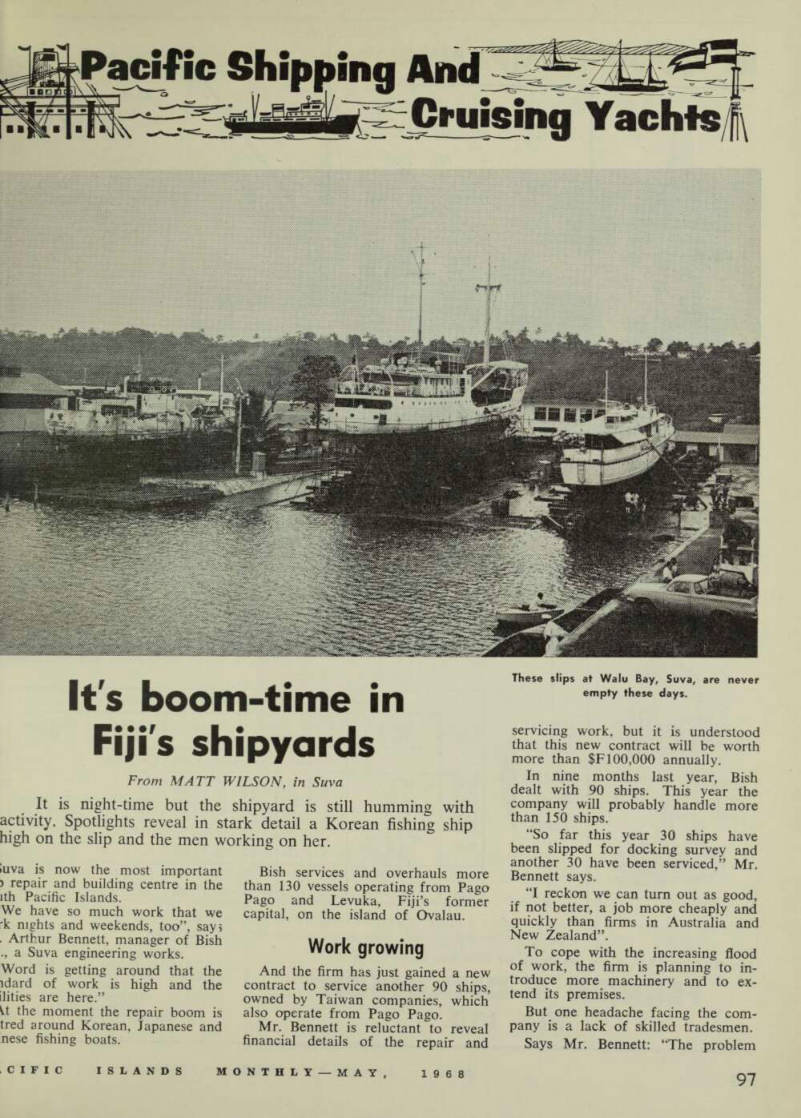
It is night-time but the shipyard is still humming with activity. Spotlights reveal in stark detail a Korean fishing ship high on the slip and the men working on her. b
:uva is now the most important ) repair and building centre in the ith Pacific Islands.
We have so much work that we *k nights and weekends, too”, says . Arthur Bennett, manager of Bish a Suva engineering works.
Word is getting around that the ward of work is high and the ilities are here.” it the moment the repair boom is tred around Korean, Japanese and nese fishing boats.
Bish services and overhauls more than 130 vessels operating from Pago Pago and Levuka Fiji’s former capital, on the island of Ovalau.
Wnrlr nrnuimn
woiK growing
And the firm has just gained a new contract to service another 90 ships owned by Taiwan companies, which also operate from Pago Pago.
Mr. Bennett is reluctant to reveal financial details of the repair and
servicing work, but it is understood that this new contract will be worth more than $F 100,000 annually.
In nine months last year, Bish dealt with 90 ships. This year the company will probably handle more than 150 ships.
“So far this year 30 ships have been slipped for docking survey and another 30 have been serviced,” Mr.
Bennett says.
“I reckon we can turn out as good, if not better, a job more cheaply and quickly than firms in Australia and New Zealand”.
To cope with the increasing flood of work, the firm is planning to in troduce more machinery and to ex tend its premises.
But one headache facing the com pany is a lack of skilled tradesmen.
Says Mr. Bennett: “The problem
These slips at Walu Bay, Suva, are never empty these days.
to get hold of marine engineers I marine fitters, although we do e a nucleus of first-class men who rate the various gangs.”
"he firm has a work-force of 250 i at the moment but within the t three months this will be bi ased to 300. )own the road at the engineering ■ks of Millers Ltd., chief engineer . Keith Dobson describes his firm’s ) repair and building facilities.
We can build ships of up to 200 s deadweight and have built a nch-way to facilitate ship build ” he says. he speaks his men are tackling lajor re-plating job on a massive II Company barge, used for trans ting fuel. ,ast year the firm constructed two barges for the Carpenter group Fiji, and built another one for the bert and Ellice Islands Govern it.
French warships
fillers also carry out repair work the Carpenter group’s Komaiwai, okula and Tovata, and other ships rating around Fiji.
'he Fiji Government is also tak a bite of the ship repair cake, nch warships from French Pacific itories arrive at the Government )yard about four times a year for airs. lere also ships for the Fiji Marine lartment fleet, which totals 35 ;els, are designed, built and main ed. Four ships are being built at moment.
Tie Fiji Government has a policy
of encouraging ship repair work in the colony. When a vessel comes for repairs it pays wharfage, port and lighterage dues at half rate.
There is also a subsidy element in the running of the Government’s three major slipways, which are hired „ , i,
“«£* TZr m T t 0
wharfage facilities. There is also a _i„ x __j i r strips It is difficult to estimate what the ship repair and building industry is worth annually to Fiji, but one marine official felt it could be nearing the £500,000 mark.
To this could be added the increased trade in paint, provisions and other commodities, which comes with the ships—not forgetting the money crew men spend in Fiji while their ships are being repaired, Qne prob|em at the moment is that the industry is too dependent on S? S • ’ , so might the work. So there is ci need * » * Cher ship wor ' Fiji shipyards believe there is no reason why the industry should not be able to get a share of the New Zealand and Australian markets.
Columbus Agency
Goes Elsewhere
The W. R. Carpenter subsidiary American Trading and Shipping has lost its main shipping agency the German shipping compam Columbus Line.
Columbus Line operates month ly cargo-passenger services frou West Coast USA ports to Australii and New Zealand with regular call at Tarawa, GEIC, and occasions calls at Papeete and Pago Pago. 1 The change was announced i early April when the managin director of American Trading, Mi Rex Morris, said he had resigned and formed a new agency cone pany called Sea Transport Sei vices Pty. Ltd.
Sea Transport would represer the Columbus Line in Australia Mr. Morris said. He added the his brother, Neil S. Morris, wh was his assistant at American Trac ing, will join him in the new con pany.
The decision by the Morri brothers to leave American Tra( ing ends a long-standing conne( tion with the W. R. Carpente Group. American Trading we started by their father, Mr. Neil Morris, with Carpenters holding major interest.
American Trading will contini its other broking and shippir businesses and a Sydney trav< agency.
W. R. Carpenter announced reorganisation of American Tra( ing following the loss of the Co umbus Line agency. Mr. J. I Beer, 45, who has had 17 year experience in shipping, was a] pointed manager of America Trading’s shipping department an also shipping manager of W. I Carpenter Ltd.
Carpenters plan to work in close co-operation with American Tra< ing in shipping matters and also 1 expand the activities of their Sy( new travel agency, Amtraco Travi Centre.
New Ships By
Year's End
The two new refrigerated shij under construction for the P and < subsidiary, New Zealand Shippir Company Matauru and Mam pouri will both be operating o the company’s NZ-UK run vi Papeete late this year.
They will replace NZ Shippir Company’s three vessels, Ruahim Rangitoto and Rangitane.
Matuara, of 11,500 tons, will I delivered in NZ in mid-May froi its builders, Tamano Works c
litsui Shipbuilding and Engineer ig Company, of Japan, and the f anapouri will be delivered in mgust.
Both ships will be equipped to arry cargoes preslung in units, argoes conventially and cargoes on allets. Space will be allowed for rveral containers in hatch squares.
Ates Up On
Tm Vessels
Passenger and cargo rates were used 10 per cent, on the three lessageries Maritimes passenger irgo vessels Caledonien, Tahi sn and Polynesie —from April 1.
The price rises only apply to outh Pacific routes, not to the >mpany’s Marseilles-Sydney run.
The most-affected routes are fdney-Noumea, Sydney - Tahiti id Noumea-Tahiti. A Messageries laritimes spokesman in Sydney id that increased general costs in e Pacific Islands, including steve iring charges, had caused the in ease.
The company last raised charges early 1964, he said.
He denied a Noumea report that e Caledonien and Tahitien, both ) years old, were to be sold and placed by the Cambodge and ios, two other Messageries Mari nes ships on the Far East run.
Caledonien and Tahitien operate gular Marseilles-Sydney schedules, fling at Papeete, Taiohae (Mar lesas Group), Vila and Noumea the Pacific Islands.
G Shipowners 7 Association
) Be Formed
A Territory Coastal Shipowners’ ssociation, to represent most local ipowners in New Guinea, will be rmed in late May or early June.
This follows an initial meeting re ntly in Rabaul of shipowners from abaul, Lae and Madang. About 1 different companies were repre nted.
Main object of the association ill be to protect shipowners’ inter ts in NG and, if possible, regulate sight charges. Three members of preliminary committee who will aw up a constitution for the asso ation are Messrs. M. W. Fish ick and Alan Tong, and Mrs. *ian Connelly.
:Cond Patrol Boat
)R New Guinea
A second Royal Australian Navy itrol boat to be based at Manus land, NG, left Sydney for Manus, a Port Moresby and Samarai, on pril 9,
Aboard the boat—HMAS Samarai —were five New Guinea sailors.
HMAS Samarai will join HMAS Aitape at Manus (PIM, Mar., p. 106). The RAN has plans for three more patrol boats to join these two at Manus.
Inter-Territory
Service Begins
A new, regular shipping service to New Guinea’s main ports, with a 965-ton deadweight motor vessel Lemana, started in mid-April.
Lemana left Port Moresby on her first 17-day run to Rabaul, Lae and back to Port Moresby. On her return to Port Moresby in early
May she was scheduled to make a 24-day trip to Rabaul, Lae, Madang, Lae and Port Moresby.
The service is operated by Southern Cross Shipping Pty. Ltd., a newly-formed wholly-owned sub sidiary of Messrs. Hetherington Kingsbury Pty. Ltd., a Sydney based shipping agency with more than 15 years’ experience in ship ping.
Southern Cross has chartered the Lemana, built 12 years ago for Bass Strait conditions, from a Hetherington Kingsbury associate firm, Hethking Steamships Pty. Ltd., for an initial period of four years.
Her master is NG skipper, Cap tain J. Hague, and her complement
icludes four European officers and 2 New Guinean crew.
Lemana is 212 ft long and has vo 42 ft by 20 ft hatchways, with ne hold, and her equipment in ludes three lifts of five tons and ne lift of 10 tons.
In the company’s first direct ven ire into NG shipping, Hethering m Kingsbury aims to build up a diable frequency of service with le Lemana. However, other major fG ports could see the Lemana fter her first few months of ser- Ice.
Ruise Liners To Get
Etter Deal In Ng
Tourist liners to Papua-New ruinea will be able to reserve srths in territory ports in future— rovidng they let the NG Harbours oard know six months ahead.
This move should eliminate lin s having to anchor in ports, par sularly Port Moresby and Rabaul, hich the liners’ owners certainly m’t like, and also encourage more ops by liners in NG giving a xist to NG’s underdeveloped tour t industry.
Ore Container
Essels For Pacific
Farrell Lines, which makes onthly calls with passenger-cargo ;ssels at Papeete on southbound >yages from Panama to Australia, ill have five 19,750-ton container :ssels built for its east coast USA ustralia and NZ trade.
Tenders for the construction of e container ships will close in me, and the first ship is expected be operating by December, 1970.
A spokesman for the line’s Syd ■Y agents, Wilh Wilhelmsen gency Pty. Ltd., said Papeete was >t on the scheduled stops for mtainer ships, “at this stage”, argo from Tahiti to Australia or om the US to Tahiti did not war nt a call.
He said it was not impossible the ships would include Tahiti, because in two or three years’ time trade might have built up sufficiently to warrant calls. Southern ports for container ships will initially be Sydney, Melbourne and Auckland, he said.
Inquiry Into "Wallisien"
A formal marine inquiry into the stranding of the 527-ton cargo ship Wallisien on Nukutolo Reef, Fiji, last year ( PIM , June, 1967, p, 41) was opened in Suva on April 16.
The start of the inquiry was adjourned from an earlier date to
The 294 ft, 66-man rew submarine HMS "Tabard" aroused nuch interest during [?]ts three-day visit to Apia in April. The übmarine took the [?]rime Minister, Mata'afa, most of lis Cabinet, the NZ righ Commissioner, Mr. O. P. Gabites, and the UN regional [?]epresentative, Mr. [?]. Hixon, on a two our trial run and dive.
liable additional evidence to be Elected.
Meanwhile the freighter, which is remained on Nukutolo Reef, ill not be salvaged. Her owners, [cNicholl Industries (Fiji) Ltd. ill strip deck equipment but not lake any attempts to refloat the »P.
Freck Of "Tiare Taporo"
Sids An Era
Tiare Taporo, the best-known d time schooner in the South Seas, ;came a complete loss after she as driven onto a reef off Aneit jm, New Hebrides, in early March y strong winds from Hurricane lorence.
On the night the hurricane hit ic southern half of the New Heb des, Tiare Taporo snapped her ichor chain and was driven raight onto the Aneitvum reef.
Huge breakers finished the job id within a short time the proud Id mariner was completely recked.
Tiare Taporo meaning Lime lossom in Tahitian—was built in uckland, NZ, in 1913 for A. B. •onald Ltd., NZ shippers and aders to the Cook Islands and rench Polynesia.
A beautiful schooner, she was 107 long and weighed 173 tons gross ith a 23 ft beam.
A. B. Donald first used her based Papeete, to sene the outer iciety Islands.
After World War I she entered ic Cook Islands trade and also Derated a regular NZ-Cook Islands ipeete run, sometimes in conjunc
tion with the old motor vessel Tagua.
For more than 32 years she was a familiar sight to people of the major and minor Cook Islands and French Polynesia, carrying vital supplies and picking up all types of Islands produce.
Two of the South Seas famous skippers Captains Viggo Ras mussen and Andy Thomson—com manded her for many years and
"Tiare Taporo", which has now ended her days on a reef, taken when she was built. her name cropped up in many books about Polynesia.
When Captain Rasmussen was taken from Rarotonga in late 1946 to die peacefully on Penrhyn Island a few weeks later, he was carried on the Tiare Taporo and said he would not regret it if he died on board the ship he had commanded for so many years.
Tiare Taporo survived many hur ricanes and rough seas in the tens of thousands of miles she travelled in the South Seas, although at times she received severe damage.
To the people of islands like Aitutaki, Mangaia, Manuae, Pal merston, Pukapuka and Raka hanga, she was the only link with the outside world for much of the 1930’s and 1940’5.
In recent years a big copra fire on her decks caused most of her decks to be rebuilt, with new cabins and cargo equipment in stalled.
In June, 1964, she was sold to Mr. W. B. Christophers, of Rotorua, NZ, who resold her a few months later to Mr. Tom Low, of Vila, New Hebrides.
Mr. Low used her for the in ternal trade in the New Hebrides and it is a paradox that after so many escapes in Polynesia Tiare Taporo ended her days on a jagged Melanesian reef.
RICH PRIZE. The "Fiji Maru No. 28", which ran aground not far from Suva last year, was salvaged in March by McNicholl Industries (Fiji) Ltd., which had bought her as a long shot. The company will use her for refrigerated cargo between Suva and the outer islands.
Faveuni" Is Name For
Ew Uss Freighter
The Union Steam Ship Com my’s replacement for the old (atua —the recently-bought Argen nean Reefer (PIM, Apr., p. 101) -will be called Taveuni, after iji’s third biggest island. She is pic ired above.
The 3,355-ton deadweight ship aveuni will be handed over to USS : a European port about late May nd undergo modifications to suit iland requirements.
Her delivery voyage to NZ is ex ected to start in late June or arly July and her first run to iji, Tonga and Western Samoa is :heduled in August. No passenger :commodation will be available.
New Port For
Apua—But Where?
Work is going on to determine hich of three spots—-Oro Bay, !una or Sanananda—will be the est site for a new port to serve le needs of Northern District of apua.
The Australian Commonwealth ►epartment of Works is currently irrying out feasibility surveys of lese sites for the NG Co-ordinator f Transport, Mr. G. J. McDonnell.
Results of these surveys should be vailable by June, and if a favour ble site is chosen, work on the ew port will start in early 1969.
Buna and Sanananda have the ight edge over Oro Bay because icy are both closer to Popondetta nd thus road freight costs would be ;duced at these two sites
Lew Service Via Fiji
Suva and Lautoka will be regular ills on a new, monthly Australia test Coast USA and Canada cargo jryice to start in May with the eighter Hong Kong Surety, one of >ur vessels to be used on the service.
Orient Overseas Line, a Hong long-based company, will be using iree other ships Hong Kong
Truth, Hong Kong Observer and Hong Kong Beauty —by late this year on the run.
Initial ports of call will be Adelaide, Melbourne, Sydney, Bris bane, Suva, Lautoka, San Francisco, Puget Sound and Vancouver. Aus tralia agents are H. C. Sleigh Ltd.
Wharf Announcement Soon
An announcement is expected any day now detailing plans for the con struction of the long-awaited, deep water concrete wharf for Vila, New Hebrides. Shipping operations, par ticularly loading and off-loading cargo, have for many years been hampered in the main port of the New Hebrides because Vila has never boasted a wharf capable of handling even medium-sized freighters.
Eel Ships To Begin
Ilding In Rabaul
Work will start in June near haul on the first all-steel ship be built in New Guinea. The ft ship, to cost about $lOO,OOO, [1 be built for Steamships Trad r, Company by a newly-formed iw Guinea and Japanese com ny, New Guinea Shipbuilding mpany Pty, Ltd., at its own ipyards on the Rabaul harbour •eshore.
Chairman of New Guinea Ship ilding, well-known businessman ■. Henry Chow, said in April that t ship would be 120 tons dead ight and capable of carrying 60 is of cargo and have 200 cubic :t of freezer room.
Hydraulic lifting gear for cargo ndling in Papuan waters would fitted, he said.
New Guinea Shipbuilding is a nt enterprise between Rabaul sinessmen and Tsuneishui Ship ilding Company of Tokyo. Its ■mation follows the decision by ; NG Administration last year to low Japanese technicians to >rk in NG for limited periods.
Four Japanese technicians arrived Rabaul in March to supervise >rk on the company’s shipyard, lich will be the biggest in the j Islands.
Its workshop will be 2,000 feet ig, 50 feet wide and 30 feet
high; and it will include a head gantry, capable of lifting ships’ sec tions of up to 10 tons.
Initially the workshop will em ploy about 50 men—including 10 Japanese, five Chinese and 33 New Guineans.
Karlander Adds
Another Vessel
Karlander New Guinea Line, which operates regular cargo ser vices from Australia to NG and
the Solomons, has bought a fifth cargo vessel MV Slidre for these routes.
MV Slidre, capable of carrying over 2,000 tons of cargo, arrived at Lae from Europe on April 19 and loaded for Brisbane and Sydney.
With her master, Captain J.
Olsen, she will make her first trip from Sydney on May 7 to Bris bane, Port Moresby, Lae and re turn.
The other Karlander vessels are Sletholm, Sletfjord, Sarang and Saidor.