Magazine Section
pp. 79-83 · Read in the full issue

Pacific Islands Monthly
When Eric Feldt was boss of New Guinea’s wild and rugged Morobe
By MALCOLM WRIGHT, author of “If I Die’’ and “The Gentle Savage”.
Eric Feldt, who died in March at the age of 69, was more than the commanding officer of the Coastwatchers, and the author of their written history. He was a native affairs officer of great energy who never asked others to do what he was not prepared to do himself.
It was his experience as a New Guinea patrol officer in the early days that helped develop his bent for strategy that won him high war time reputation with the Australian and American high commands. As he used to say, “Once you have been a patrol officer you can do anything!”
Certainly it was true of Eric Feldt.
Born in 1899 at Ingham, in North Queensland, Eric Feldt grew up in a district where kanakas recruited from the Islands still worked on the sugar-cane farms and here he heard his first Pidgin English.
When he was only 13 he was selected as a cadet to become one of the inaugural class in the first Royal Australian Naval College at Geelong.
He served as a midshipman with the RN in the Atlantic in 1917-18, but the navy did not provide what he wanted, and in 1922 he elected to take his discharge, as a lieutenant.
The tang of the sea was still strong in his nostrils and he bought a yawl in Tasmania to begin crayfishing at Welshpool in Victoria. After cross ing Bass Strait the ship was wrecked, and down with it went Feldt’s hopes of making a fortune, or even a livelihood, from the sea.
Gold fever
The following year he went to New Guinea as a clerk. Here he quickly saw where his future lay and transferred to District Services as an assistant district officer. Almost immediately he was assigned with G. W. L. Townsend to John Walstab’s patrol up the almost unknown Sepik River in the Aloha. It was the first extensive exploratory patrol under taken by the Australian Administra tion.
Then in 1928, when he was the youngest Acting DO in the service 'his position was confirmed in 1932), be was given charge of the Morobe District with its headquarters at Salamaua.
Morobe was in the throes of a mighty gold-fever, and Salamaua was the hottest point. Prospectors, old hard-heads and greenhorns, came in hundreds to the tiny fort which was no more than a few saksak buildings dumped on the narrow isthmus, It was a busy time. Prospectors were employing native carriers in large numbers and native labour laws had to be enforced. Customs dues had to be collected on the great mass of cargo that was piled up on the beach with the arrival of every ship, and the normal business of government was carried on by a clerical staff of three. (One of the clerks made himself an official cap with four peaks, each with an official designation, and as he carried out
the duties of postmaster, native labour officer, Customs officer or storeman, he brought the proper peak to the fore). There was a pub at Salamaua and there were drinking bouts and fights day and night, and any law-breakers that the one police man brought before the court made his Pl ea to Eric Feldt.
Huge responsibility
J r 7 E was a huge district extending from the Rai Coast to Morobe on the coast and inland to Mount Hagen, Ee divided the district into three parts, and made a patrol officer re sponsible for the native administra ti°n °f eac h section, It was a mighty task for these
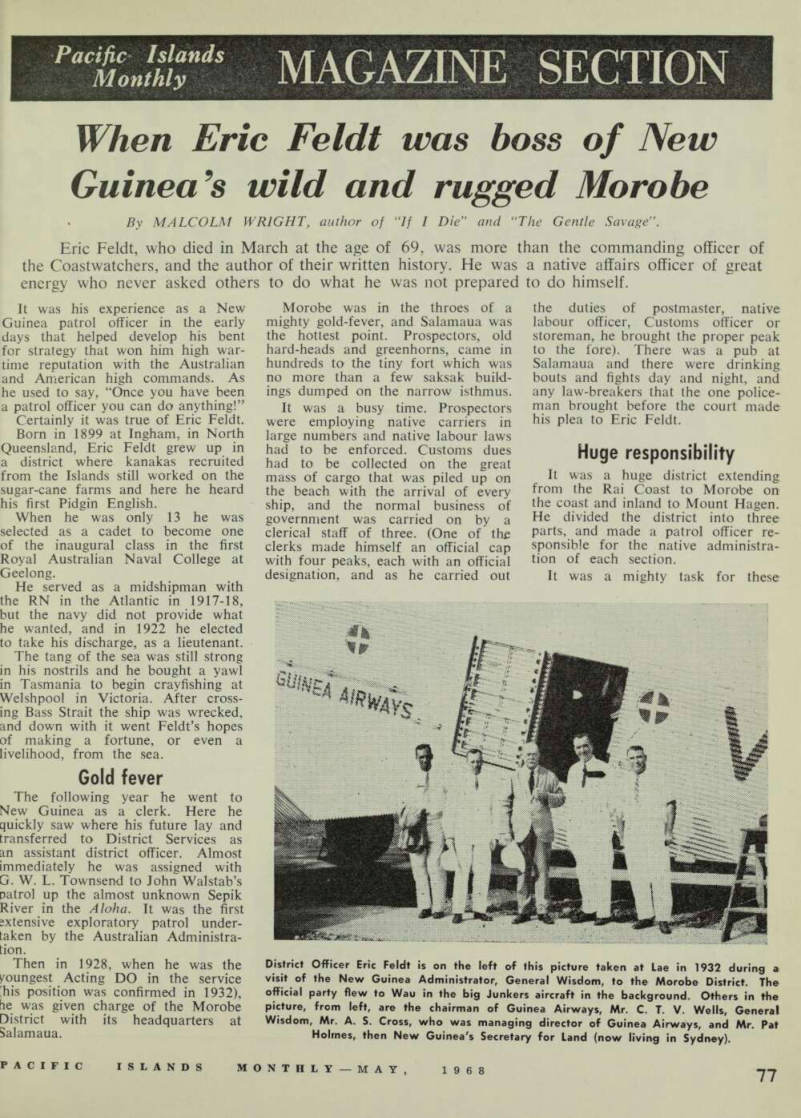
District Officer Eric Feldt is on the left of this picture taken at Lae in 1932 during a visit of the New Guinea Administrator, General Wisdom, to the Morobe District. The official party flew to Wau in the big Junkers aircraft in the background. Others in the picture, from left, are the chairman of Guinea Airways, Mr. C. T. V. Wells, General Wisdom, Mr. A. S. Cross, who was managing director of Guinea Airways, and Mr. Pat Holmes, then New Guinea's Secretary for Land (now living in Sydney).
Into the unknown Kukukuku country
hree young men—Alan Roberts, Slick Penglase and Bill Kyle—but sric Feldt was asking no more from hem than he demanded from him ;elf.
It was in Salamaua that Feldt earned how to get the most out )f staff, a knowledge that was most iseful to him in the early days of he war.
In spite of his crowded life at Jalamaua he was first into the Kuku :uku country when Baum was nurdered. It was wild, unknown egion but Eric accurately fixed the icsition and established that the scene >f the murder was on the New Juinea side of the border (by only hree miles) and so came under his urisdiction.
Head-hunting
When a report was received that , recruiter had been murdered in the .eron, he set off for the scene to ind, after many day’s walk, that he Lerons had never seen a white lan before, let alone been able to lurder one.
After Salamaua came a term in he Sepik District where he again lade the acquaintance of the river eople. Only a year or two before,
the Administration had waged a campaign against head-hunting and a number of convicted killers had been publicly hanged in their villages.
It was, I think, “Kassa” Townsend who brought the murderers to book, and when Eric Feldt went to the Sepik there was a tense situation on the river. By showing the people that by-gones were by-gones and by good administration, the Sepiks were converted into useful citizens.
After this came a relatively easy stint in Madang, where with his wife, Nan, a former Brisbane journalist, he was able to enjoy for the first time the amenities and social life of a good station.
At this time the position of warden of the Wau goldfields became vacant and Feldt was appointed to it. But after a couple of years in Wau the comparative inactivity of the job made him restless and he had thoughts of returning to District Services.
Hitler made up his mind for him, and in 1940 he was recalled to the Navy with the rank of lieutenant commander.
The "Feldt Method"
Posted to Port Moresby, Feldt’s job was to organise a coastwatching system in Papua, New Guinea and the Solomons. It was a good plan, but the Navy provided little or no money to set it up.
He proposed the use of teleradios that were already installed in the Islands —on government stations, missions, and plantations—and he
set out to link up these places to a single communication centre in Port Moresby.
Travelling by plane, schooner, truck and on foot he visited scores of people and taught them coast watching. He decided against in volving them in the use of com plicated codes. Instead he taught every one in the network how to use the commercial Playfair code with a simple modification. This became known as the Feldt Method.
His friends killed
It was used by coastwatchers for more than a year after the Japanese entered the war. So far as is known, it was never cracked by the enemy.
When the Japanese invaded New Guinea the coachwatching net work was working effectively—but the rest of that story is well known.
The Coastwatchers provided ex cellent intelligence, but the cost was great. Many were captured and killed by the Japanese, and each loss affected Eric Feldt deeply. He had known most of them personally; many of them were his close friends, who had served under him, who had drunk with him as his guests and his hosts.
He felt a personal responsibility for every man who had died, although every man knew of the danger and had volunteered for the job. It was worse in those instances when he could, from his position, see the end coming; one day the station would
district Officer Eric Feldt photographed in alamaua in 1931, just after he had re urned from Surprise Ceelc with the [ukukukus he had arrested for the murder [?]f Helmut Baum. When he took over the [?]orobe District Feldt was the youngest DO in the service.
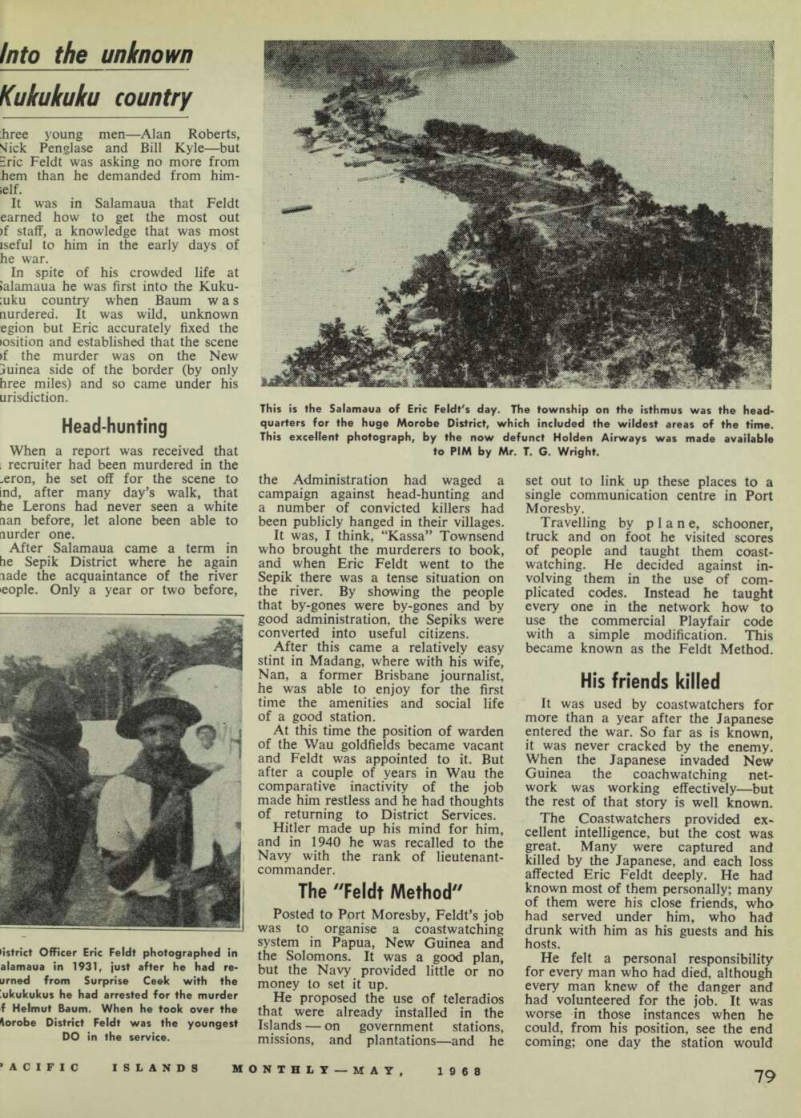
This is the Salamaua of Eric Feldt's day. The township on the isthmus was the head quarters for the huge Morobe District, which included the wildest areas of the time.
This excellent photograph, by the now defunct Holden Airways was made available to PIM by Mr. T. G. Wright.
Coastwatcher death a 'persona! cross'
lot answer the call and there was silence.
He said that sometimes he wished le had the outlook of a hard-headed general who could push his divisions nto battle and forget about the con sequences; but deep-down he was ?lad he hadn’t, and so were his friends.
With the later operations of in serting parties of Coastwatchers into :nemy territory, the strain was no ess. To each one he said, “If it smells, don’t go in,” and each one cnew that this was not just advice, t was an order.
At this time he began to feel that le should do more himself. He was it and active and could well take command of a party, but GHQ vetoed he idea.
Instead, it was agreed that he could go to the Solomons to visit he radio bases attached to the US Vlarines.
A few days after he left he suf ?ered a coronary thrombosis. So »reat was the Americans’ regard for lim that they provided a special plane 0 fly him to Brisbane where their op surgeon, one of the greatest in he States, assisted in the operation hat saved his life.
Ashes for NG
While he was recovering he was old that he had been awarded the 3BE. “Other b—r’s efforts,” he said characteristically.
After his discharge, Eric suffered 1 great set-back when he realised that ic was unfit to return to New Guinea.
For a time he acted as secretary of he United Services’ Club but he : ound that his health would not itand the work. Now he accepted he fact that he had to take life juietly, and after a long absence, he crinkle of good humour returned o his eyes.
In his quiet retirement in the Peasant atmosphere of his home in Brisbane, he began to take a new nterest in people. Through his authorship of The Coast Watchers, vhich had also been translated into French, he had a great number of correspondents in many parts of the ivorld, and he became a letter writer af great note. With his death went a link with an era of adventure and auman endeavour. • See also the photograph on p.