dead, but long
pp. 59-61 · Read in the full issue
The king is dead, but long live who?
From a correspondent in Mount Hagen
Any recent visitor to the New Guinea Highlands town of Mount Hagen would have been intrigued by the large number of native people with faces and bodies painted a brilliant chrome yellow. The uninitiated visitor might have been forgiven for think ing that this was just one more manifesta tion of the Highlander’s love for colourful display, and probably indicative of some local festival.
In New Guinea’s Western High nds, to daub one’s face and body ith yellow clay, far from signifying ly festive mood, is a symbol of deep ourning. And the mourners take eir job very seriously indeed, being is some people have discovered to ieir cost) extremely intolerant of ly sign of levity from onlookers.
The recent mourning at Mount agen for Jiga clan leader, Waak opun, was attended by most of the wnspeople. Waak, of the Maipengil [ilakemb line, leader of 20 tribal oups in the Mount Hagen area, died i March 1 at the Mount Hagen eneral Hospital. Aged about 50, 5 had been receiving treatment for incer for some time. His last ad ission to the Hagen Hospital was i the day before his death.
Waak’s death was a big blow to s people, as shown by their grief his funeral on March 3. About 000 mourners, bedaubed with the aditional yellow clay, wailed and re out their hair at the burial iremony at Waak’s home village of okglamp, about two miles from [ount Hagen, and some 10,000 ;ople visited Kokglamp at different nes to pay their respects.
Mourners represented many dif
ferent clans and sub-clans, which some observers claim is an indication of a decline in the traditional enmity between these groups.
Whether this claim is justified or not, the importance of inter-group harmony was hardly exemplified by the actions of certain Christian mission adherents engaged in an un seemly battle for Waak’s remains. In the end, it was the infidel who had the final word, and Waak’s body was buried, according to native tradition, at Kokglamp village.
Still, the dispute left a nasty taste, and there was a distinct undercurrent of feeling among the mourners at the funeral.
Wamp protests!
Ominous rumblings were heard when one local mission adherent got up and publicly proclaimed that, while his church may have missed out on Waak’s mortal remains, it was not going to miss out on Wamp’s! Wamp, the still hale and hearty president of the Mount Hagen Local Government Council, obviously regarded this as highly indecent anticipation, and brought this zealous oration to a rather abrupt end.
What sort of an impression these
goings-on made on the visiting United Nations mission, whose members at tended the funeral, is not known.
The Administration was well represented at the funeral. A police guard of honour was there, Waak’s coffin was draped with the Australian flag, and Acting Western Highlands District Commissioner, Mr. Bob Bell, spoke at the graveside. Other speakers included the presidents of three Local Government Councils; and president Wamp, paying tribute to Waak’s former position as first president of the old Kui Council, placed a councillor’s badge on the coffin.
Seeing that a local funeral of such magnitude has not occurred since 1963, when the Mogei clan mourned the death of their headman, Ninje, Waak’s people could hardly have desired more honour for their dead leader. Yet it soon became apparent that the Jigas felt that some in dividuals and groups were not show-
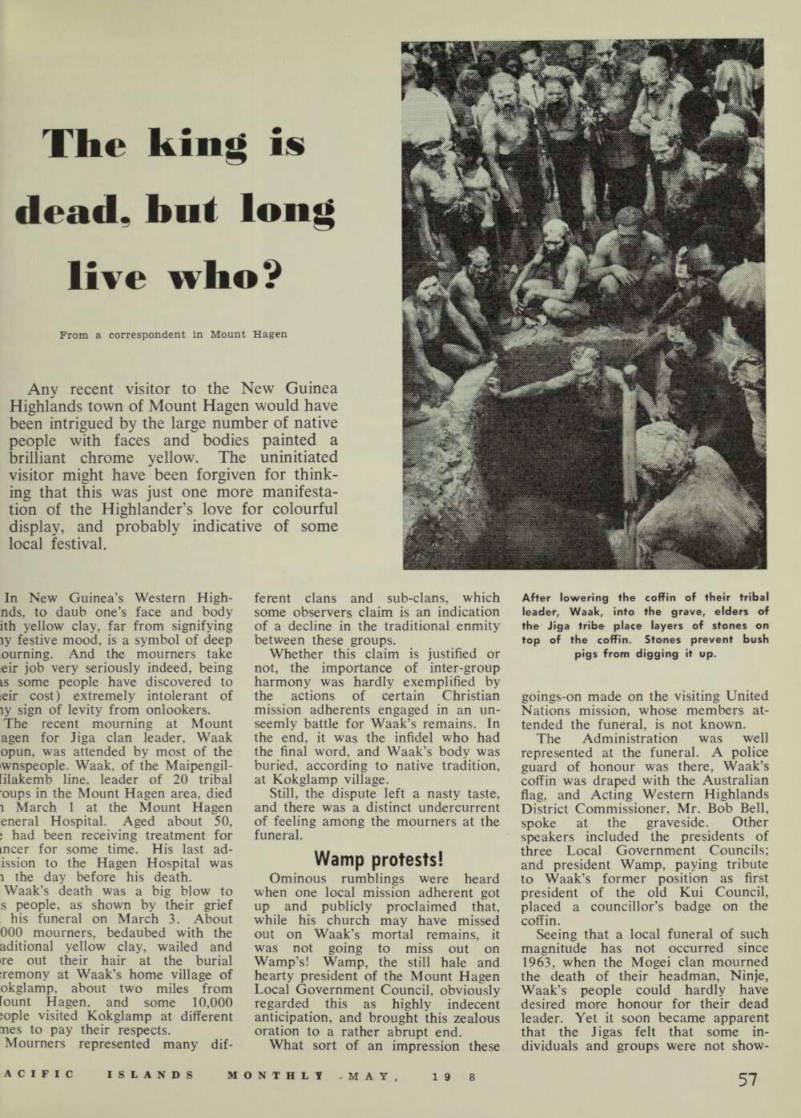
After lowering the coffin of their tribal leader, Waak, into the grave, elders of the Jiga tribe place layers of stones on top of the coffin. Stones prevent bush pigs from digging it up.
Levity not welcome
ing sufficient grief over Waak’s pass ing.
Retribution was swift. One Southern Highlands man, who was foolish enough to ridicule a group of mourners, was lucky to escape with his life after being chased by an incensed mob of Jigas. He was later charged at the Mount Hagen District Court with offensive behaviour, fined S4O and sent back to the Southern Highlands—no doubt thanking his stars for the Administration’s inter vention. A woman who showed some amusement at the yellow-painted faces of the mourners was later manhandled by a group of Jigas, and has no doubt learned to curb her sense of humour.
If that is not enough to prove that Western Highlanders take their mourning seriously, there is the case of the young man from the Jiga Andapoints sub-clan, who was in fear of his life for some days after Waak’s furneral, even though he was not personally guilty of any disrespect towards the dead leader. However, as youngest male member of his sub clan, he was responsible for the actions of another, older member of the sub-clan who, according to the rival Jiga Maipgin sub-clan, had some connection with Waak’s death, and, furthermore, had failed to attend the funeral in suite of being the recipient of many gifts from Waak. Therefore, said the vengeful Jiga Maipgins, his young kinsman must die.
They let him live
The claim that the older man had some connection with Waak’s death had no foundation in fact. It appears that Waak had, before his death, been actively campaigning for a certain House of Assembly candidate.
His driver during these campaign trips was the Jiga Andapoints man who had later failed to attend the funeral. So, to the primitive mind, it seemed quite logical to connect him in some way with the death of their leader.
However, the story has a happy ending. The young man from the Jiga Andapoints sub-clan was allowed to remain alive. This, he explained, was due to the fact that his wife is a member of the sub-clan which was after his blood!
But the fact that this young man, a well-educated Administration em ployee, was for some days clearly terrified of tribal retribution, indicates that the Jigas are in deadly earnest about their mourning ritual. It also indicates that, contrary to some
iriews, old clan enmities die hard.
Furthermore, it indicates the extent )f Jiga misunderstanding as to the •eal cause of their leader’s death.
One wonders what might have lappened if the Jigas had decided o put the blame on the European louse of Assembly candidate for vhom Waak was campaigning before lis death! This gentleman, however, vas not foolish enough to stay away fom the funeral.
The hunt for a scapegoat now eems to have been called off. Yet nany Jigas are still resentful over vhat they consider the indecent haste vith which some groups concluded heir period of mourning.
Full week's mourning
Large-scale mourning for Waak asted a full week, during which teriod Radio Mount Hagen, the local Administration radio station, was isually full of yellow-painted tiourners, anxious to broadcast their jief. Many broadcast appeals to heir clansmen for gifts of money, tigs and food—partly, it appears in irder to sustain the mourners, but Iso in order to fulfil Waak’s last /ishes.
Shortly before his death, Waak had tarted a project to collect gifts for
his mother’s clan, and his followers are continuing this project. Which makes mourning an expensive business.
The week Of large-scale mourning culminated in a big ceremony in Mount Hagen township. On the Saturday following the funeral, many hundreds of mourners moved into town, holding up traffic while they Stopped to weep and wail and pull out handfuls of their own hair. These mourners, from the jiga and Mogei clans, gathered outside Radio Mount Hagen, a location obviously chosen SO that the proceedings could be recorded.
And what proceedings! Radio Mount Hagen staff returning to work on Monday were horrified to find the station’s one claim to beauty, its gardens, trampled into the ground, with hardly a sign that its tall flowermg shrubs had ever existed. Which makes mourning also a destructive business. One Radio Mount Hagen announcer, who, armed with a stick, attempted to drive the mob off the station gardens, is to be highly commended for bravery.
Had nine wives
, , , , While Saturday s ceremony marked the end of mourning on a grand scale, Waaks own family, including h * s .,, nme . lt wives nd numerous children, will mourn for several more months, possibly even years. And some of these long-term mourners have apparently expressed their disapprova! of the fact that others are disinclined to follow their example.
But perhaps all hard feelings will dwindle into insignificance beside the
anticipation of the great feast which Waak’s sub-clan must hold to pay b ac k o th er groups for food supplied during the mourning period. This would appear to pose quite a problem. One Administration officer pointed out that the Mogeis still haven’t managed to raise what they consider a sufficient number of pigs to hold Ninje’s “pay-back” feast. And Ninje died in 1963.
However, the Jiga clan has a more pressing problem—choosing a new leader. This is causing some concern, since most Jigas feel their clan con . tains no one w jth sufficient strength to hold the various sub-clans together, Which would appear to be yet another fact to confound those idealists who claim that the Hagen people are just one big, happy family.
But still, do people anywhere really love one another?
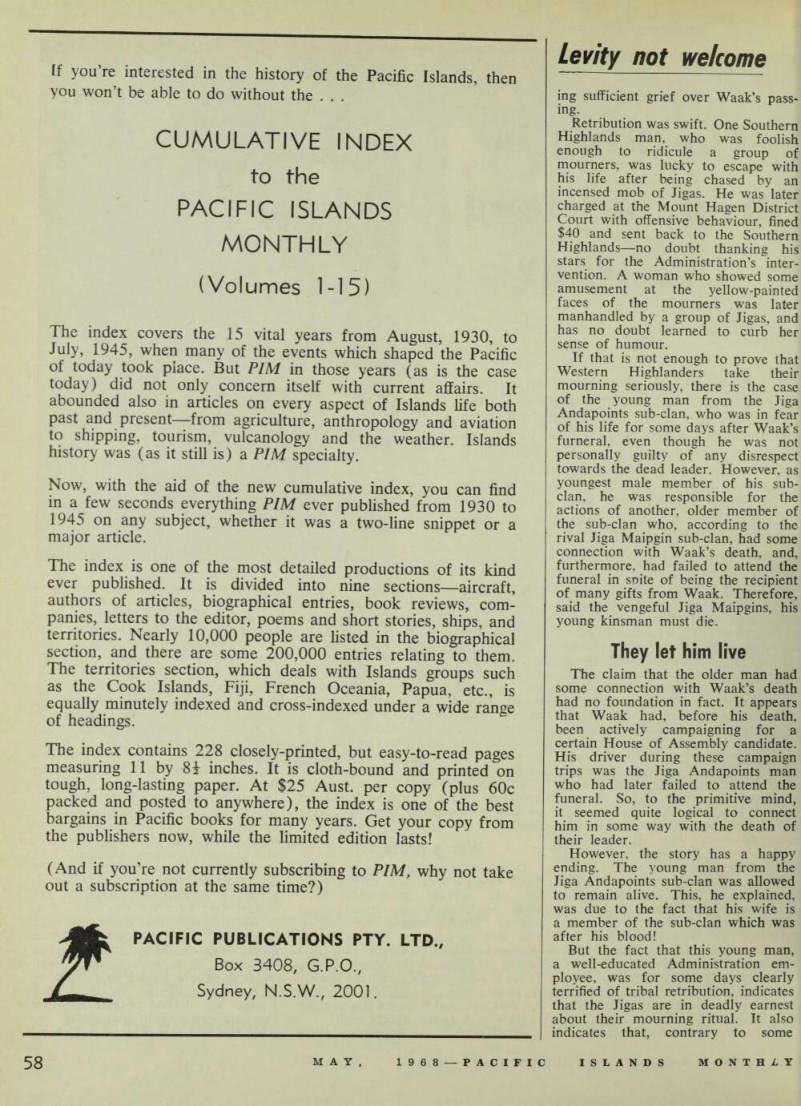
The helping hand. One Kokglamp villager [?]elps his friend to smear himself with [?]nud before attending the mourning cere monies.
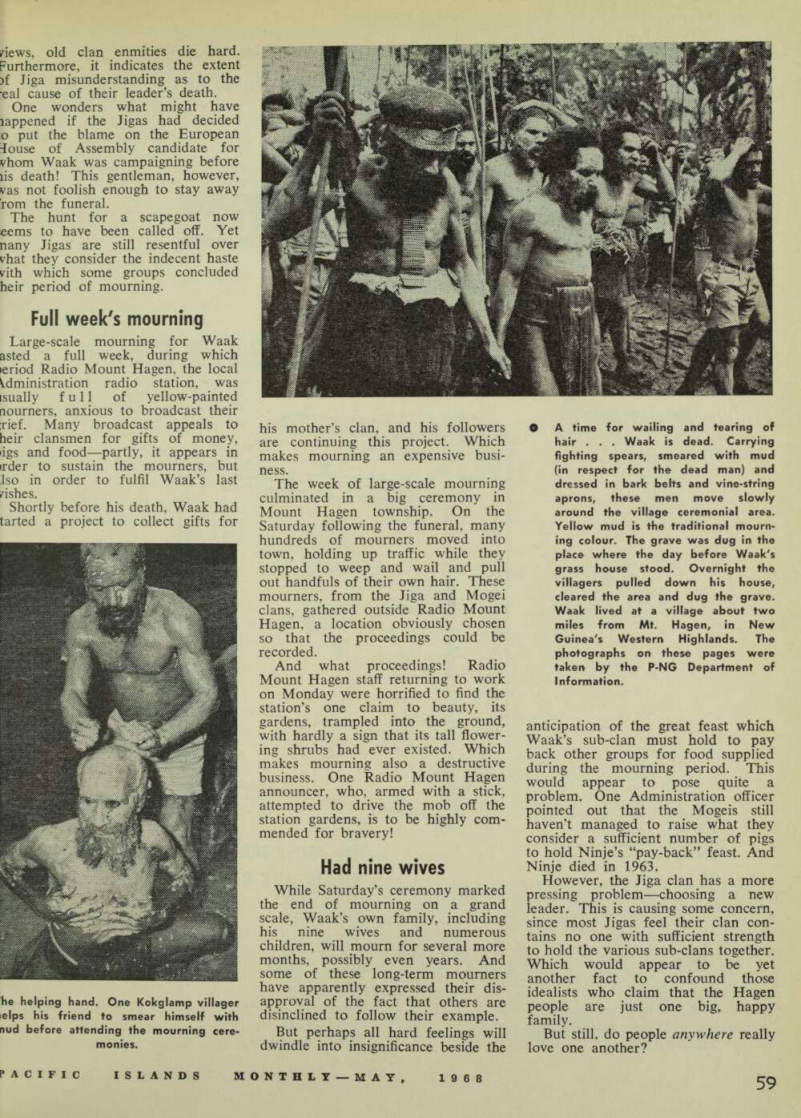
A time for wailing and tearing of hair . . . Waak is dead. Carrying fighting spears, smeared with mud (in respect for the dead man) and dressed in bark belts and vine-string aprons, these men move slowly around the village ceremonial area.
Yellow mud is the traditional mourn ing colour. The grave was dug in the place where the day before Waak's grass house stood. Overnight the villagers pulled down his house, cleared the area and dug the grave.
Waak lived at a village about two miles from Mt. Hagen, in New Guinea's Western Highlands. The photographs on these pages were taken by the P-NG Department of Information.