Waiting) For
pp. 51-52 · Read in the full issue
Tonga Ready (And
The Air Age
Tonga—the land with no
locally-based planes—will have
four airfields by the middle of the year. Airfield No. 1 is the origi nal one at Fua’amotu. Airfield
No. 2, just completed, is at
Vavau. Airfields Nos. 3 and 4, at Ha’apai and ’Eua, will be operating by the middle of the year.
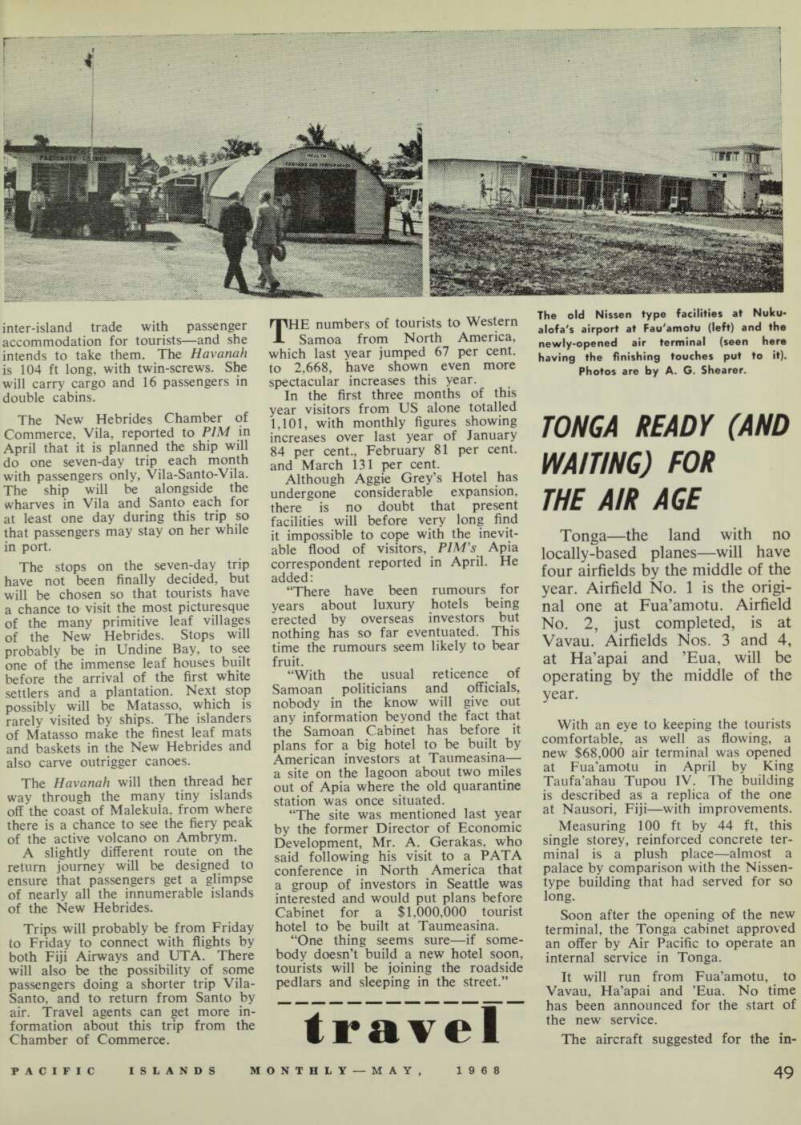
With an eye to keeping the tourists comfortable, as well as flowing, a new $68,000 air terminal was opened at Fua’amotu in April by King Taufa’ahau Tupou IV. The building is described as a replica of the one at Nausori, Fiji—with improvements.
Measuring 100 ft by 44 ft, this single storey, reinforced concrete ter minal is a plush place—almost a palace by comparison with the Nissen type building that had served for so long.
Soon after the opening of the new terminal, the Tonga cabinet approved an offer by Air Pacific to operate an internal service in Tonga.
It will run from Fua’amotu, to Vavau, Ha’apai and ’Eua. No time has been announced for the start of the new service.
The aircraft suggested for the in
ternal service is the two-engine 10-seater Beechcraft Queenair A 65, distributed by Hawker De Havilland.
Air Pacific is De Havilland’s dealer in Fiji.
In Sydney, De Havilland was un able to say whether the Queenair had been chosen. The company was awaiting the return from Tonga of Mr. John Benson, marketing man ager of Beechcraft Australia Division of De Havilland, with a full report on the matter. The Queenair was demonstrated in Tonga in November last year.
Captain G. U. Allan, chairman of Fiji Airways, who was in Tonga in February, advised that Tonga use a two-engine, nine-seater Britten-Nor man Islander aircraft.
In late April Fiji Airways was reported to be making a counter offer to Tonga for the service.
The man chiefly responsible for the building of the terminal is Mr. Joe Furniss, who was sent to Tonga by the British Ministry for Overseas De velopment to advise on both internal and on communication be tween Tonga and her neighbours.
He said that because of limited capital, the runways on the airfields are not constructed in permenent materials. However, with four planes weekly, two by Fijian and two by Polynesian Airways, bringing more and more traffic into the kingdom it might soon be possible to make run ways in permanent materials.
King Taufa’ahau thanked the British Government for contributing 90 per cent, of the total cost of the project and for sending Mr. Furniss to Tonga.
Much praise
The king praised the builders and the Fiji Government which had donated plans for the building and the services of an air control officer.
The officer would remain in Tonga until Tongan trainees were ready to take over.
In a droll moment, the king said he was prepared “to put the cart be fore the horse” by creating new air strips without possessing a single plane, and added: “Though some may doubt the wisdom of this policy, a start has been made and I am proud of the confidence of my government in proceeding with the four runways.
All that remains now is to find air craft to utilise them!”
The king mentioned, presumably hopefully, that there was a rumour about that an unknown philantrophist was about to reward the optimism of his government with a gift of a small aircraft for internal use!