‘Momentous ' airport decision will launch
pp. 39-43 · Read in the full issue
Cooks on international travel scene
By a staff writer
With a brief announcement in April New Zealand put the neglected Cook Islands well and truly on the tourist-destination map for the tens of thousands of additional travellers confidently expected to invade the South Pacific in the 1970’5. The announcement was that at long last an in ternational airport is to be built in the Cooks.
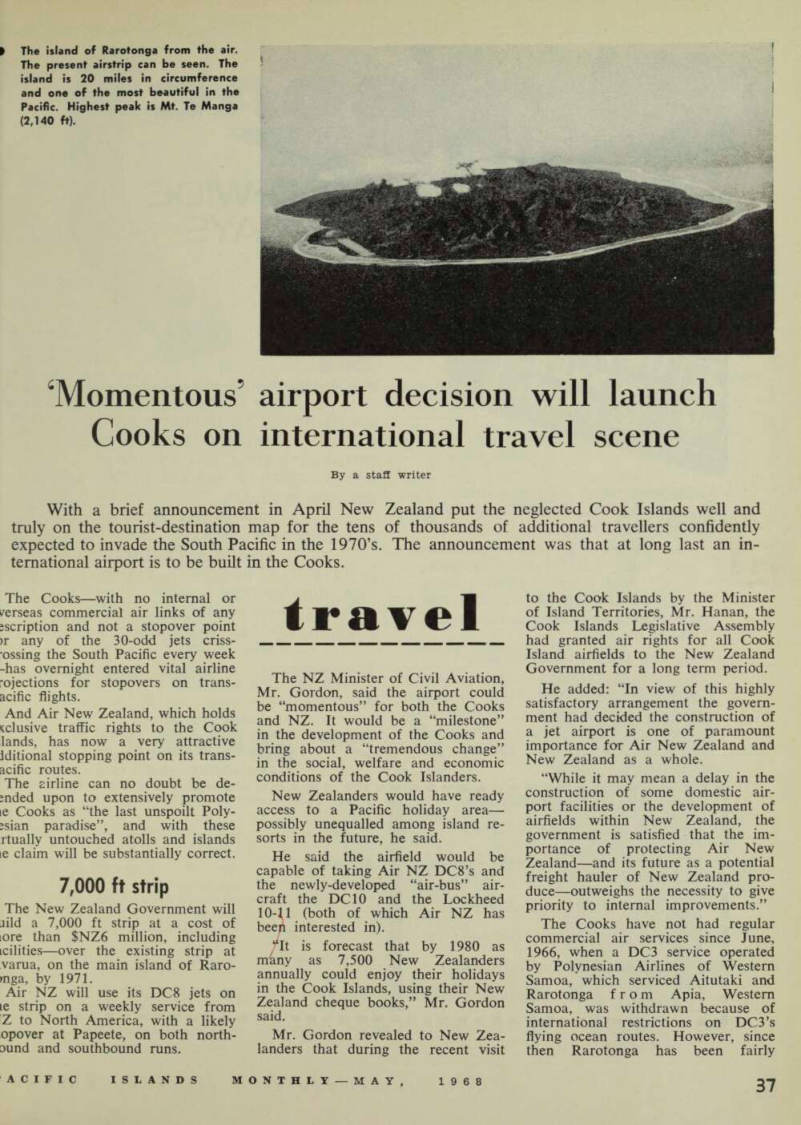
The island of Rarotonga from the air.
The present airstrip can be seen. The island is 20 miles in circumference and one of the most beautiful in the Pacific. Highest peak is Mt. Te Manga (2,140 ft).
egularly serviced by aircraft of the
Inzaf.
For more than a year there has ieen talk about building an airstrip tf international standard at either Ututaki or Rarotonga. In this time everal missions from NZ have isited the Cooks to inspect the avail ble facilities.
Planned some time
People living or planting at Nikao, n area at the inland end of the xisting 4,000 ft Avarua strip claimed ompensation if their land was used i airstrip plans. Presumably, they rill now be paid compensation, but 4r. Gordon did not make any men ion of this.
The very high cost of building an irfield of international standard was nother factor which delayed plans 3 start.
Many Cook Islanders are known to ave favoured the strip on Aitutaki s the better site. Last year, the 'ook Islands News —a Cl Govern lent newspaper—said: . . . the jovernment (Cl) has agreed to air trip extensions so long as they do ot have any major effect upon the eople living in or planting the Nikao rea. This certainly would not be tie case if an international jet strip constructed at Rarotonga.”
New bargaining power
For Air NZ, the NZ Government ecision will mean new bargaining ower in negotiations for flying rights cross the South Pacific—Air NZ las the Cooks on its own and the hance to be the biggest financial icneficiary of what could be the most ttractive Pacific Islands resort terri ory of the 1970’5.
For the Cooks, a stopover on a hrough-jet service across the South will mean the start of a real ourist industry (which currently con ists of periodical visits by cruise hips) and a much-needed boost for he territory’s stagnant and hurricane >rone economy.
Several NZ interests would wel :ome a chance to build a modern lotel at Rarotonga, and the Cl Gov ;rnment would be equally sure of in isting on a share of this, or a limilar project.
Overseas interests need the land, md Cook Islanders want the money—
compromise deals could be the answer to tourist developments.
The significance of the new develop ments was summed up by the Auck land Star in this editorial of April 10;
Newspaper comment
“There have been times when air port development in New Zealand has been governed more by political pressures than economic sense. No body can say that of the govern ment’s two most recent decisions. It has refused to throw money away on an international airport for Well ington. And it has decided to invest $6 million in a jet airport at Raro tonga.
“An investment it literally is. With its one hotel-cum boarding house, Rarotonga today may seem an un likely place to establish an inter national airport. The Cook Islands have had no civil airline services at all for some years.
“Apart from the monthly visits of the Moana Roa the islands have no sea contacts with the outside world either. All most tourists know of the group is what they see from the rail of a cruise ship.
“But given regular air services the tourist potential of the Cooks is almost unlimited. Several groups are interested in building hotels in Raro tonga and will presumably go ahead now that an airport is in prospect by 1971.
“New Zealand can expect three major benefits from the move. The stagnant economy of the Cooks will get a shot in the arm; Air New Zealand will have a new bargaining counter in negotiations for flying rights across America; and New Zea landers will be able to have tropical holidays without using overseas funds.
“Though Air New Zealand’s am bitions have probably been the decid ing factor in the decision to build the airport, the economic advantages of tourism in the Cooks are likely to bring the greatest returns in the long run.
“New Zealand is spending some $2 million in direct subsidies to the islands each year. The inclusion of Rarotonga on South Pacific tourist routes could tighten this burden con siderably.
“With a network of air strips through the smaller islands the un spoilt beauty of the Cooks could give the group some of the popularity of Fiji, which has been doing a brisk trade in winter holidays from New Zealand in the past few years.
“The penalty of tourist expansion will inevitably be a loss of the islands’ charm. But their isolation could not last. One by-product of the opening
jet services may be a sharply in eased flow of Islanders to New ;aland.
“The Government will need to jdy the wider implications of a cision which Mr. Gordon rightly ils ‘momentous’ for the future of e Cooks,” the editorial added.
The decision to enlarge the Raro nga airfield does not necessarily ean the Cooks will have to wait itil 1971 for air services. Polynesian irline’s chairman, Mr. E. F. Paul, still making rude noises in at npts to get his newly-acquired DC4 to the Cooks from Apia.
Samoan links
In Auckland recently he attacked e NZ Government for “missing a luable chance to earn and save erseas funds” by not allowing an ■ service to operate from Samoa the Cooks.
He added that Polynesian Airlines d applied to the NZ Government r rights to fly to the Cooks. Pre mably as Air-NZ has a share of dynesian, a DC4 link via Samoa 11 not be discouraged.
Polynesian’s upgraded 60-seat DC4 early April was put into service Polynesian Airlines’ routes to idi and to Tonga. It is also flying ree services a week between Western d American Samoa. Added to the isting DC3 services this gives Poly sian Airlines 16 flights a week be een Apia and the international air rt at Pago Pago.
The DC4 has more powerful gines than other DC4’s, giving it longer range and a cruising speed about 250 mph.
Modifying the DC4 for its 2,600 • engines was done by an American rcraft firm which is converting for economical use by smaller dines operating long-distance routes, ily five other DC4’s have been odified in this way.
Livery of the DC4 includes a palm tree insignia and the flag of Western Samoa. It will fly once a week to Nadi and to Tonga, with one of the airline’s DC3’s operating a second service to each destination (the second service to Nadi will be via Wallis Island).
Polynesian Airlines was founded in 1959 to link the two Samoas.
Niue gets airstrip
Meanwhile, little Niue, NZ ter ritory west of the Cooks, is also to get an airfield, although certainly not of international standard. But since the island may only be reached by sea at the moment this is an important development.
On the same trip which took him to the Cooks in March, NZ’s Min ister for Island Territories, Mr.
Hanan visited Niue and announced that NZ had approved the money to build the strip.
At a sod turning ceremony at the airfield site at Vaiola, Mr. Hanan said that a new era was starting for Niue. The money for the airfield was available now and work could commence immediately, and if there were any delays it “would not be New Zealand’s fault, but the Niue Island Government’s.”
He said that the airfield would be able to take the RNZAF’s biggest aircraft, the Hercules, and within 18 months he hoped to be on the first proving flight.
He said that it would be possible to fly from Auckland after breakfast, enjoy a huge island welcome as he had enjoyed, and listen to speeches “as lengthy as the Niueans were accustomed to making,” and still fly back to Auckland to be in time for a late dinner!
'plynesian Airways' New, modified DC4.