bring spectacular changes of
pp. 22-132 · Read in the full issue
Final P-NG election results bring spectacular changes of fortune for some
From a Port Moresby correspondent
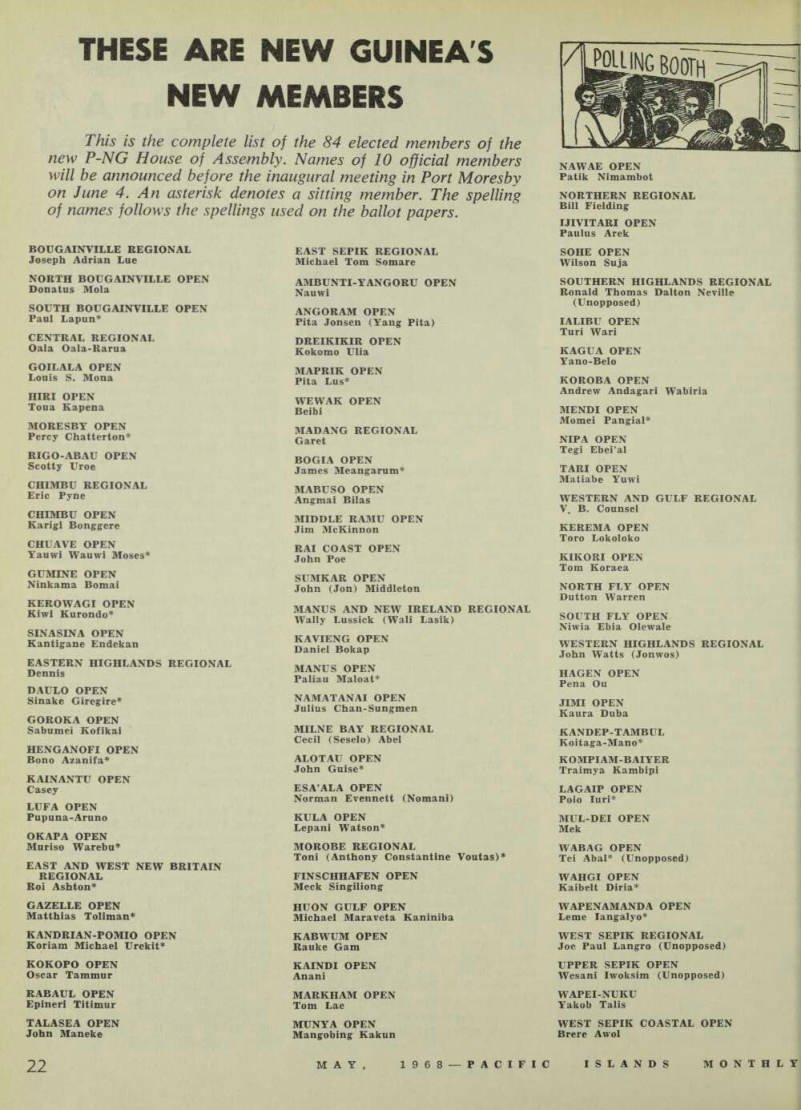
Counting of preference votes in the P-NG elections has been going on during the first half of April and is now com plete. In all but nine of the 84 electorates the leaders in the primary count held their leads and were elected. But in the nine where this was not the case preference counts brought some spectacular changes of fortune.
In each of three Highlands elec torates there was a field of 16 can didates. In Gumine Open, a can didate who was seventh in the primary count won the seat. In Sinasina Open, a candidate who in the primary count ran sixth, with only just over half as many votes as the leader, romped home to victory. And in Goroka Open the winner had been fourth in the primary count.
In the remaining six cases in which preferences affected the result, the successful candidate had been running second or third in the primary count.
Two of these results are of special interest. In Finschhafen Open, Meek Singiliong defeated former Under secretary for Treasury Zure Zurecnuoc, who had led in the primary count. And in Central Regional, Workers’ Association leader Oala Oala Rarua came up from third place in the primary count to defeat former Legco member Ron Slaughter.
22 old hands re-elected
Of the 46 elected members of the Old House (out of a possible 54) who stood again, only 22 were re elected— two Papuans, 16 New Guineans and four Europeans.
Of all the 11 under-secretaries in the old House, two did not stand again, four were defeated, and five were re elected, so that, surprisingly, under secretaries did rather better than rank and-file members. This result should be of some comfort to members of the new House who are wondering whether acceptance of a ministerial post would be political suicide.
Indigenous candidates secured four of the 15 regional seats, while Euro pean candidates won 10 of the 69 open seats.
Three conclusions stand out fairly clearly; first, that European candidates can still win in open electorates;
second, that indigenous candidates cai win in regional electorates; and third that young well-educated candidate: can defeat their elders.
This last conclusion is important.
When the special electorates wit! their racial qualification were dropped one of the arguments for replacing them by regional electorates with ar educational qualification was thal this would give young educated Ne\* Guineans a chance of success whicl they would not have if they stood against their tribal leaders in open electorates.
However, in the new House we shall have, among others, Ebia Olewale, young ex-high school teacher, who not only won the South Fly Open seat, but secured more votes in the primary count than former under-secretary Robert Tabua and former Legco member Simoi Paradi put together.
We shall also have Oscar Tamur, still in his mid-twenties, with a high school education behind him and a teacher’s certificate in his brief case, who in Kokopo Open secured an absolute majority over his three opponents, one of whom was that highly regarded veteran Yin Tobain ing.
These young men have proved that it can be done, and so have written a big question mark against the retention of regional electorates in 1972.
Two new recruits
Two other interesting recruits to the House may be mentioned. Eric Pyne, who defeated sitting member Graham Pople in Chimbu Regional, is a former co-operatives officer who has latterly been manager of the highly successful Kundiawa Coffee Society. His advent will provide the
low will political arties behave?
[official side of the House with an thoritative voice on co-operatives.
The other is Julius Chan-Sungmen 10, as member for Namatanai (one the two New Ireland open elec rates), will have the distinction of ing the first member of Chinese part-Chinese race to enter the ause.
What of the political parties?
As party organisation is still rudi ;ntary and few candidates laid any ess on their party affiliations, we Dn’t really get a true picture of the uation till the House settles down work. It seems clear, however, at Pangu Pati, with its radical plat rm including early “home rule”, s done best, with the conservative 1 Peoples Party, apparently pledged the perpetuation of paternalism, runner-up.
The National Progress Party—a ddle of the road party emphasising onomic before political develop ;nt, does not appear to have won y seats at all, though it is possible, course, that some so far unde ired members may later declare for
\Pro.
Similarly the United Democratic Tty does not appear to have won y seats, though again this appear ce may turn out to have been de ptive. This party suffered the mis rtune of having one of the main inks of its platform—seventh ite-ism - unceremoniously jerked im under it by the Minister for :ternal Territories!
Pangu Pati suffered a set-back with 3 defeat of its secretary, Albert aori Kiki. However, with its ecutive members, Michael Somare, )ia Olewale, Tony Voutas and Cecil Del all in, and with its fiery Pita is back in the House with an abso te majority of more than 4,000 er the combined scores of seven her candidates in Maprik Open, e party is well placed to make an ipact in the House.
What its actual voting strength will is anybody’s guess; guesses currently ing made range from 12 to 20.
McKinnon elated
Jim McKinnon, elated by his land de win in Middle Ramu Open, will > doubt be active in trying to recruit (committed members for his All copies Party. This party is unlikely equal Pangu in voting strength, it the confrontation of the two
should produce some lively debates and perhaps some hotly contested divisions, with each party competing energetically for the votes of un aligned members.
A question to which we still don’t know the answer is: What will be the attitude of the parties to acceptance by their members of ministerial appointments?
Such acceptance would mean that a minister who was out-voted in the Administrator’s Excutive Council would find himself ranged against his fellow party members on the floor of the House, since ministerial mem bers will be pledged not to oppose in the House policies agreed on in the council. As members of the council will also be sworn to secrecy, a min ister in such a position would not even be able to give an account of himself to his party.
One wonders whether those who propounded this quasi-ministerial system just didn’t look ahead, or whether they wanted to put difficulties in the way of the growth of a party system.
One by one those who were re garded as possibles, and even aspirants, for the Speakership have fallen by the wayside: first Home Niall, Don Barrett and Keith McCarthy; now John Stuntz and Ron Slaughter, with their experience of parliamentary pro cedure dating back to Legco days.
Who will be Speaker now? Any one of the four European survivors of the
(Continued on p. 130)
For Final Election Results
See P. 22.
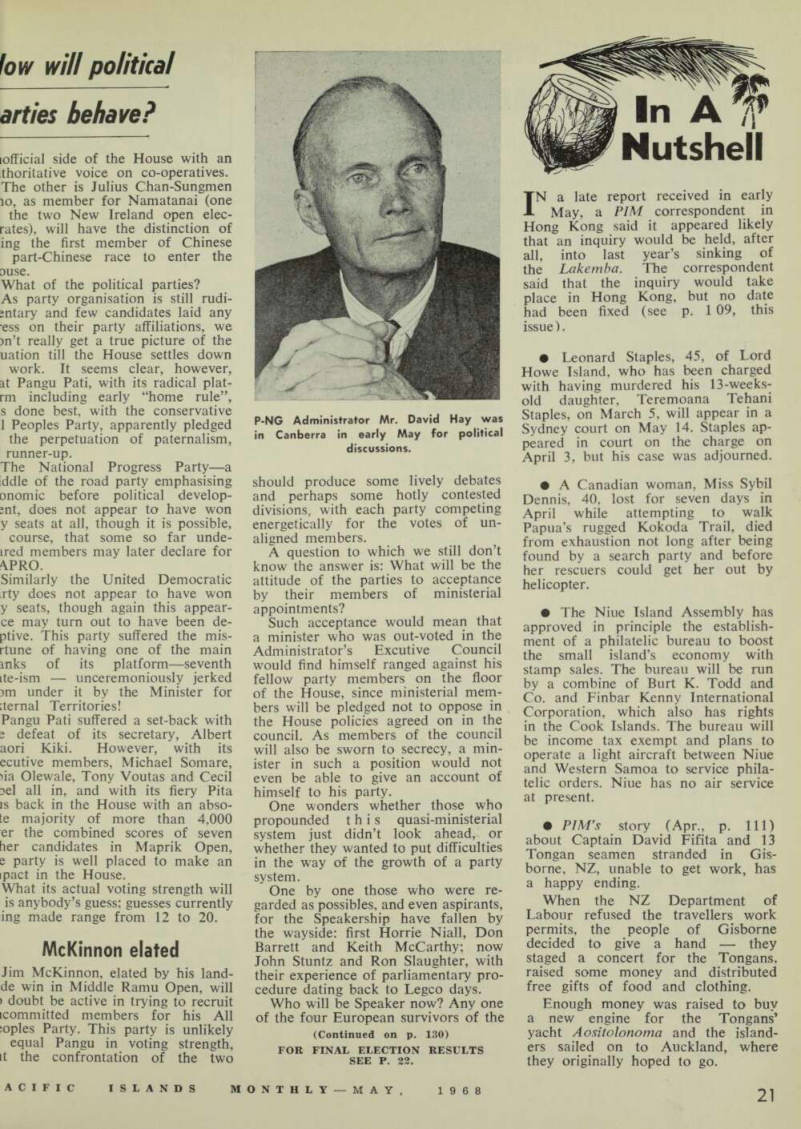
P-NG Administrator Mr. David Hay was in Canberra in early May for political discussions.
first House Ron Neville, Roy Ashton, Percy Chatterton and Tony Voutas—might be considered as a possible. Among indigenous mem bers, the names of John Guise, whose experience also dates back to Legco days, Matthias Toliman and Tei Abal have been giving an airing. A third possibility would be, Canberra per mitting, the appointment of an official member as Speaker, In the absence of a gentlemen’s agreement, such as that obtaining in Great Britain, under which the Speaker is unopposed at election time, an elected member of the House whether New Guinean or European, with long-term political ambitions could hardly be blamed for thinking twice before consenting to having conferred on him an honour which might well jeopardise his chances of re-election.
Another post which may be dif ficult to fill is that of Chairman of the Public Accounts Committee, a job which in the last House Don Barrett performed with tremendous energy and great ability. However, it may well be found that among the new members there is someone with a flair for this kind of work.
What will be the attitude of the new House, bereft as it is of its staunchest traditionalists, to the com plexities of Westminster > procedures?
Within a few days of the final election results being known, the House’s translation staff announced with some pride that they had com pleted translations of Standing Orders into Pidgin and Motu.
As a feat of intellectual endurance and linquistic skill this is certainly something to be proud of. But it may be questioned whether it will really help members very much.
The plain fact is that complicated language is complicated language, in whatever tongue it is expressed, English which is hard to understand will translate into Pidgin (or Motu] which is equally hard to understand, and some members may feel that there is need to simplify not only the language but also the procedures which the language describes.
Anyway, whether the decision is to adhere to Westminster’s time honoured procedures or to modify them in the interests of simplicity and better understanding, there is good hope that the new House will tackle its job competently, even without the advice which is currently being showered on it so lavishly by its Old Boys.