The Practical Planter
pp. 141-143 · Read in the full issue
Mechanical harvesting may overcome high costs in New Guinea tea industry
Because hundreds of workers have to be em ployed to harvest tea by hand-plucking, the economic production of this crop has been re stricted to countries where labour costs are low.
In New Guinea, where wages and ather costs are higher than in India md Ceylon, some form of mechanical harvesting may have to be used to overcome this when the infant tea industry begins to develop.
Thus, mechanical harvesters are /ery much in the news among planters there now.
By 1972 it is expected that 14,000 teres of the New Guinea Highlands vill be under tea.
Tea employs more labour per unit irea than any other large-scale crop n the world and the workers engaged n the vital part of plucking tea
leaves comprise nearly half of the entire labour force.
There are at least three ways of plucking tea leaves by machine which could be used in the territory.
These are manually-operated hand shears; shears operated by motors at tached to the backs of the pluckers; and the Loiseau-Tarpen leaf cutter.
Double speed
The motorised hand shears pick leaves at twice the rate of the average hand picker. They usually have a knapsack generator powered
by a fractional horsepower petrol engine carried on the picker’s back.
Rotating blades of the shears are edged with rubber. They snip the tea leaves off the tea plant, and direct them to a collecting box or basket. Quality is said to be better because the leaf is not bruised by the fingers.
Adaptations of the Loiseau-Tarpen harvester are used in Russia and Argentina. But the tea plucked in Russia is used only for local con sumption, and the Argentine tea is sold on world markets at low-grade prices.
Queensland tests
If New Guinea planters should use the harvester with good results.
New Guinea will be the first tea producing country to sell high quality tea on the world market that has been plucked by machine rather than by hand.
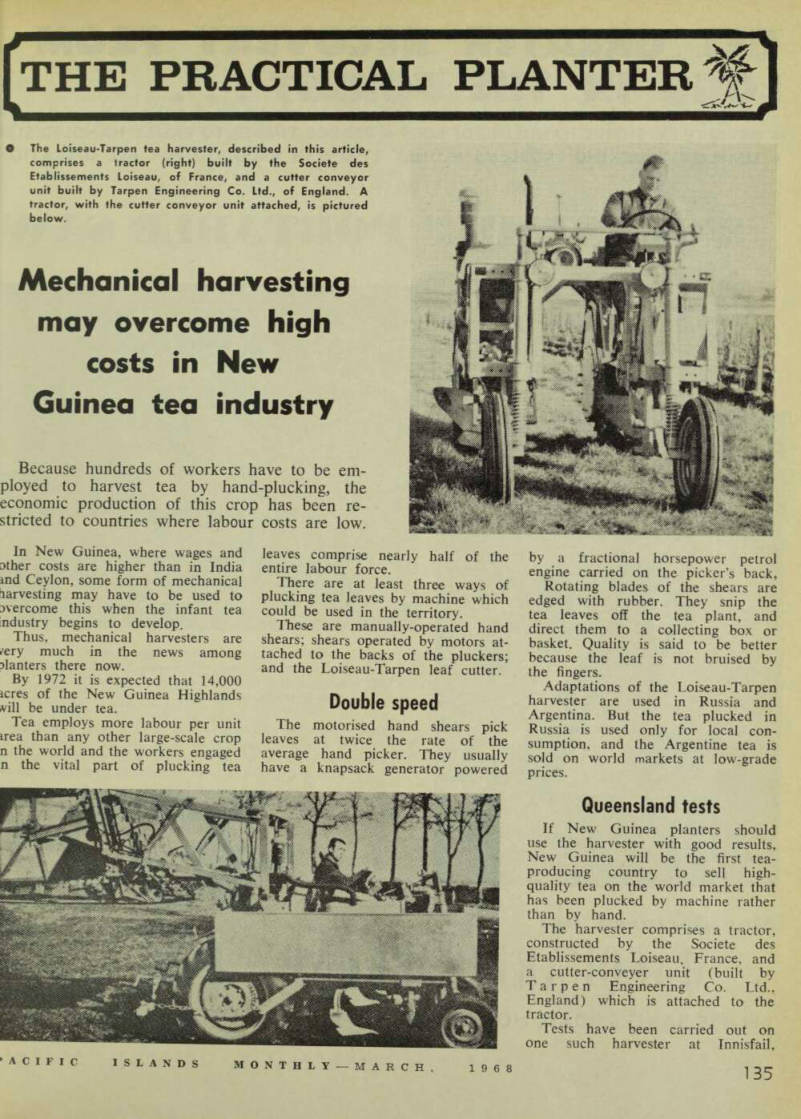
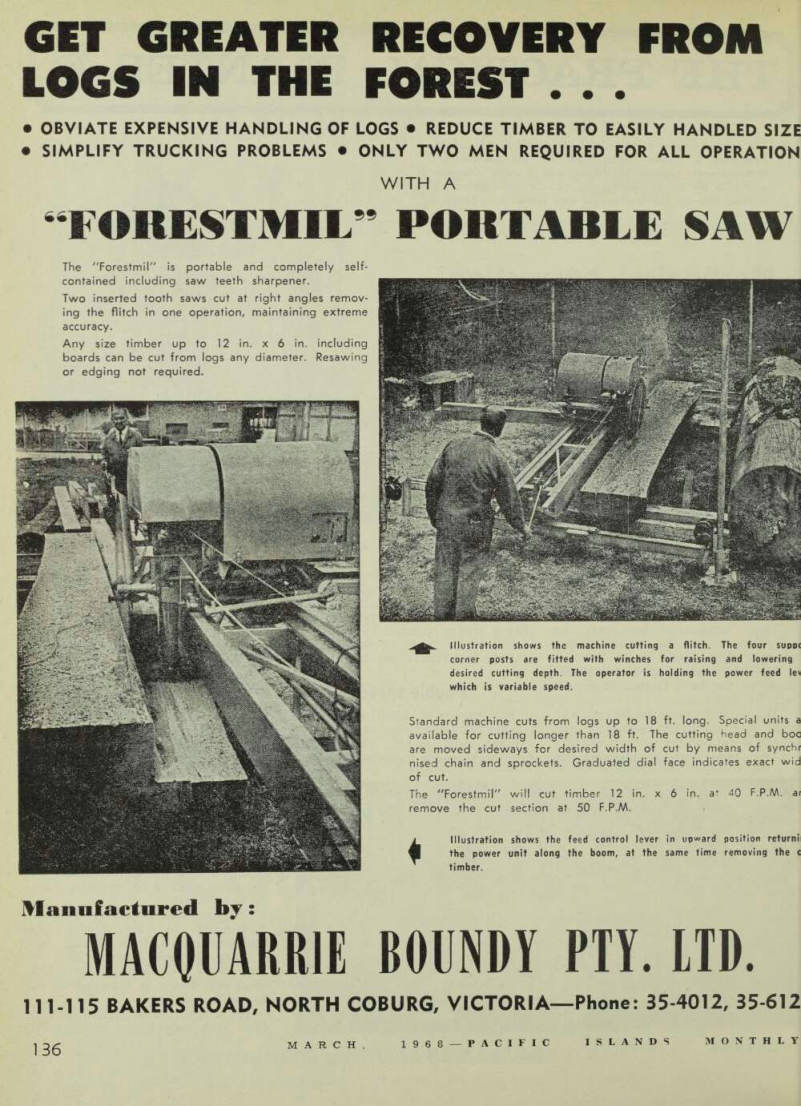
The harvester comprises a tractor, constructed by the Societe des Etablissements Loiseau, France, and a cutter-conveyer unit (built by Tar p e n Engineering Co. Ltd., England) which is attached to the tractor.
Tests have been carried out on one such harvester at Innisfail,
O The Loiseau-Tarpen tea harvester, described in this article, comprises a tractor (right) built by the Societe des Etablissements Loiseau, of France, and a cutter conveyor unit built by Tarpen Engineering Co. Ltd., of England. A tractor, with the cutter conveyor unit attached, is pictured below.
Practical Planter
ueensland. Tea experts told PIM lat the results were “very satisfac ►ry”. They felt the harvester would ork well in New Guinea, where anters have planted their tea in stematic rows in anticipation of achines being used to pluck the aves.
The machine tested in Queensland in operate over two hedged rows : tea plants, but it could be used New Guinea when the tea has so r been planted in rows of only one ant.
By plucking 20 acres of tea in an ght-hour day the harvester would ill be economical on single rows plants.
Machines are now under trial hich straddle the bushes and move i four twin-tyred wheels, the two unt ones steering and the back ones oviding the traction. The cut shoots e transferred by conveyer to a con iner.
Five machines can do about 20 iles of plucking a day.
Ideal plucking calls for discrimina >n between mature and immature oots. This necessitates altering the ve\ at which individual shoots are eked, perhaps by an inch, or even ore.
Main growers
A machine that operates at a igle level can never emulate selec m to this extent, although some scrimination has been obtained by fitting located just below the tting mechanism, which pushes •wn the immature roots. However is can be overcome to some extent.
Hydraulic blade cutters in the test harvesters automatically rise d fall in the required cutting level up to two feet to deal with ir gularities in the ground surface.
The main European tea growers the Highlands are Mr. Ivor anton, W. R. Carpenter and Co. d., Kimel Plantations Ltd., the jstralia New Guinea Corporation d Kurumul Plantations Pty Ltd.
(now run by Pioneer Concrete which recently took over its former owners, R. W. Williams Holdings Ltd., of Sydney).
Loiseau-Tarpen harvesters cost about $lO,OOO, manually-operated shears about $lO each and motorised shears about $2OO.
Mr. Ivor Manton, a Melbourne businessman, who has one of the tea estates in the Western Highlands, about 10 miles from Mount Hagen, has bought some hand shears very similar to the Japanese variety. Made of aluminium, the shears are light and easy for pluckers to use.
However, one thing for planters to keep in mind in selecting shears is that shears get blunt quickly, and then tend to tear the shoot on the tea stem. Mechanical harvesters can cut the shoot very cleanly. This is an important point to note because damaged stems or leaves can add greatly to the percentage of coarse, poor-grade tea leaves collected.
Hand shears
Hand shears have been used for over 50 years in Japan. They are also used, but not so widely, in South India, Indonesia and East Africa.
Tests made at the Tocklai Experi mental Station in Assam, India, show that machine-cut leaf by mechanical harvesters may include as little as 50 per cent, fine leaf, the rest being coarse. Of the total harvest, 15 per cent, may be hard stalk and old leaf unsuitable for manufacture.
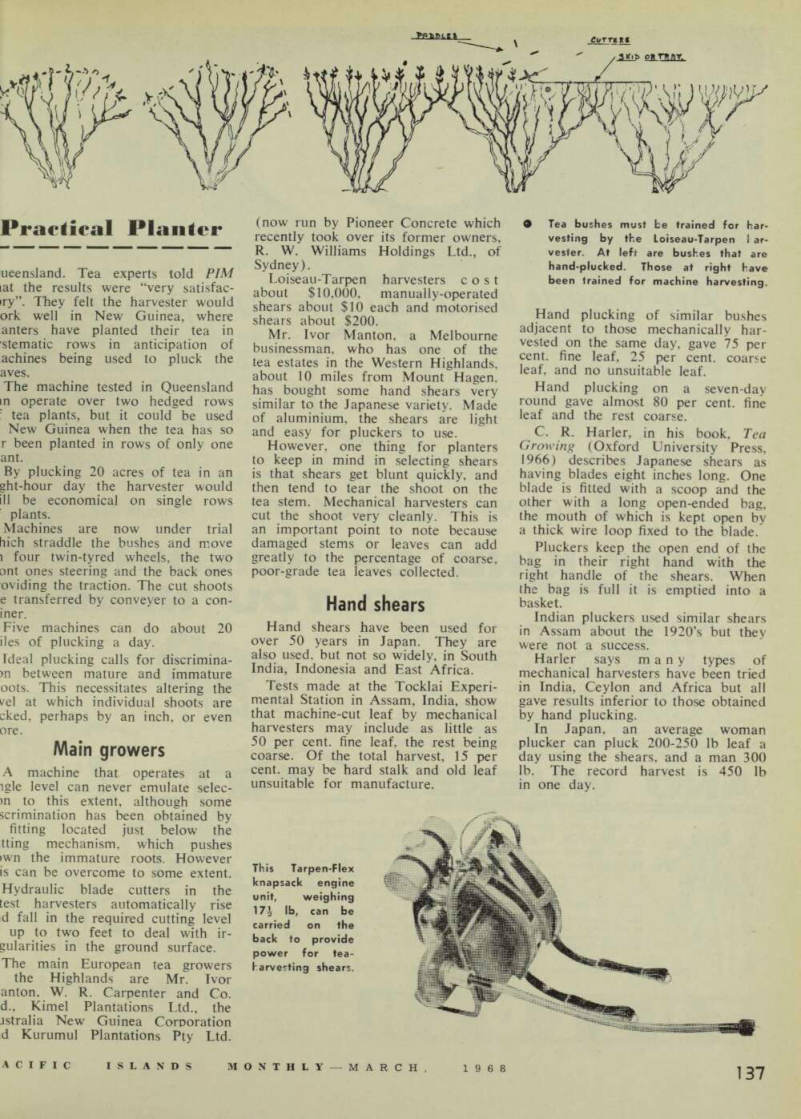
9 Tea bushes must be trained for har vesting by the Loiseau-Tarpen I ar vester. At left are bushes that are hand-plucked. Those at right have been trained for machine harvesting.
Hand plucking of similar bushes adjacent to those mechanically har vested on the same day, gave 75 per cent, fine leaf, 25 per cent, coarse leaf, and no unsuitable leaf.
Hand plucking on a seven-day round gave almost 80 per cent, fine leaf and the rest coarse.
C. R. Harler, in his book, Tea Growing (Oxford University Press, 1966) describes Japanese shears as having blades eight inches long. One blade is fitted with a scoop and the other with a long open-ended bag, the mouth of which is kept open by a thick wire loop fixed to the blade.
Pluckers keep the open end of the bag in their right hand with the right handle of the shears. When the bag is full it is emptied into a basket.
Indian pluckers used similar shears in Assam about the 1920’s but they were not a success.
Harler says many types of mechanical harvesters have been tried in India, Ceylon and Africa but all gave results inferior to those obtained by hand plucking.
In Japan, an average woman plucker can pluck 200-250 lb leaf a day using the shears, and a man 300 lb. The record harvest is 450 lb in one day.
This Tarpen-Flex knapsack engine unit, weighing 17½ lb, can be carried on the back to provide power for tea harvesting shears.