Cruising Yachts
pp. 101-111 · Read in the full issue
Pacific Shipping And Cruising Yachts
Specially-built ship for New Guinea timber run
A new shipping service from Australia to New Guinea, with a new 1,000-ton Danish-built freighter Jette Bue, will begin in the first week of March.
Jette Bue will leave Sydney on a three-week trip and make calls at Lae and Fulleborn, on the east coast of New Britain. She will take a full cargo of general supplies and return with her holds full of New Guinea logs.
The new ship was due to arrive in Port Kembla, NSW, in late February from Denmark with a cargo af explosives. She was then to sail io Sydney, The Australia-New Guinea service vill be operated by a new company, \mplex (New Guinea) Line, a fully >wned subsidiary of Amplex Pty. -td., a private Australian firm with ixtensive shipping, timber and plani ng interests in New Guinea.
A spokesman for the firm said the ette Bue service could also take in ’ort Moresby, Townsville and Bris >ane if future demand warranted it.
He said his firm had decided to un the service because they found urrent shipping services between the wo countries inadequate.
At Lae, the Jette Bue would pick p klinkii pinewood, which is carried i by truck from Bulolo where an ssociate Amplex company, Golden 'ine Sawmilling Co. Pty. Ltd., carries ut milling operations with about a 0-year life, he said.
At Fulleborn, where another asso late company, Fulleborn Plantations td., had cocoa and copra operations 5 well as a 50,000-acre timber lease, ? tte Bue would pick up hardwood )gs.
The company spokesman said he ;lt there was a big demand in Aus alia for New Guinea timber, which as very good for indoor decorations, ibmets, plywood and other uses.
He said several previous attempts ► export New Guinea timber to ustralia had failed because freighters
not designed for carrying timber were used.
The Jette Bue, he said, was built last year specially for transporting timber logs.
Amplex (NG) Ltd. operates two small island traders around New Guinea. They are the 150-ton Sumiho and the 130-ton Katara Maru, which both carry general goods and small quantities of timber.
The Jette Bue will be registered in New Guinea.
Russian Ship
In Pago Pago
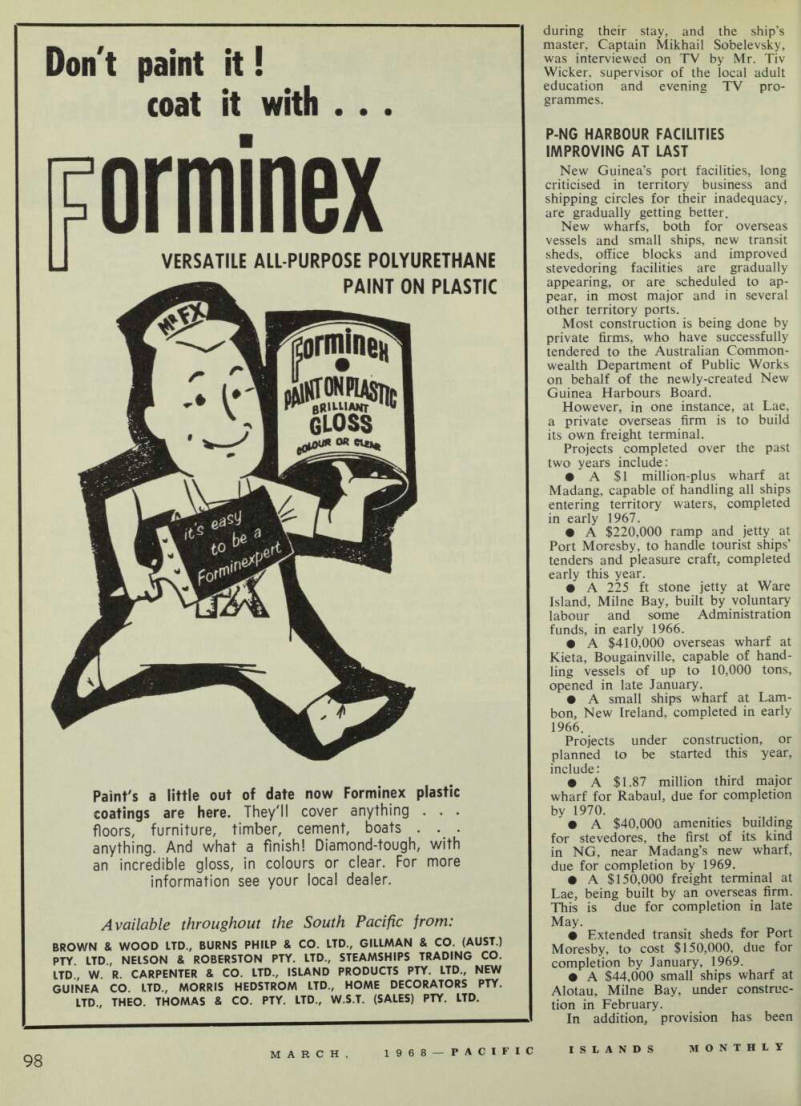
The Russian research vessel Vityaz became the first Russian ship to visit American Samoa in about two years in early February when she sought permission to enter Pago Pago Har bour to wait out a storm.
The Vityaz sent a message to Governor Owen S. Aspinall on
February 7 asking permission to stay about six miles outside the harbour.
The Governor gave the permission and accompanied it with an invita tion to the ship to enter port. How ever, the invitation was not accepted until early in the morning of February 9.
The ship remained in port until the morning of February 11.
Many of the scientists aboard were entertained by government employees
The "Vityaz" sheltering in Pago Pago. Photo: Tui F. S. Chanel.
during their stay, and the ship’s master, Captain Mikhail Sobelevsky, was interviewed on TV by Mr. Tiv Wicker, supervisor of the local adult education and evening TV pro grammes.
P-Ng Harbour Facilities
Improving At Last
New Guinea’s port facilities, long criticised in territory business and shipping circles for their inadequacy, are gradually getting better.
New wharfs, both for overseas vessels and small ships, new transit sheds, office blocks and improved stevedoring facilities are gradually appearing, or are scheduled to ap pear, in most major and in several other territory ports.
Most construction is being done by private firms, who have successfully tendered to the Australian Common wealth Department of Public Works on behalf of the newly-created New Guinea Harbours Board.
However, in one instance, at Lae, a private overseas firm is to build its own freight terminal.
Projects completed over the past two years include: • A $1 million-plus wharf at Madang, capable of handling all ships entering territory waters, completed in early 1967. • A $220,000 ramp and jetty at Port Moresby, to handle tourist ships’ tenders and pleasure craft, completed early this year. • A 225 ft stone jetty at Ware Island, Milne Bay, built by voluntary labour and some Administration funds, in early 1966. • A $410,000 overseas wharf at Kieta, Bougainville, capable of hand ling vessels of up to 10,000 tons, opened in late January, • A small ships wharf at Lam bon. New Ireland, completed in early 1966.
Projects under construction, or planned to be started this year, include: • A $1.87 million third major wharf for Rabaul, due for completion by 1970. • A $40,000 amenities building for stevedores, the first of its kind in NG, near Madang’s new wharf, due for completion by 1969. • A $150,000 freight terminal at Lae, being built by an overseas firm.
This is due for completion in late May. • Extended transit sheds for Port Moresby, to cost $150,000, due for completion by January, 1969. • A $44,000 small ships wharf at Alotau, Milne Bay, under construc tion in February.
In addition, provision has been
made in Administration work plans for work to start on a wharf at Wewak late this year.
But whether the East Sepik Local Government Councils will get their desired overseas wharf is open to doubt as the Administration has yet to state any definite plans.
The chairman of the Harbours Board, Captain G. A. Hawley, said in early February that Madang’s imenities building would be part of i multi-million dollar scheme to im prove the port’s facilities.
It would have a large dining room 0 seat 170 men, modern kitchens, howers, changing rooms and a first lid section, he added, Madang’s new wharf had been »adly needed for many years because •f the town’s closeness to big copra nd coffee producing areas and for he transhipment of goods to and rom the Highlands.
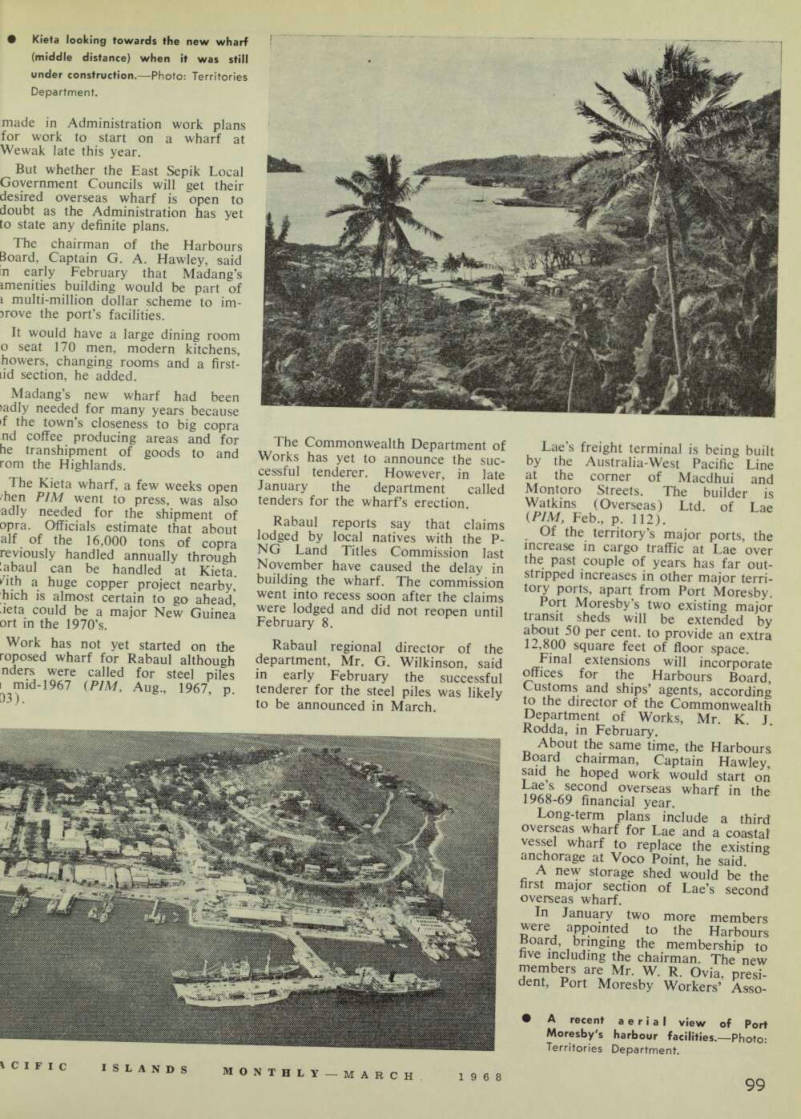
The Kieta wharf, a few weeks open /hen PIM went to press, was also adly needed for the shipment of opra. Officials estimate that about alf of the 16,000 tons of copra reviously handled annually through Rabaul can be handled at Kieta. /ith a huge copper project nearby, hich is almost certain to go ahead, .ieta could be a major New Guinea ort in the 1970’5.
Work has not yet started on the roposed wharf for Rabaul although nders were called for steel piles 1 mid-1967 {PIM, Aug., 1967, p. 33).
The Commonwealth Department of Works has yet to announce the suc cessful tenderer. However, in late January the department called tenders for the wharf’s erection.
Rabaul reports say that claims lodged by local natives with the P NG Land Titles Commission last November have caused the delay in building the wharf. The commission went into recess soon after the claims were lodged and did not reopen until February 8.
Rabaul regional director of the department, Mr. G. Wilkinson, said in early February the successful tenderer for the steel piles was likely to be announced in March.
Lae’s freight terminal is being built by the Australia-West Pacific Line at the corner of Macdhui and Montoro Streets. The builder is Watkins (Overseas) Ltd. of Lae (PIM, Feb., p. 112).
Of the territory’s major ports, the increase in cargo traffic at Lae over the past couple of years has far out stripped increases in other major terri tory ports, apart from Port Moresby.
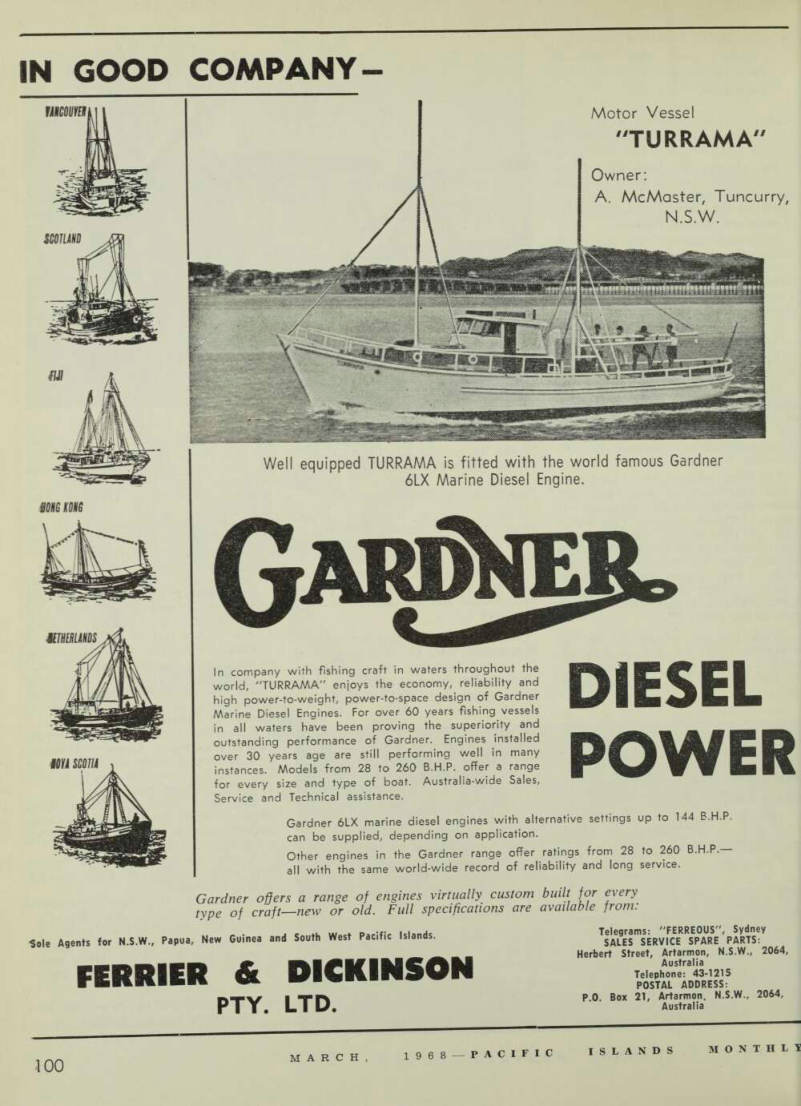
Port Moresby’s two existing major transit sheds will be extended by about 50 per cent, to provide an extra 12,800 square feet of floor space.
Final extensions will incorporate offices for the Harbours Board, Customs and ships’ agents, according to the director of the Commonwealth Department of Works, Mr. K. L Rodda, in February.
About the same time, the Harbours Board chairman, Captain Hawley said he hoped work would start on Laes second overseas wharf in the 1968-69 financial year.
Long-term plans include a third overseas wharf for Lae and a coastal vessel wharf to replace the existing anchorage at Voco Point, he said.
A new storage shed would be the first major section of Lae’s second overseas wharf.
In January two more members were appointed to the Harbours Board bringing the membership to five including the chairman. The new members are Mr. W. R. Ovia, presi dent, Port Moresby Workers’ Asso
• Kieta looking towards the new wharf (middle distance) when it was still under construction. Photo: Territories Department,
• A recent aerial view of Port Moresby's harbour facilities. Photo: Territories Department.
iation, and Mr. F. R, Wilson, a lember of the Planters’ Association f New Guinea.
The board became autonomous on anuary 1 and now controls six ports -Port Moresby, Lae, Samarai, Madang and Kavieng.
Lew Trader In
Ervice At Santo
Burns Philp (New Hebrides) Ltd.’s jcently-purchased island trader 'onanda ( PIM, Jan., p. 109) has sgun operating out of Santo.
A spokesman for BP said in ebruary that a trade shop had been istalled, but no passenger space was /ailable.
He said the Konanda was comple ienting the trade of her sister ship, tanutai, which operated out of Vila, 'fith the Konanda, BP hoped to give •owing native co-operative societies rect access to Vila and Santo for )pra and a better service for trade 3ods and general supplies.
Orean Fishing Boat's
Rew Ordered Out
The Government of American rnioa ordered the deportation to iuth Korea in late January of a orean fishing boat’s crew which ►ught with Chinese fishermen in ago Pago a week earlier ( PIM, eb., p. 34). Similar punishment as also promised for the Chinese ihermen who led an abortive march the Marine Railway.
The Korean fishing boat is the am Hae No. 201. Both the boat, id the ship’s captain, who was not volyed in the fight, were allowed to ay in Pago Pago, American Samoa’s Governor Owen
S. Aspinall said in a letter to the Korean and Nationalist Chinese consuls-general in Honolulu that if the Chinese leaders of the abortive march could not be identified, the entire crew that participated in the march would be deported.
Tongans Warn Japanese
Fishing Ship
The Tongan Police Department and the Tonga Marine Superintendent recently warned the captain of the Japanese long-line fishing vessel Sakura Mam about fishing in Tongan territorial waters. The Sakura Mam is one of the Van Camp fleet, based in Pago Pago.
The Japanese captain was told that the ship would be arrested and her catch and fishing gear impounded if caught violating territorial waters again.
Well-Known Master
Retires After 29 Years
Captain F. W. Bales, well-known as a master of Union Steam Ship Company ships trading in Fiji, the Samoas, Tonga, Niue and the Cook Islands, retired on February 2 after 29 years’ service with the company.
Born in Dundee, Scotland, in 1905, he joined the company as fourth officer on the trans-Tasman passenger ship Tarama in 1928. He was retired
s third officer on a company collier, le Karepo, two years later owing to ic depression.
Reinstated in the USS service in 94 1 aboard the collier Kartigi, he orked his way up until he became lief officer of the Matua in May, 949. It was in the Matua that he it his first taste of the Pacific lands.
Two years later he was sent to ritain to bring out the Tofua, which itered the USS Pacific Islands service 1 Polynesia in May, 1952. Later the me year he was given command of e Waipahi.
For the past 16 years Captain Bales unmanded several of the company’s rgo vessels, including the Tarawera id Tofua. He retired as master of e Matua.
Dngan Seamen Seek
)Bs In New Zealand
Two Tongan yachts, the 42 ft atukimoana and the 33 ft Aositolo 'ma, arrived in Auckland from
jkualofa recently.
Siatukimoana is skippered by alakai Tapealava and has 11 crew ambers.
Aositolonoma, under Captain David fita, of Minerva Reef fame, has a ;w of 12.
Captain Fifita said in Nukualofa hoped to secure employment for j party at a Gisborne cannery and * the money to purchase replace :nt engines and materials to build larger boat.
Lartered Freighter To
Irry Nz Timber
The Holm Line freighter Holmburn s been chartered to carry a special 3ort order of timber from New aland to New Caledonia and the w Hebrides in early February.
The Holm burn will carry 294,000 board feet of sawn Douglas timber from Waipa worth $37,000 for the New Zealand Forest Service. NZ exporters said sales of timber had increased so fast to particularly New Caledonia in late 1967 that orders shinnins “ eXCeSS ° f availab,e pp g ‘ By chartering the Holmburn, the NZ Forest Service had gained export orders that otherwise would have been lost to other countries.
The Holmburn normally maintains a two-monthly cargo return service from NZ to Noumea and Norfolk lsland -
Changes In New
rinK . c . r . urmiir .
Guinea Schedules
Karlander New Guinea Line vessels and will service Samarai, Papua, on voyages from Australia to New Guine/and return instead of the China Navigation Company vessel Papuan Chief.
The Papuan Chief made her last call at Samarai on January 27 and is now doing a faster run from Sydney to Brisbane and Port Moresby and return, The Karlander vessel Sletfjord, which already calls at several New Guinea ports from Australia, will
aptain Bales, photographed in the 1950's.
ike her first Samarai call after she ives Sydney on March 9.
With her sister ship, Saidor, she 11 maintain a 17-day service to marai.
The new schedules follow the re it withdrawal of the Burns Philp p Bulolo from her New Guinea i in which she made calls at riarai ( PIM, Feb., p, 101).
It is understood that these ledules suit both Karlander and ina Navigation better than the vious ones. n another change of China Navi ion schedules recently, the ighter Kweilin was taken off the npany’s Far East to New Guinea i. Another freighter, Ninghai, will itinue this monthly run, which es in New Guinea calls at Lae 1 Port Moresby.
W Inter-Island Ship
S American Samoa
new 59 ft inter-island vessel for Government of American Samoa ived in Pago Pago in mid iruary. he is the motor vessel Manusina waning “white tern”).
'he Manusina is equipped with the st electronic gear and has a maxi m speed of 26.3 knots compared i about 10 knots for the govern it s YF-340, which has recently n bringing surplus gear from iton Island to American Samoa.
The Manusina will be used only for government business and will not be available to the public as a passenger ship,
Y/ Degei Ii" Briefly
Aground
The Fiji Government ship Degei II went aground on a mudbank in the Labasa River, about two miles from the wharf, early in the afternoon of February 3.
The tide next morning lifted her off.
The ship then sailed to Suva, carry ing volunteers for the Fiji Military Forces.
New Ship For
Captain Rusden
New Hebrides shipowner Captain Athol Rusden, now based in New Zealand, has bought the 397-ton motor vessel Matipo from the Anchor Shipping and Foundry Company, of Nelson, New Zealand, She began a service from New Zealand to the New Hebrides in early February with general and re frigerated cargo.
Captain Rusden said in Suva in February that his new ship was able to berth at Vila’s small wharf, whereas such ships as Burns Philp’s Tulagi, which served the New
Hebrides regularly, had to anchor off-shore and have their cargo lightered.
Captain Rusden said there would be a big demand for NZ goods in the New Hebrides. NZ onions could sell for SNZ7O a ton compared with SNZ3OO a ton for Australian onions.
Australia Has 12-Mile
Fishing Zone Now
Legislation prescribing a 12-mile exclusive fishing zone around the Australian coast came into operation on January 30. Foreign boats apprehended for fishing without a licence in the zone will be liable to a fine of $lO,OOO, imprisonment of
the crew and forfeiture of boat, fish ing gear and catch.
The act also applies to the Papua- New Guinea and the Ashmore and Cartier Islands. All processing vessels will be included under the licensing provisions, which also cover foreign factory ships operating within the zone.
The issue of a licence to a foreign boat will be considered only where a phase-out agreement has been negotiated between the Australian and the foreign government con cerned on the basis of previous fish ing operations within the new zone or where a joint-venture operation has been approved.
Hmas "Aitape"
Visits Aitape
HMAS Aitape, a Royal Australian Navy patrol boat which was com missioned last year ( PIM, Dec., 1967, p. 109), paid her first visit to her namesake—Aitape, on New Guinea’s north-west coast—in late January.
Immediately after the visit, HMAS Aitape resumed her normal patrol duties, from her base at Manus Island.
During the Aitape-Wewak cam paign of World War 11, 454 Aus tralian and 5,200 Japanese soldiers lost their lives.
New Guineans To
Train As Midshipmen
Four New Guineans have been selected for a 12-month cadet midshipmen training course at HMAS Cerberus, in Westernport, Victoria, the Royal Australian Navy’s major training establishment.
The cadets, who have already undergone a 12-month course al HMAS Tarangau, Manus Island, are Jack Maniana, 19, of Kwato, Samarai; Kary Frank, 22, of Milne Bay; Francis Molean, 20, of Mbuk Island, near Manus Island; anc Garafoi Elias, 19, of New Ireland.
After completing their training ir Victoria, they will undergo a furthei 12-month training period aboarc RAN ships and then help mar P-NG’s new patrol boats.
Studies On The
Migrations Of Fish
Scientists were releasing batches o; tagged fish in February west o: remote Johnston Island, 717 mile: west of Honolulu, to learn mor< about fish movements and migration A tubular yellow plastic tag hac been inserted in each fish’s bad behind its dorsal fin. The tags bon the name and address of the Bureai of Commercial Fisheries Biologica Laboratory, Honolulu, of the Ul!
Department of the Interior.
The scientists from the laboratory hope that if any fishermen in tb Pacific Islands find the fish, they wil return the tags with information oi the date, location and size of tb fish.
Better Connections
Sought With Tahiti
Australian exporters of foodstuff and specialised electrical or mechani cal equipment are backing curren moves to set up improved shippin services between Sydney or Mel bourne and Papeete.
They need better shipping link
th Tahiti to take full advantage the territory’s recently-won status the Pacific Islands’ biggest porter of foodstuffs.
French Polynesia is importing •re and more food because it iply cannot feed the big influx of cialised personnel at present in the ritory and expected soon for ince’s nuclear testing programme, ; to restart about May or June e p. 105).
Vhile French Polynesia’s import has risen dramatically in recent rs, Australia’s proportion of it low only about two per cent, and stralian exporters blame this on poor shipping connections, hey point out that the biggest sr to French Polynesia—the USA as direct, fast shipping links from US West Coast and another big plier of foodstuffs—New Zealand as direct Tahiti links with Holm Company and New Zealand
iping Company vessels.
One of the principal goods Australia could sell more of are chickens —in 1966 1,000 tons of poultry were imported to Tahiti from the US, worth about SUSI million.
The Australian Trade Commissioner for the Pacific Islands, Mr.
W. R. Carney, left Sydney in late February for a week-long stay in Tahiti to investigate trade openings for Australian goods.
He told PIM he had had talks with three shipping companies— Matson-Oceanic Line, Parrel Line
and General Steamship Company of the US—with a view to setting up better Australian connections with Tahiti.
Mr. Carney said Australian ex porters were competitive in many lines of food for the Tahiti market.
These lines included frozen meat, butter, cheese, eggs, onions, potatoes, tomatoes, canned vegetables, apples, pears, canned meats and oysters.
He said freight charges to Tahiti from Australia were about the same as those from the US to Tahiti.