Yesterday
p. 89 · Read in the full issue
With serious earthquakes and typhoons affecting pro duction in the Philippines, the world’s biggest coconut grower, world prices for copra in February, 1948, reached over £Stg.Bo a ton landed in bulk in London. This was one of the news items in PIM for March, 1948. Other items in that issue of 20 years ago were: —
OUSINESSMEN in New Cale -■“* donia, beset by labour diffi culties, were talking about intro ducing new labour from the Netherlands East Indies. Lack of labour, together with a shortage of Australian coal supplies, was holding up mining production in the territory. last of the American troops A from the huge US base at Manus Island, in the Admiralty Islands of New Guinea, were withdrawing and a small party of Australian troops were moving in.
This followed a decision by the Australian Government not to let the US maintain its base at Manus.
OANKING facilities were at last ** available to residents of the New Hebrides. A branch of the Bank of Indo-China had opened in the main street of Vila, Efate.
A FTER three years of “Marching Rule”, the Solomon Is lands version of cargo cult, the movement was reported to have been broken up. Twenty-three leaders of the movement were given prison sentences in Honiara
by the BSIP Judicial Commis loner, Mr. W. T. Charles. The sentences ranged from six years to one year. fIMRAWA, not Abemama, was reported to be the likely site for the new administration head quarters for the GEIC. Before World War II Ocean Island had been the headquarters, but during the war all installations had been destroyed.
T IFF was tough in Port *** Moresby. PlM’s correspon dent reported that eggs were 7/6 a dozen, electricity supplies were limited to one bulb per house, water had been cut off in February from 9 p.m. to 6 a.m. each day, and the local roads resembled “ploughed paddocks”. To top this, the correspondent said, phones refused to work and at the local picture show, sound effects broke down.
ITONIARA was suffering from a “ serious scarcity of staple foods because the BSIP Government vessel TSMV Kurimarau, which operated a six-weekly run from Suva, was laid up in Suva for
repairs. A two-day government organised fishing expedition from Honiara, which had resulted in a moderate catch of fish, had brightened matters, and a good bag of pigeons had been shot.
March 1, 1948, there was to be a fortnightly airmail service from Australia to French Polynesia. Mail posted in Aus tralia (7d for a letter or 5d for a postcard) was to go by air to Noumea and then on to Tahiti by the newly-started French-owned TRAPAS service.
APIA had been having some dis agreeable weather. Tempera tures had risen to 92 degrees— the highest temperature recorded since 1915—and very heavy rains had slowed up the cutting and drying of copra and had ruined thousands of cocoa pods. All this was at a time when Samoan cocoa was fetching £250 a ton f.o.b. in the US and Australia.
A FORMER New Zealand bank officer, Mr. D. R. Richards, was operating Norfolk Island’s first taxi-bus. Mr. Richards and a few others hoped to build up a solid tourist trade on Norfolk.
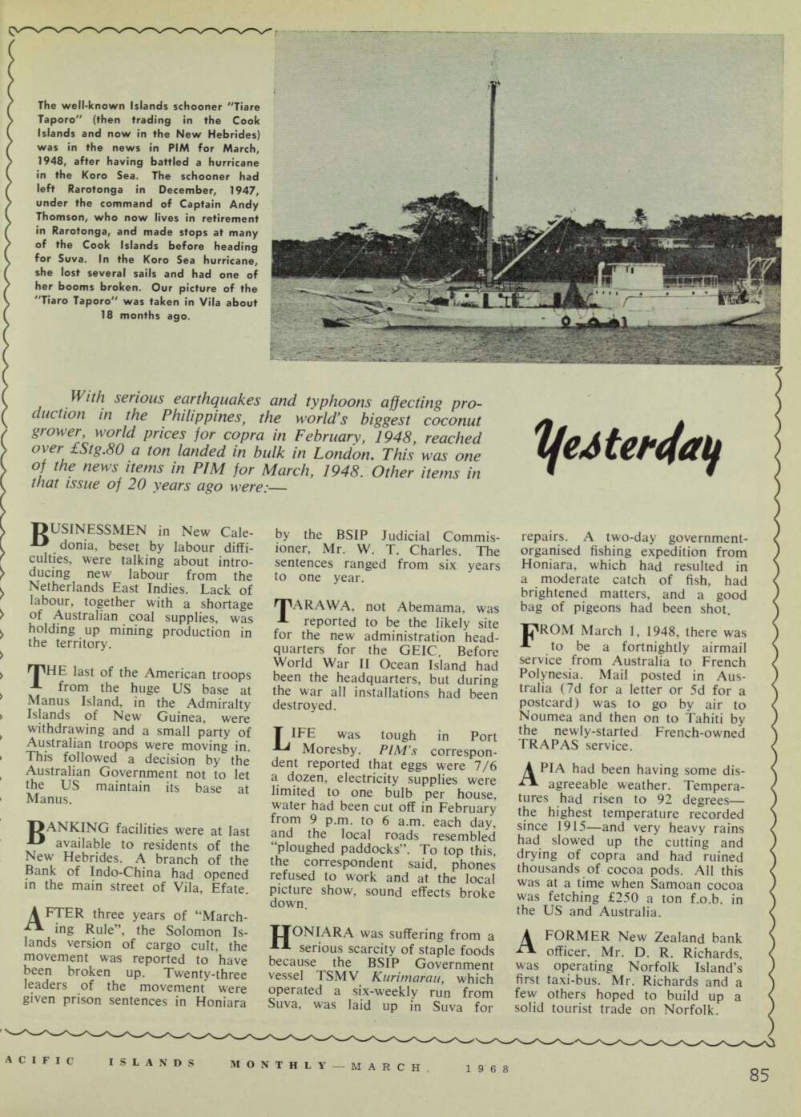
The well-known Islands schooner "Tiare Taporo" (then trading in the Cook Islands and now in the New Hebrides) was in the news in PIM for March, 1948, after having battled a hurricane in the Koro Sea. The schooner had left Rarotonga in December, 1947, under the command of Captain Andy Thomson, who now lives in retirement in Rarotonga, and made stops at many of the Cook Islands before heading for Suva. In the Koro Sea hurricane, she lost several sails and had one of her booms broken. Our picture of the "Tiaro Taporo" was taken in Vila about 18 months ago.