Pacific Islands Monthly
pp. 81-87 · Read in the full issue


Magazine Section
Formidable Austrian lady tourist sampled the South Seas when the going was really tough
Mrs. Ida Pfeiffer, traveller extraordinary of the 1840's
By Robert Langdon
On the morning of May 7, 1847, people in Papeete must have been startled to see a small, rather frail European woman of 50 striding purposefully through their infant town in a pair of men’s trousers and shoes (but no stockings) and with her blouse rolled up to her hips.
Even though she was off on a climbing expedition to the mountains, it was scarcely the done thing in Tahiti in those times for European women to get about in male attire.
Nor, for that matter, was it exactly usual for frail European women of 50 to go hiking into the mountains.
This particular woman, however, was neither usual, nor, when it suited her, especially concerned about clothes. She was, in fact, one of the most extraordinary and unconven tional women of her time, for in an era when lady tourists scarcely even existed, she was venturing into out landish places all over the world.
This formidable lady tourist was an Austrian, Mrs. Ida Laura Pfeiffer, who achieved the distinction, before she died, of being the world’s most widely travelled woman.
Early marriage
She deserves a place in Pacific literature for being the first tourist —as opposed to sailor, soldier, scientist, trader or missionary— to publish a book dealing with any sland in the South Seas.
The book, entitled A Lady’s [ravels Round the World (London, 1852), was the third of a series of
ughly successful, but long-forgotten
)ooks, which Mrs. Pfeiffer wrote ifter becoming a professional tourist it the age of 45.
Although it contains only a dozen >r so pages on the South Seas
(Tahiti), these pages are so vivid that one can only wish that Mrs Pfeiffer had had the opportunity of visiting some of the other islands y p f •« , omer islands. u'*? 0 Was , . born ir J X 1 179 . 7 > had wanted to travel
of‘two Tons
frustrated her desire until 1842 when her husband died and she was able to “‘/h ‘vt ‘° h H °‘ y Land '
Ze, thtS £
J™ mediate ly set off on another, even !!L n COn I e I 10n 3 journey for a woman of her time—to Scandinavia mm* After visiting Brazil, where she narrowly escaped being murdered by a runaway Negro slave, Mrs. Pfeiffer sailed to Valparaiso, Chile, where she booked a passage in a Dutch shin travelling to China, via Tahiti P /m# . • .
Very inopportune
no^d 184?" that
wi
"f syfisar
where no beef tea or any light food can be had”.
However, Mrs. Pfeiffer did not wish to miss the opportunity of going to China, nor to lose the 200 dollars she had paid for the trip. So, trust ing to the good luck that had never deserted her in any of her journeys, she went grimly aboard.
At first she tried to combat her malady by starving herself. But this did no good and she continued to suffer constantly until she “hit on the happy idea of using cold sea baths”.
Cut-down cask
She took her baths in a cut-down wooden cask, remaining in them for 15 minutes at a time. After her second bath she was much better, and after her sixth, her diarrhoea was cured. ‘‘l mention this disorder.” Mrs.
Pfeiffer said in the account of her voyage, “only to show that sea-baths and cooling drinks, such as butter milk, sour milk, sherbet and orangeade, etc., are very suitable remedies.”
Mrs. Pfeiffer said that the greatest cleanliness reigned in her ship and that the sailors were “not near so gruff as thev are generally painted by travellers”. The food was good, except for “some Dutch dishes” and
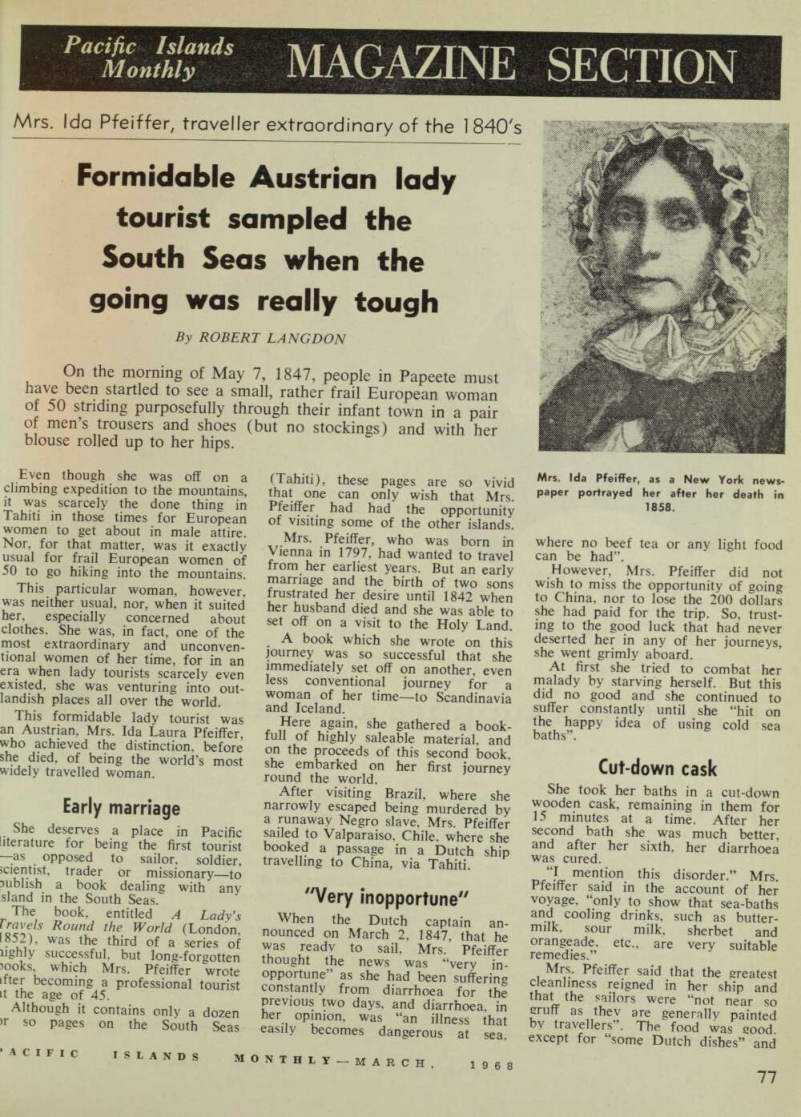
Mrs. Ida Pfeiffer, as a New York news paper portrayed her after her death in 1858.
“a superfluity of onions”. But luckily for her, a great number of “those noble roots” were spoiled in the course of the voyage.
The voyage to Tahiti took 39 days. After the ship was steered safely into Papeete Harbour by a pilot, half-a-dozen canoe-loads of Tahitians scrambled aboard and offered fruit and vegetables for sale.
Mrs. Pfeiffer noted, however, that the “golden times for the traveller are past”. The Tahitians were no longer content to sell their goods for red rags and glass beads. They demanded gold, and were “as close and acute in their dealings as the most civilised European”.
“I offered one of the Indians a little ring of brass,” Mrs. Pfeiffer -ecorded. “He took it, smelled it, ;hook his head and gave me to mderstand that it was not gold. He hen saw a ring on my finger, took ny hand, smelled it, drew his face nto a friendly smile and intimated hat I should give him this. . . .”
The date of Mrs. Pfeiffer’s arrival n Papeete was April 26, 1847. It vas thus only a matter of a few nonths since the Tahitians had inally surrendered after fighting
against the establishment of the French protectorate for nearly three years; and it was only a matter of five weeks since Queen Pomare IV had returned to Tahiti from a self imposed exile of similar duration on Raiatea.
Mrs. Pfeiffer noted that the queen was then living in a four-room house and that she dined daily with the French Governor, Captain Armand Bruat. The French Government was building her another house and was paying her an annual pension of 25,000 francs.
Only 400 people
Papeete, at that time, contained only 300 or 400 inhabitants—it now has more than 20,000—and consisted of a row of small wooden houses along the harbour, separated by small gardens. There was a scattering of huts in the woods behind.
The principal buildings were the governor’s house, the French magazines, the army bakehouse and the unfinished queen’s house. All around, small wooden one-room houses were being built to meet the demand for housing as quickly as possible.
“The demand for dwellings . . at the time of my stay was so great that even the superior officers were glad to get the most miserable Indian cabin,” Mrs. Pfeiffer recorded.
“In vain I sought to hire the smallest room, and went from hut to hut; all were full. I was at last obliged to content myself with a small part of a hut. This I got at a carpenter’s, at whose house there were already four persons.
“They gave me a place behind the door exactly six feet long and four broad; the ground was not boarded; \the walls were made of palings, and no such thing was thought of as a bedstead or a chair. . . .”
Mrs. Pfeiffer said that since the advent of the missionaries about 50 years earlier, the Tahitians’ clothing had been “tolerably decent”. Both men and women wore a kind of apron called a pareu which they bound round their loins. In addition, the men wore a coloured shirt and frequently “a wide hose”, while the women wore a long blouse in folds.
Both sexes wore flowers in holes in the lobes of their ears.
Mrs. Pfeiffer thought the Tahitians were remarkably strong and robust, and that the men were handsomer than the women. But she did not like their large mouths, thick lips and “ugly noses”. On the other hand, she did not object to the uni versal tattooing of their hips and thighs, which, she thought, was “very regular, skillfully formed and tastily done”.
Wild, licentious
“It is the more wonderful that the men should be so strong here when we remark how wild and licentious they are,” Mrs. Pfeiffer went on, adding that the girls lived as free as any profligate can.”
“I had several opportunities of seeing their dances,” she said. “They are the most indecent I have ever seen. But every poet would envy me the scene.
“Imagine a thicket of noble palms and other gigantic trees of the warm zone and beneath a few palm huts and a troop of joyful Indians as sembled to celebrate the coming lively evening in their own way. , “At first only the men were on the scene, but soon two female figures sprang from the ranks of the spectators and danced and tumbled about like the possessed, the more indecent, bold and lascivious their gestures and movements, the more stormy the applause. . . .”
Mrs. Pfeiffer said that on May 1,
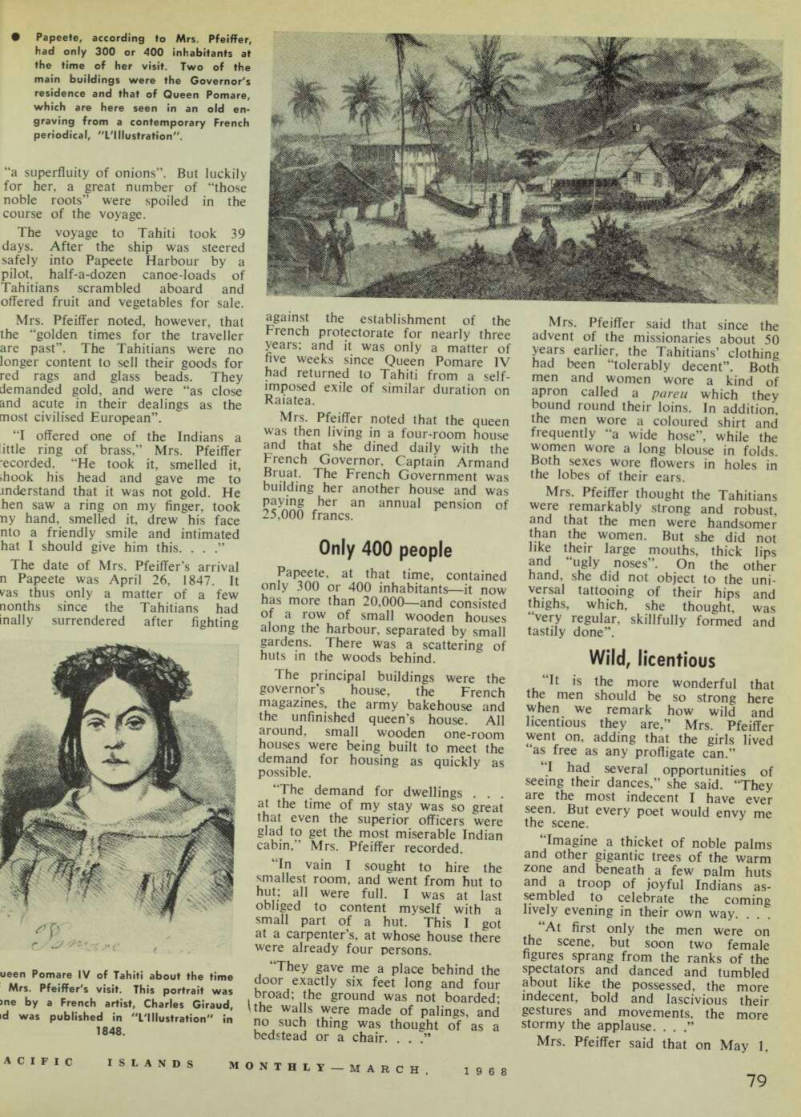
Papeete, according to Mrs. Pfeiffer, had only 300 or 400 inhabitants at the time of her visit. Two of the main buildings were the Governor's residence and that of Queen Pomare, which are here seen in an old en graving from a contemporary French periodical, "L'Illustration".
[?]ueen Pomare IV of Tahiti about the time Mrs. Pfeiffer's visit. This portrait was [?]ne by a French artist, Charles Giraud, [?]d was published in "L'Illustratlon" in 1848.
1847, birthday celebrations were held for the French king, Louis Philippe.
Governor Bruat made every effort to entertain the Tahitians well.
In the morning, French soldiers enacted a small sham fight at sea; and at midday, the chiefs and other notables were entertained on the lawn before the governor’s house where provisions, such as salt meat, bacon, bread, roast pig, fruit, etc., were laid out in heaps.
Food taken home
“But instead of the guests sitting lown as we had expected,” Mrs.
Pfeiffer recorded, “the chiefs divided he provisions into portions and each :arried his share home.”
In the evening there was a fire vorks display and ball, which Mrs.
Pfeiffer attended.
It was at the ball that Mrs. Pfeiffer ;aw Queen Pomare for the first time. >he was a woman of 36, “clumsily nade, but little marked by time”, f races of “great good nature” were ibout her mouth and chin.
She wore a sky blue satin gown >n which double rows of costly black ace had been sewn, large jasmine lowers in her ears, and a wreath of lowers on her head.
Her hand “daintily separated a
fine kerchief, richly worked and broadlaced”, and although she generally went barefoot, she had “forced her feet” into shoes and stockings for the evening.
“The entire dress was a present from the king of France,” Mrs.
Pfeiffer said.
Queen Pomare’s husband, the prince consort Ariifaite, wore the uniform of a French general. This looked very well on him, “as he knew how to adapt himself to it”.
Besides the queen and her consort, there was another Polynesian “crowned head” whom Mrs. Pfeiffer understood was king of one of the neighbouring islands. He looked “most comical” in wide, short white trousers, bare feet, and a coat of sulphur yellow cotton, which “had certainly not been made by a Parisian artist”.
Quadrilles
Mrs. Pfeiffer said that the queen had four maids of honour who were dressed in blouses of white muslin.
They also had flowers in their ears and wreaths in their hair.
“Their behaviour and carriage were on the whole surprisingly good,”
Mrs. Pfeiffer thought. “Three of them even danced French quadrilles
with the French officers, with but few mistakes.”
The proceedings were watched by a number of old women in European bonnets, and by some young Tahitian women who suckled their babies “without any ceremony” to keep them quiet.
“Before going into supper,” Mrs.
Pfeiffer observed, “‘the queen slipped into an adjoining room to smoke a few cigars, and her spouse whiled away the time at billiards.”
Food taken home
At supper, Mrs. Pfeiffer sat be tween the prince consort and the “canary-coloured” king from the outer islands. Both were “so far advanced in their education” that they filled her glass and handed her dishes, etc.
However, some of the guests occasionally forgot themselves. At dessert, for example, the queen asked for a second plate which she heaped with delicacies and put aside to take home with her. Some of the other guests had to be restrained “in their free use of the champagne”. But on the whole, the entertainment passed off “agreeably and decently”.
Mrs. Pfeiffer said that as the fight ing between the Tahitians and French
had ended, it had become possible to travel unmolested through the whole island.
It was Mrs. Pfeiffer’s wish to do this in the company of the French officers who were sent to various places from time to time on govern ment missions. However, she found that the officers always had excuses for not taking her with them.
It was not until she had made quite a few inquiries that she dis covered that her company was not wanted because the Frenchmen always travelled with their Tahitian mistresses.
Captain Cook remembered
Despite this, Mrs. Pfeiffer did manage to see a good deal of Tahiti.
She went to Papara, for example, where she met the old chief Tati, then nearly 90, who remembered the second visit of Captain Cook, She visited Paea; and attended the funeral of one of Tati’s 21 sons.
Mrs. Pfeiffer then decided to make an excursion to Lake Vaihiria, a body of water some 1,500 ft above sea level in Tahiti’s rugged interior.
With a guide who charged her three dollars a day (he had originally wanted to charge her 10), Mrs.
Pfeiffer set out from Papeete on May 7, 1847, “very conveniently dressed” in men’s shoes and trousers, and with her blouse rolled up to her hips. The distance to the lake was reckoned at 38 English miles.
The first six miles were along the coast, and there were 32 streams that Mrs. Pfeiffer had to wade through.
Inland, the going was even more difficult.
Mrs. Pfeiffer and her guide followed the course of a “tolerably wide mountain stream” which ran through a steep-sided chasm. This stream, sometimes three feet in depth, had to be waded 62 times.
“At the dangerous parts,” Mrs.
Pfeiffer recorded, “the Indian grasped me by the hand and drew me, some times half-swimming, after him. The water often reached to my hips and it was needless to think about getting dry.
“The footpath, also, grew even more tiring and dangerous; we had to climb over rocks and stones, which were so covered with oputu that we could never set our feet in safety.
“I got several severe wounds in my hands and feet from trusting to the stem of the dangerous pisang, which broke from my grasp.
“It is really a break-neck affair, undertaken by few officers and perhaps never before by a woman.”
Tjr^i ter ei sj l t hours climbing, Mrs.
Freifter and her guide had reached the lake. When Mrs. Pfeiffer, with typical enthusiasm, said she would like to cross it her enide mad** a raft from such materials as were to hand.
Mrs Pfeiffer took her nlace in this “fragment of a vessel”, and with her guide swimming and towing it, she travelled across the lake. ■ , In constant tear “I certainly felt some dread, but would have been ashamed to show it,” Mrs. Pfeiffer recorded. “There was nothing to hold on by, and I was in constant fear of tumbling overboard. I should never recommend the passage to one who could not swim. .
Having crossed the lake Mr<?
Pfeiffer and the guide began their long climb down to the coaftWhen night came on they sloped at an Indian bower” where the guide
together. 3 He" ihL 'gathered "Imeti
(wild plantains) fof supper ; As soon as Mrs. Pfeiffer had finished her “meagre repast”, she stretched out on some dry leaves and went to sleep.
“It is pleasant to record,” she said, “that in these wild and distant spots, there is nothing to fear either If tIS ‘ f nd . P ea . c f abe ’ and few swiLe " "° ne 15 W,ld except a Dnrina ttiP nJoiat u . .
During the night, it began to ram,
and although there was no prospect of better weather when morning came, Mrs. Pfeiffer and the guide continued their descent to the coast. , . m Papara wet through, Mrs.
Pfeiffer teamed up with a French office , r and bis Tahitian “friend” and £ arched the 3 °-° dd miles back to a P e ete.
This. however, by no means exhausted her. In the next few days, she was off on a visit to Point Venus, where, she said, the stones on which 17fiq ® Venus in ere stl to seen ‘ She also made an excursion to precipitous Fautaua Gorge, behind Papeete, where the Tahitians had made their last stand against the French in the protectorate war.
I + •
Last l oUrne Y
Mrs. Pfeiffer’s visit to Tahiti came to an end on May 17, 1847, when she A conti f nued her voya B e to China w A f art from Penrhyn Island in the Cooks, she saw no more lslands m the South Seas.
After visiting China, she travelled extensively in India, Ceylon, Mesopotamia, Babylon and the Mediterranean, reaching her home in Vienna a B ain after an absence of two years.
Mry Pfeiffer subsequently made a second voyage round the world—this tlm H e .l la . SoU, x h Af, : ica ’ ,be East ’udies f. nd . th( ; t . wo Americas, where she was lionised in New York and where she
climbed both Chimborazo and Cotopaxi mountains in Ecuador, among many other things, * Mrs. Pfeiffer s last journey was to the island of Madagascar, where she got involved in local politics, was imprisoned, and caught fever, Returning home in 1858, she man aged to complete a book on her adventure before succumbing to the fever on October 14 of the same year. r m fix ° STafUr6 An obituary in the New York paper Harper’s Weekly a few weeks after her death said that Mrs. Pfeiffer was not, as her travels would lead one to suppose, a masculine woman, .„ oe • - . nr* ~S he * as ’ > n , fal =‘. small of stature a P~ ra m er frail, the paper said.
Her bones were small and her by ™ans so
del that ste^was^enUrely^llpaWe
of grem or prolonged exertiol She owed to her mental energy her capacity for the great labours she
performed. . . .
Although Mrs. Pfeiffer’s books en joyed a great vogue in their day, being translated from German into both English and French, copies of them are not easy to come by now Sydney’s Mitchell Library for example, which prides itself 'on its collection of Pacific literature has only one of the two English Irans lations of A Lady’s Travels Round the World.
Mrs. Pfeiffer waded through streams 94 times in making her excursion to Lake Vaihiria in Tahiti's mountains. Many of the streams present a charming aspect like this.