NG planters want
p. 69 · Read in the full issue
a bigger pay-out for copra
By a staff reporter
The P-NG Copra Marketing
Board’s continued high rate of retention of copra proceeds was
“not satisfactory to planters”,
the president of the Planters Association of New Guinea, Mr.
W. J. Grose, told me in Sydney
in February.
Planters were now receiving an initial payment against sales of not much more than 60 per cent, of recent world prices, instead of a normal figure of about 90 per cent, of these prices, he said.
“On past experience they will wait up to 20 months before they receive the difference,” Mr. Grose said. “As a consequence many planters, particu larly smaller planters, are suffering unnecessary financial stringency.”
Mr. Grose said the Planters Asso ciation had raised the matter with the board in January, after it had in creased its payout on sales by $lO per ton, against a market rise in copra prices of up $lOO per ton.
Planters had been banking on a considerably larger increase.
“We believe the board’s increased rate of retention is partly to cover losses incurred through devaluation of sterling, and that the Australian Government should make up these losses as it has promised to do for
Australian marketing boards,” Mr.
Grose said.
“Through our producer representa tives on the board we were advised that the board has advised the Aus tralian Government of its losses and made an application for reimburse ment.
“The board has claimed the right to make its own decisions, with which we do not argue, but the matter is of vital concern to copra growers.
“If it has lost $230,000 through devaluation, as seems likely, then it will take only a few weeks to recoup this amount from weekly proceeds while it is waiting for reimbursement.
“Surely it could have forecast when we could expect a better tenta tive price?
“We trust that the board, or those who direct its policy, have not de cided to operate on a generally higher rate of retention in the future.”
Mr. Grose said the high rate of retention was a burden on the primary sector of the territory’s com munity which it could not afford.
It was very apparent, he said, that primary development was “not pro ceeding at the most desirable rate”.
“What is needed is a stimulus to primary industry because it offers the biggest single avenue for developing a viable economy for the territory, and everybody in the territory would support this need,” he added.
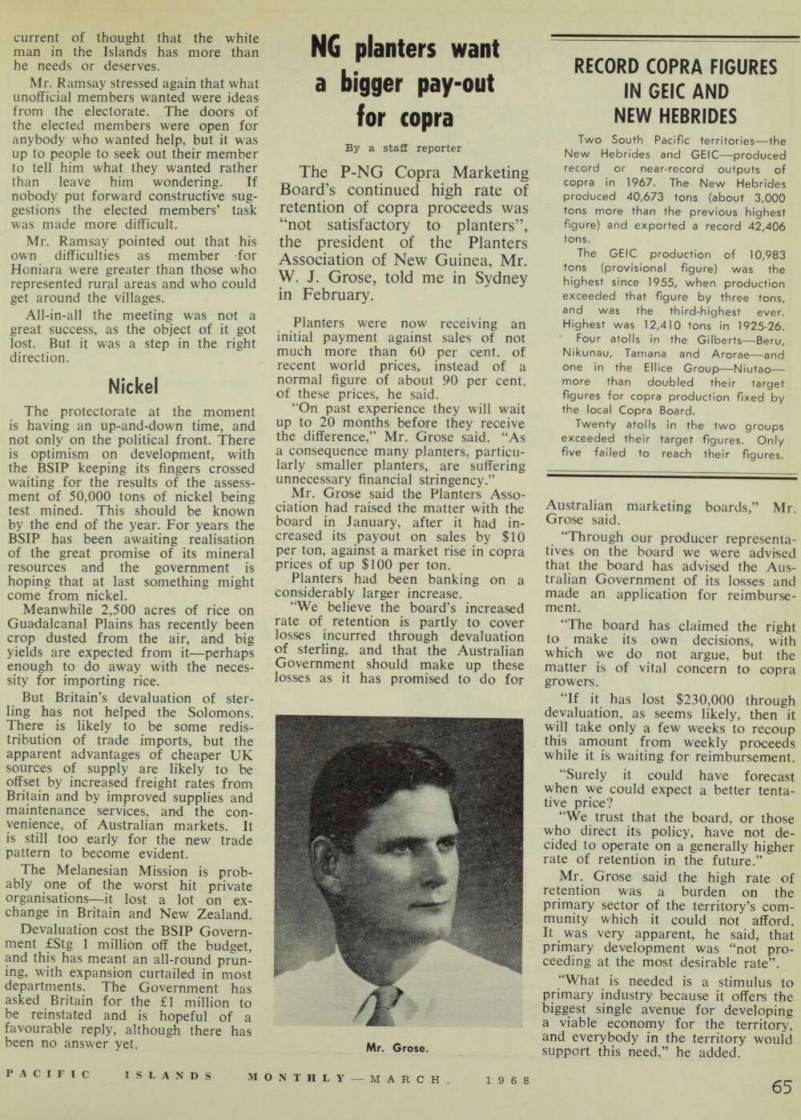
Mr. Grose.