Cook Islands doctors hand
pp. 63-65 · Read in the full issue

Government a bitter pill
From PlM’s Rarotonga correspondent The population of Rarotonga was shocked to learn on January 24 that all doctors on the island had delivered demands to the Government to pay increased salaries, and had decided to strike until their demands were met.
News of the doctors’ action was made public by the Premier, Mr.
Albert Henry, in a special radio broadcast. Mr. Henry said that he had decided to broadcast the un pleasant news because of the number of distorted rumours that were current.
During the previous week, the Premier said, the doctors had dis cussed their demands with the head of the Public Service who had given an assurance that he would make a reassessment of the doctors’ position.
At a meeting held on January 16, the doctors had agreed to wait for this reassessment, but by January 22 they had gone back on their word and had issued an ultimatum to the Government. The ultimatum con tained the following demands: • That the salary scale proposed by them in their letter of January 9, 1968, be considered as the final scale for all medical officers. (The scale was divided into three groups.
Group one began at SNZ4,OIO up to 5NZ6.200 p.a.; group two, 52,940 to $3,790 and group three ranged from $2,310 up to $2,840.) • The proposed salary scale was to be back-dated to January, 1964. • The demand was to be con sidered by noon of January 23 (the
day before the Premier made his radio speech) and if the Government failed to meet the conditions of the doctors, they would withdraw their services from the public.
The Premier stated that he had had a one-hour meeting with the doctors on January 23, but had failed to convince them that they should continue their negotiations with the Public Service, as they had previously agreed to do. He pointed out that his Government could not be dictated to, and that all submissions made to Government by sections of the Public Service had always been considered.
Many of the doctors involved had received scholarships and overseas courses at the Government’s expense, and now they were demanding superior salaries to other local public servants.
"Little left"
If similar salary demands are received from other sections of the community,” the Premier said, “there will be little left for Government to spend on promoting our economy in the best interests of all people of the Cook Islands.”
Mr. Henry said he had reported the matter to the High Commissioner, Mr. L. J. Davis, and had asked him to report it to the New Zealand Government and also to seek medical aid from New Zealand for the dura tion of the emergency.
“Even though the doctors’ demands may appear disproportionate and the method of approach unacceptable to the Government,” the Premier went on, “I publicly announce that if the doctors are prepared to with draw their ultimatum and negotiate in the proper way, then I will still be prepared to reassess their position as previously promised. But the de sire to do this must now come from the doctors.”
The Premier informed his listeners that he had visited the Black Rock Hospital that morning and had found no doctors there. He had also visited the Tupapa Hospital where he talked to Dr. A. Guinea, Director of Health.
Dr. Guinea, an imported officer, was
on duty, but he could not say whether or not his doctors would report for normal duty.
Mr. Henry concluded his speech by issuing this Government ultimatum to the disgruntled doctors: “I appeal to all medical officers to return to their normal duties im mediately. If doctors are not back on normal duty by 9 a.m. tomorrow, January 25, I will be left with no other choice than to suspend them all pending a full medical inquiry into their behaviour.”
He also ordered all doctors in the other islands of the Cook Group to remain at their posts. “This is an order!” he stressed.
The following day, Dr. J. Williams made a radio broadcast on behalf of the doctors. Dr. Williams is the Medical Superintendent, and second in-charge to Dr. Guinea. He is a Cook Islander, and took his quali fications in New Zealand. Another fully-qualified Cook Islands’ doctor on the staff is Dr. Dominique Peyroux, who graduated from Otago University in 1963 in medicine and surgery.
Doctors Guinea, Williams and Peyroux are said not to have de manded pay increases. The demands came from the other medical officers who were trained in the Fiji School of Medicine.
In his reply Dr. Williams said that the doctors had not forgotten their professional obligations towards the public. The drastic action they had taken was “the end result of long standing dissatisfaction, frustration.
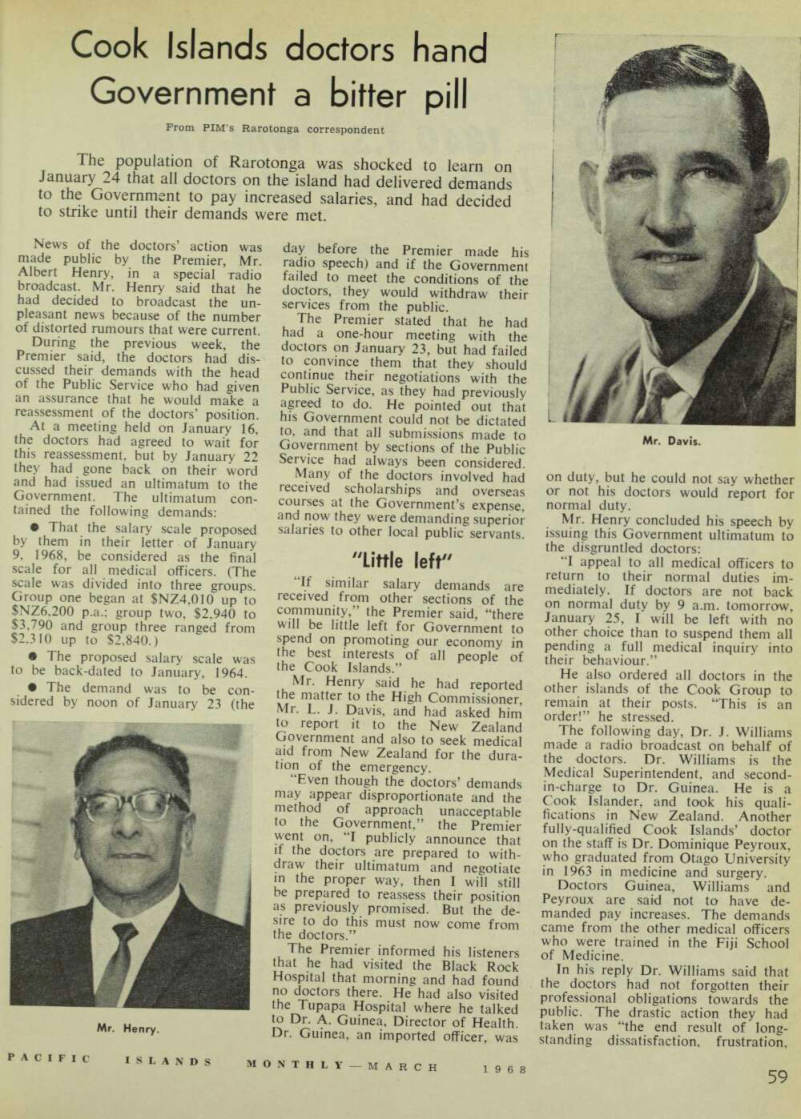
Mr. Henry.
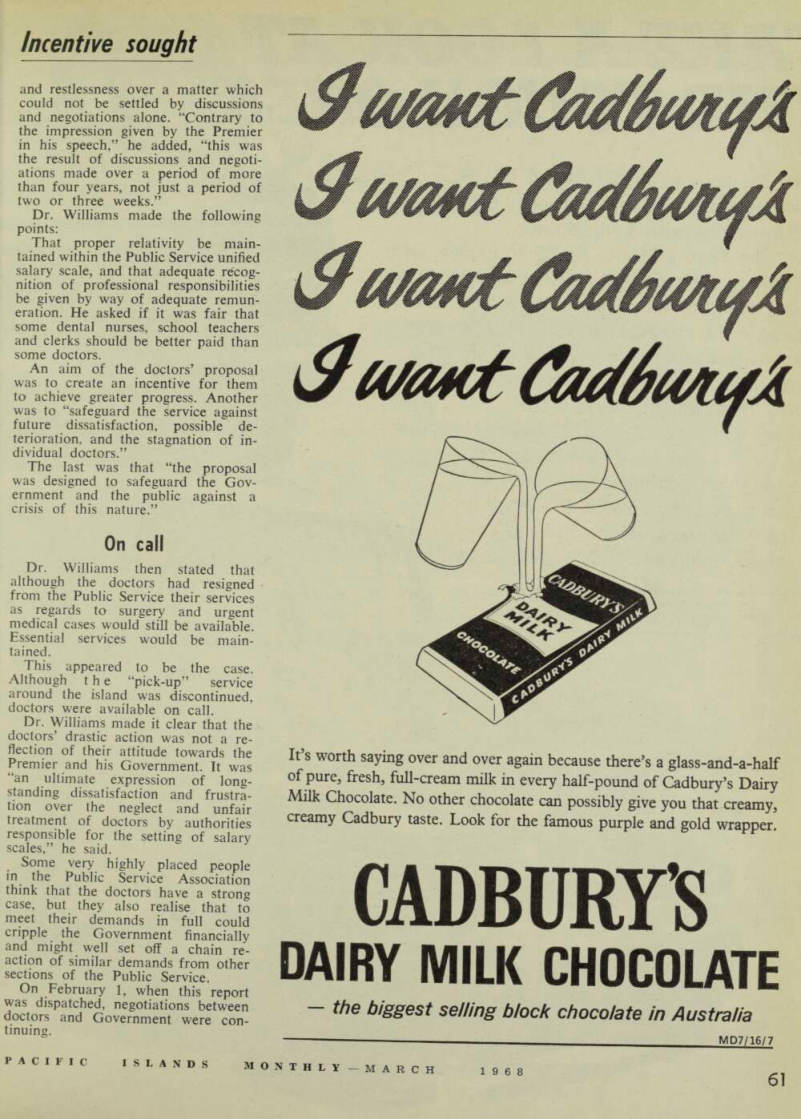
Mr. Davis.
Incentive sought
and restlessness over a matter which could not be settled by discussions and negotiations alone. “Contrary to the impression given by the Premier in his speech,” he added, “this was the result of discussions and negoti ations made over a period of more than four years, not just a period of two or three weeks.”
Dr. Williams made the following points: That proper relativity be main tained within the Public Service unified salary scale, and that adequate recog nition of professional responsibilities be given by way of adequate remun eration. He asked if it was fair that some dental nurses, school teachers and clerks should be better paid than some doctors.
An aim of the doctors’ proposal was to create an incentive for them to achieve greater progress. Another was to “safeguard the service against future dissatisfaction, possible de terioration, and the stagnation of in dividual doctors.”
The last was that “the proposal was designed to safeguard the Gov ernment and the public against a crisis of this nature.”
On call
Dr. Williams then stated that although the doctors had resigned from the Public Service their services as regards to surgeiy and urgent medical cases would still be available.
Essential services would be main tained.
This appeared to be the case.
Although the “pick-up” service around the island was discontinued, doctors were available on call.
Dr. Williams made it clear that the doctors’ drastic action was not a re flection of their attitude towards the Premier and his Government. It was “an ultimate expression of long standing dissatisfaction and frustra tion over the neglect and unfair treatment of doctors by authorities responsible for the setting of salary scales,” he said.
Some very highly placed people in the Public Service Association think that the doctors have a strong case, but they also realise that to meet their demands in full could cripple the Government financially and might well set off a chain re action of similar demands from other sections of the Public Service.
On February 1, when this report was dispatched, negotiations between doctors and Government were con tinuing.