When Bill Seale moved into Kavieng,
pp. 51-55 · Read in the full issue
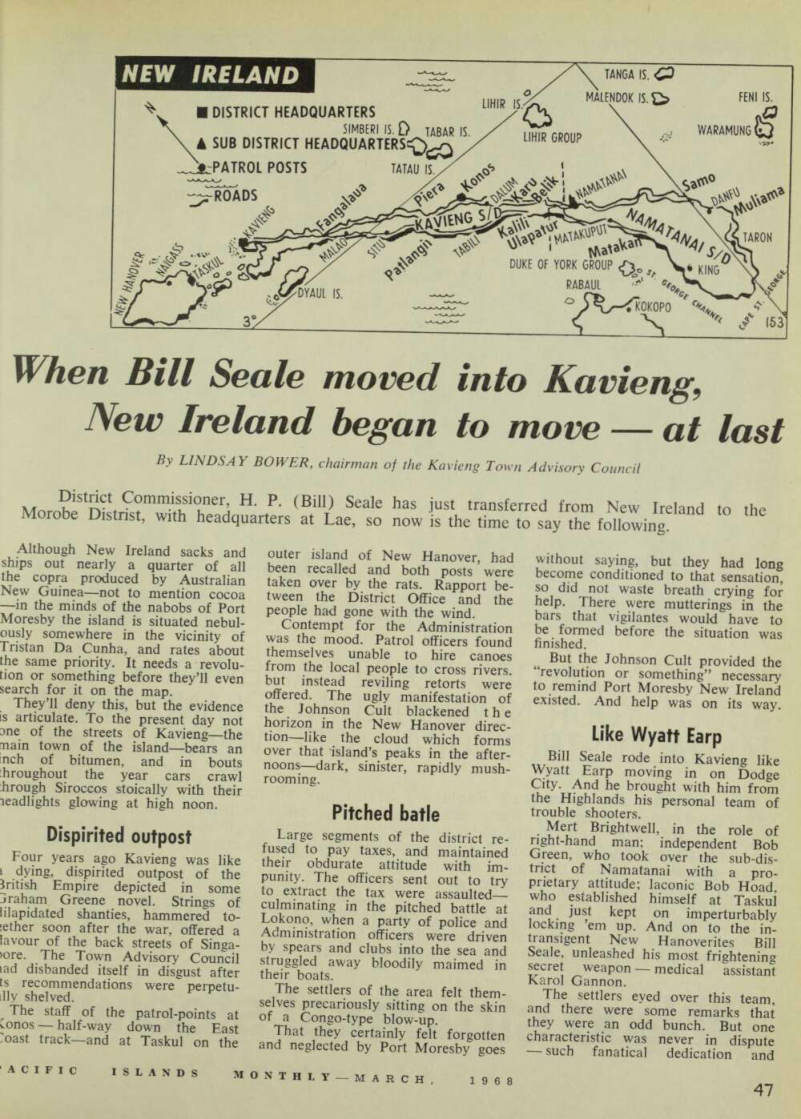
New Ireland began to move at last
By LINDSAY BOWER, chairman of the Kavieng Town Advisory Council
Mornhi St niL C c? mmi i Si< i ner ’, H - P - (Bill) Seale has J ust transferred from New Ireland to the obe Distnst, with headquarters at Lae, so now is the time to say the following.
ships^ouf* 1 nearly “all
Ihe copra produced by Australian New Guinea-not to mention cocoa
Moresby WSft SSfJS
“ V the same tion or something before they’ll even search for it on the map. is Present j V ’ denc ® is articulate. To the present day not main town rffc ,1* avi ® n B— the ncT o7 n bilme h „ e Throughout the year cars crawl ;hrough Siroccos stoically with their leadlights glowing at high noon.
Dispirited outpost
Four years ago Kavieng was like i dying, dispirited outpost of the Iritish Empire depicted in some jraham Greene novel. Strings of lilapidated shanties, hammered toaether soon after the war, offered a lavour of the back streets of Singa- >ore. The Town Advisory Council lad disbanded itself in disgust after t ny7eZd endati ° nS WCre PCrpetU - , The staff of the patrol-points a.
Conos half-way down the East -oast track and at Taskul on the
taken over by dre rats Rannort te tween the DisWct Office Td the ,
wa^LMoII“SS
fromM°to cmss
but instead revilme retorts Xpt-p offered The ndv f r
‘he. fohnlo'n cl ILlke“hl
horizon in the New Hanover direcbon—like the cloud which forms
must
rooming ’ P y mush '
pitched
segments of the district retheir obdurate attitude punity The officers sent nut t 'F 1 '
foextractthe
culminatine in the SmheH Lokono when a nartv
Administration offfrers II~A
by snears ind strugded awav v their § boats Y ° dl y ma,med m J he 'hearea felt .hem
rfTcS™\tw.L° n
That they' certainlT’feh forontipn
and
N With ° Ut Sayin ®> but **» had long condittoned to that sensat.on, i„ t ‘ WaSte breath • cr V'"g for
Hf t
*** ™ “ *7 7 J ° hnS ° n Cult P rovided the revolu . tl s n or something” necessary to remind Port Moresby New Ireland A " d he ' P WaS its way ' ~..
L| l< e Wyatt Earp
Wva« f* rode >*» Kavieng like yatt , E f P ™ OV ™S m on Dodge u be brought with him from trouble shooters.
'''San^’indepe^denT^Bob
Sh?*’ f Wh £ to ° k °. Ver the sub‘dis tn.ct of Namatanai with a pro- Pr il etary attitude; lac onic Bob Hoad, Wh f ? stabll f hed h ™self at Taskul ? n l- JUS kept on imperturbably ockl ? g em up - And on to the in transigent New Hanoverites Bill Seale ; unlea shed his most frightening !^ cre t weapon medical assistant sett,er . s The eyed over this team thm were some remarks that T er - e + - an ° dd bunch * But one
TCt“TnaS "SclfS
energy had never been observed in Administration employees before.
New Ireland never knew what hit it. Suddenly the whole district felt as if it were tied on to the handle of a pneumatic drill.
It’s all history now, of course.
And with short human memories we’ve fallen accustomed to coasting securely on the crest of the wave, and have forgotten the atmosphere of crisis and flux that prevailed three years ago just before Seale arrived.
First the riot squad was flown in to settle the score with the John son cultists. And with truncheons and shields they cavorted daily on the golf course—allowing plenty of time for the intelligence to filter back to New Hanover of how fit they were, and how aggressive.
After the psychology was allowed a few weeks to ferment, Superin tendent Holloway and his bunch of toughs set sail. The fleet anchored in Lavongai inlet, armed like cats and eager to start rowing. While magistrate John Frawley set up a vulnerable court with a camp table on the beach they watched across the water through binoculars.
It was a tense moment when the first tax-refuser, brought up to the table by two flanking constables,
was sentenced. Would he accept it?
Would the village of scowling males —ominously devoid of women and
children—accept it?
Watching every movement through the glasses, Superintendent Holloway recorded each step into a microphone.
But the offender accepted the pro nouncement and was escorted to the dinghies, and the crisis lapsed.
The humiliation of Lokono was erased, and the first of a stream of Lavongais wearing red laplaps began to flow towards town. From then on, gangs of red-clad pick-and-shovel wielders, vigorously altering the land scape in all directions, became a feature of the district.
Roads started sprouting. The West Coast road had been stagnating so long that at the furthest-out point the workers had put up permanent houses and settled down comfortably with gardens and hens. The next moment their idyll was uprooted and the gardens and hens were left in the dust of a flurry of activity. The road below Namatanai lunged southward at a spectacular rate of knots.
Wizardry
New officers kept arriving every few days so you couldn’t keep track of their names. Under Mert Brightwell’s wizardry all at once the Administration sprouted a fleet of assorted speedcraft, and into these boats the officers were bundled. You would go down to the District Office on some mission and wander through empty rooms in frustration. Every body was away on patrol!
All at once you couldn’t stand on a peak at Lavongai or Lelet and swing a palai by the tail without knocking down some kiap showing ’em the mechanics of democracy, some welfare officer urging ’em to
build a women’s club, some teacher showing ’em how to spell CAT, some fisheries bod explaining how to smoke tuna, or some ‘didiman” educating ’em on the construction of cocoa dryers.
Under this onslaught the afflicted New Islanders must have yearned for the good old days of vegetation when they could sit on their bottoms and chew betel in peace.
Whirling dervish
The master of this intensive pressure was Karol Gannon. Karol is a human willy-wagtail, a whirling dervish, an auctioneer, a typhoon.
After five minutes of merely listen ing to him (and nobody else gets a chance to talk in his presence)—you find yourself panting. But his frenetic energy alone is not Karol’s secret. His success is because he is on the side of the local people. And now after three years they all know it.
Wherever he sallies on New Hanover, sleeping in their huts, or sharing their food with them out of the same bowls—whenever he appears at a village a spontaneous cry of welcome breaks out; “Karol!
Karol!” Single-handed, by his own person, among a disgruntled people who had wanted to pay the plane fare of President Johnson to come out to New Hanover and take over their island, Karol restored the image of the Australian Administration officer as not a bad bloke.
Under his spurring, aid posts be gan popping up like toadstools all around the coast, culminating in his triumph—the smart new hospital at Taskul.
Taskul! An unremitting shuttle of building materials poured out to that site. Visitors became amazed to find
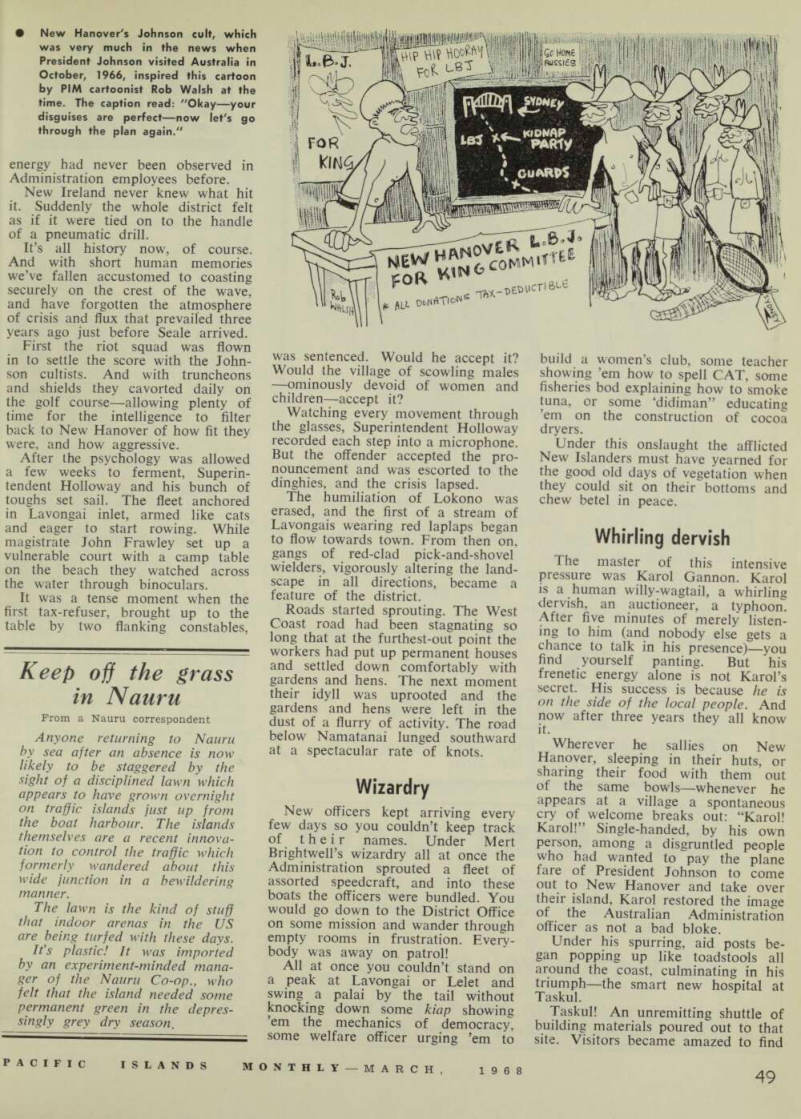
• New Hanover's Johnson cult, which was very much in the news when President Johnson visited Australia in October, 1966, inspired this cartoon by PIM cartoonist Rob Walsh at the time. The caption read: "Okay—your disguises are perfect—now let's go through the plan again."
it no longer a forlorn place of the winds, but a small town! Under Bob Hoad the airstrip took shape and landscape gardening with dams, pools, ducks, and caged Nicobar pigeons turned the area into a postcard vista.
But the greatest metamorphosis occurred south of Namatanai. If Kavieng had been stagnant, Nama tanai was in rigor mortis. Local residents tended to assert acridly that independence held no fears for them.
They had already achieved it by the opposite method of going back wards.
Now a new mood swept through.
Under Bob Green, with Bill Seale peering over his shoulder, roads crawled outwards like caterpillars, bridges were built. A multi-racial council was evoked. Airstrips took shape on Lihir and Tanga islands.
An aquatic club raised its bricks on the Namatanai waterfront.
New enthusiasm
Back in Kavieng the pace wound up furiously. The District Advisory Council was injected with en thusiasm. The Town Advisory Coun cil was disinterred and set wheeling.
Orders of demolition were slapped on ugly shanties. The renowned scenic harbour foreshore was top dressed, rock-lined, and cemented.
Heavy new power-lines were strung along the streets and a new power house with greatly increased output was built out of town where the hammer of the diesels couldn’t drive the populace batty.
By incredible pulling of strings a glossy new post office materialised at a time when the Madang-ites were screaming they needed Wellington boots to wade to the counter in their obsolete shack. New radio trans mitting and receiving installations were erected on the outskirts. Streets were widened and glamorous garden strips planted up the middle.
Suddenly the climate of boom was on! New Irelanders realised they had 10 years of restriction to catch up, and responded in excitement. New private buildings began to decorate the freshly bulldozed new streets.
And in the midst of all the fever, like a benevolent paternal galley ship whip-cracker, lumbered the Dis
trict Commissioner—the famous re volving eyes missing nothing. Trudged and drove, and cruised, and flew, and speedboated. He popped up every where.
He wore out cadets trailing behind him a third his age. The inhabitants marvelled and called him a human dynamo. And they sucked in their breath in admiration at his funds manipulating ability. He tapped and drained funds his predecessors never heard of.
Nobody could resist his bullying manner. He organised everyone. He would ring you up and congratulate you that he had decided to allow you the honour of carrying out such-and such a task for the benefit of the community.
You would ponder ruefully on this for a day then ring back, and pro test that you appreciated the honour, however, you didn’t feel you could find the time and. . . You never got a chance to complete the sentence.
“Of course, you can, m’boy. Of course, you can,” would come the brusque retort, and clang would go down the phone at the other end.
Konos patrol post began to bloom into a hamlet. By wangling that is best not even thought about, it sprouted a police station. A fine new town library building was magically unveiled —and named after Carteret, the discoverer of New Ireland. The lew golf club house was chivvied nto existence under the District Com
nissioner’s patronage.
Look out Lae!
You could babble on with strings )f his accomplishments. But most 'ratifying of all—nowadays we never tear rumours of Texas flags hidden n the villages down the road, waiting o be waved.
When we contemplate it—we could lever hope to thank him. Not with hundred fulsome farewell speeches T presentation silver trays. And we nvy Lae for getting him to our iss. But Lae is the BIG centre of tew Guinea, and with its hinterland ; will be the capital one day. We re pleased for him that he will be ble to summit his career with this sat of prestige.
He could not hit Lae with such dramatic impact as he did Kavieng, ecause the circumstances are not le same. Lae has never been eglected. But one thing I can warn ou —all you Administration em loyees in the Morobe District who ajoy sneaking a clandestine beer dur ig working hours. . . You’ll be PPlying for your transfers soon after e gets there.