Trading cutter
p. 45 · Read in the full issue
New Bp Move
In South Seas
Travel Sales
By a staff reporter
Burns Philp and Company
Ltd. started a South Pacific wholesale travel department at its Sydney headquarters in late January. The move was part of
company plans to play a bigger
role in tourism, especially in air travel “package” tours, to the Pacific Islands.
BP will retain its growing retail travel business and run its new whole sale tours—with an initial head quarters staff of four—in conjunction in its travel department.
Retail travel consists of all tour, airline or shipping tickets sold by agencies over the counter. Wholesale travel, a more sophisticated form of travel selling, can include tours sold to other travel agencies before being marketed directly to the public.
Wholesale agents usually use their own travel brochures.
New to the wholesale side of travel —except for New Zealand operations —BP will face stiff competition from 12 wholesalers in Australia and six in New Zealand, most of whom are well-established and currently operat-
ing with bigger turnovers than BP will be a ble to start with, u r»n i • However, BP have almost un r'™]|ed access to the Pacific Islands '” ,h wldes Pread trading, planting or shipping interests in all major terri tories except the Solomons and the Cooks, where “package” tourism rea |l y hasn’t started -r , , * , . , . :ad t ‘g* " ew wholesale travel d fP a £ m ? . BP ha ™ 31-year -oft English-born Mr. Ray Clark. A widely-travelled agent, Mr. Clark was working for a BP Auckland sub sidiary, Henderson and Macfarlane Ltd., when this company took on wholesaling as well as retailing some three years ago.
Mr. Clark said that during this time he sold “H and M Tours” from New Zealand to most of Polynesia
except the Cooks, and Norfolk Island, New Caledonia the New Hebrides (last year) and New Guinea.
He said this New Zealand whole saling would continue, together with selling in Australia, of BP “Hibiscus Holidays” to Fiji, the Samoas, Tonga, New Caledonia and Tahiti. Holidays ranged from an eight-day $lB2 New Caledonian holiday to a 20-day tour of Tahiti and Moorea for $620.
To promote these tours, BP have brought out its first-ever 16-page colour brochure, he said.
Mr. Clark said tourism was more advanced in Polynesia than Melanesia because of air excursion and inclusive fares, which applied mostly to Poly nesia.
When similar fares were started for New Guinea, the Solomons and the New Hebrides, he said more tourism development would follow.
Melanesian excursion air fares were only a matter of time, he said.
Mr. Clark said recent BP invest ments in tourism included three chauffeur-driven station wagons in Suva—for tourists on BP tours—and a fleet of about 12 vehicles for rental to tourists, based in Suva, Fiji travel plans included “antici pated extensions” to the BP hotels— the 12-bed Hotel Garden Island, Taveuni, and the nine-bed Hot Springs Hotel, Savusavu, he said.
Trading cutter
At Apia, Western Samoa, BP has refurbished its 59 ft trading cutter Maretana, to carry about 20 deck passengers on $lO day trips from Apia to Savaii Island, These are operated three days a week.
BP is co-operating with Nou Tours of Noumea for its New Cale donian holidays. Visitors are booked into the Noumea Hotel, owned by two Australians, Mr, Max Bradley and Mr. Colin Bakker.
In the New Hebrides, BP has a travel expert stationed in Vila to handle inquiries. BP already handles travel throughout Australia.
And what, we asked Mr. Clark, was the best spot he had seen in the Pacific Islands for a few of x those “unforgettable” days he was selling on the beach?
Taveuni, Fiji, was his answer.
Why? Well, the people were ex tremely friendly, the scenery was lush and restful, then there were the glorious Bouma Falls ... We told Mr. Clark that was enough, we had the message.
The Hotel Garden Island at Taveuni.
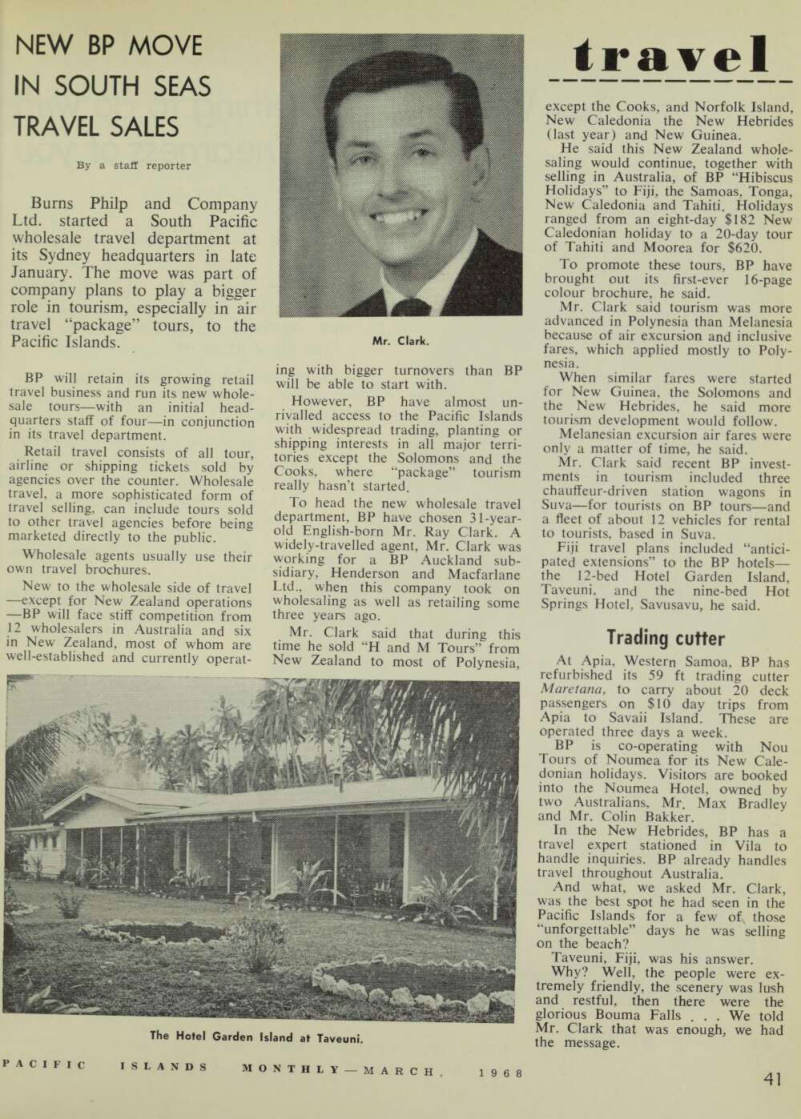
Mr. Clark.