P-Ng Voters Know What's What Now.
p. 29 · Read in the full issue
But Nobody Yet Knows Who's Who
From a Port Moresby correspondent Voters in Papua-New Guinea’s second general election, which began on February 17, have shown a better understand ing of what the poll is all about than they did in the first general elections in 1964.
But no positive clues had emerged to the end of February to indicate which of the 484 candidates would occupy the 84 seats available to them in the new House of Assembly.
About 1,100,000 people are eligible to vote.
Of the candidates, about 50 are Europeans and three are Asians, the rest being Papuans and New Guineans. Voting ends on March 16.
The Chief Electoral Officer, Mr.
Robert Bryant, said in Port Moresby at the end of February that, gener ally speaking, voters were showing much more sophistication than in 1964.
Mr. Bryant said that in 1964 many of the voters were nervous and had to be “almost pushed” into the polling booths.
“Now,” he went on, “they are anxious to vote and know exactly who they want to vote for.”
Mr. Bryant added that there was little discernible pattern in the voting.
Without doubt, self-government or independence for Papua-New Guinea are not issues in the election.
In the rural electorates, the chief issues in the election campaign were more and better bridges, schools and hospitals, and accelerated develop ment of cash-crop economies.
Higher wages and better housing were important topics in the large towns, where many of the people are public servants Party P olitics won’t enter into this election—voters are obviously voting for Persons. But the big question be mg asked here is whether something that could be construed as a general vote for radicalism, whether brown or white, will show up. .. .. . , .
Thus u att l en f lon IS bem 8 fprcused on . sucb electorates a 8 T tbe .Morobe regional, where old-hand Horne Niall, H l6 f ormer Speaker, is opposed by European radical Tony Voutas, who bas go ?. e ‘ n bo °ts and all looking for ! be native v °te. In itself, the result beri ® f| ot anything—it de pends whether there are similar trends elsewhere, In .the East Sepik, old hand Frank Martin, the sitting member, is opposed hy a foundation member of the Pangu Pati, Michael Somare, a New Guinean regarded as radical, There is a general view that the 1972 elections, not the 1968, will be the most important, but there are some observers who believe that this year’s elections will be the ones to show whether there is to be a speed up towards independence.
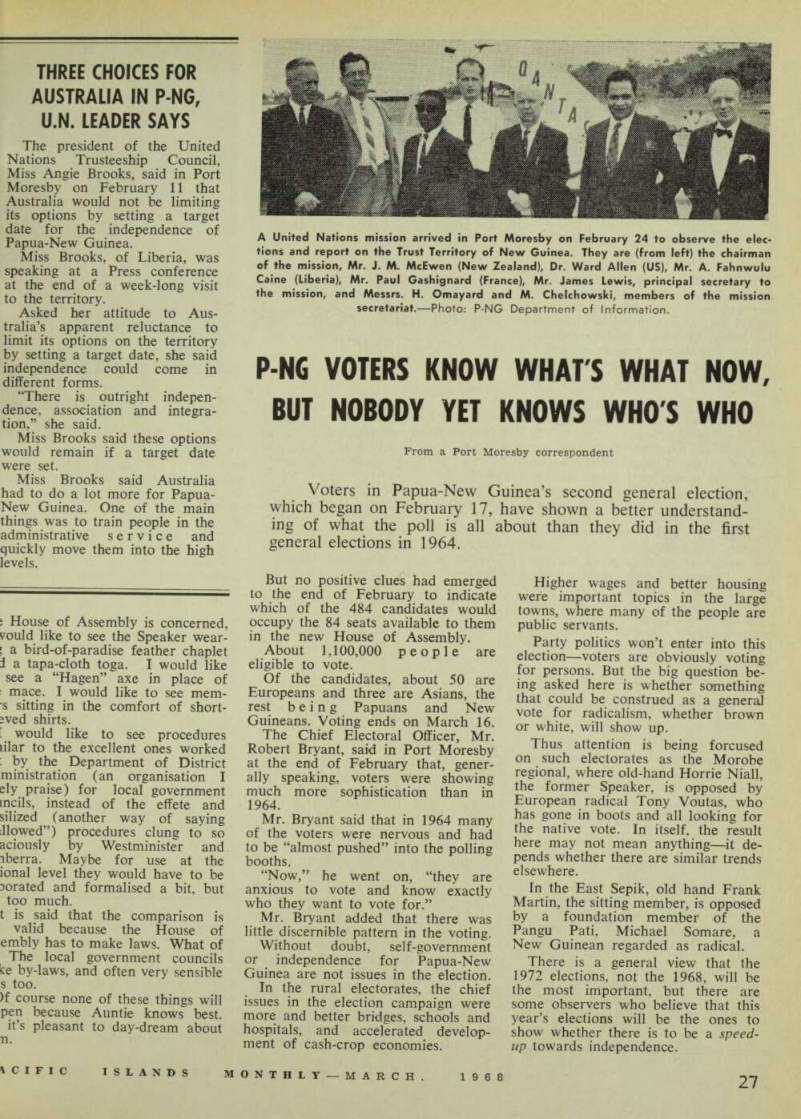
A United Nations mission arrived in Port Moresby on February 24 to observe the elec tions and report on the Trust Territory of New Guinea. They are (from left) the chairman of the mission, Mr. J. M. McEwen (New Zealand), Dr. Ward Allen (US), Mr. A. Fahnwulu Caine (Liberia), Mr. Paul Gashignard (France), Mr. James Lewis, principal secretary to the mission, and Messrs. H. Omayard and M. Chelchowski, members of the mission secretariat. Photo: P-NG Department of Information.